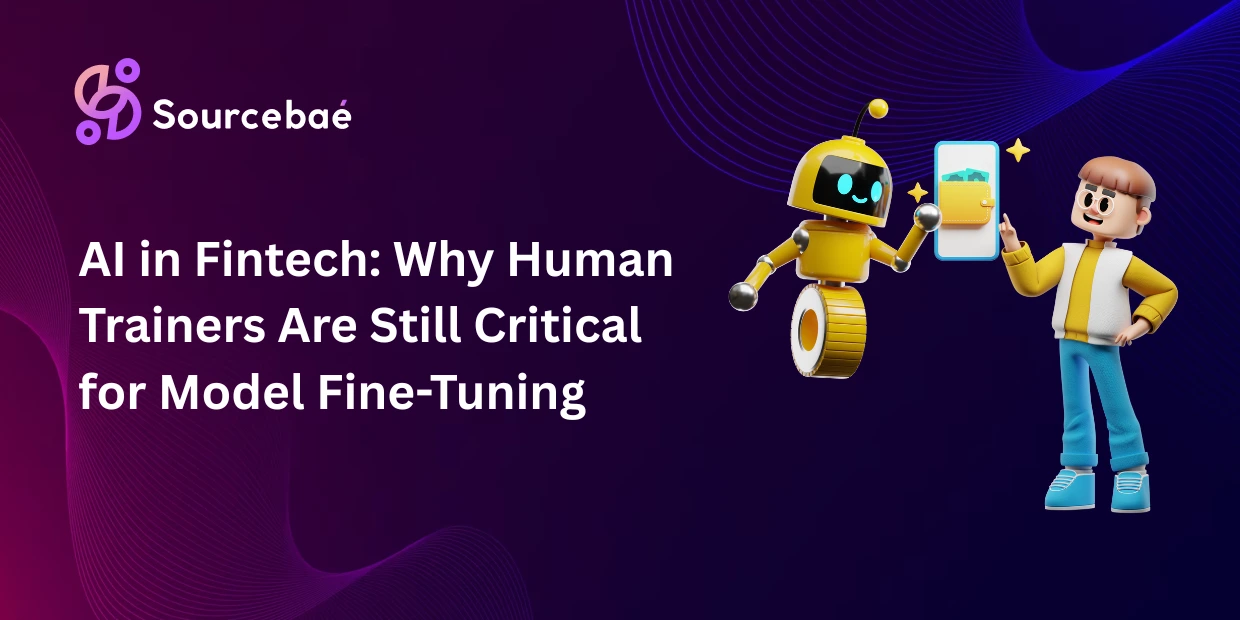

The financial services industry stands at a transformative crossroads where artificial intelligence meets human expertise. As AI in fintech market revenues reached over $21 billion in 2024, the role of human trainers in developing sophisticated finance AI systems has become increasingly critical. This comprehensive guide explores how human expertise shapes the development, fine-tuning, and deployment of AI models that power modern financial services.
The Evolution of AI in Fintech
The landscape of fintech AI solutions has undergone remarkable transformation in recent years. Artificial intelligence has revolutionized financial services in 2024, with personalization reaching unprecedented levels of sophistication. Major fintech companies now implement advanced AI models that analyze spending patterns, predict future expenses, and offer tailored financial guidance.
What sets successful finance AI systems apart isn’t just sophisticated algorithms—it’s the quality of training data and the human expertise behind model development. Financial technology uses AI and machine learning to help with management of financial transactions, risk assessment, predicting delinquencies, and fraud detection.
Market Growth and Adoption
The numbers tell a compelling story. The global AI in fintech market is expected to grow from $13.3 billion in 2024 to reach $296.73 billion by 2033, at a CAGR of 41.2%. This explosive growth reflects the increasing sophistication of fintech machine learning models and the critical role of human trainers in their development.
North America currently leads the market, but Asia-Pacific shows the fastest growth trajectory. The rapid shift towards digital payments and uptrend in internet services in the Asia Pacific region, along with favorable government policies, presents many possibilities for AI development in the fintech industry.
Understanding AI Model Fine-Tuning in Finance
AI model fine-tuning represents a specialized process that adapts pre-trained models to specific financial applications. Unlike training models from scratch, fine-tuning leverages existing knowledge while tailoring responses to domain-specific requirements.
What Makes Financial AI Model Training Unique
For an LLM to deliver accurate responses in finance, it must be well-versed in unique jargon related to accounting, compliance, investments, and more. The financial landscape encompasses specialized terminology that general-purpose models may not adequately understand.
Financial AI model training requires:
Domain-Specific Knowledge Integration: Adding domain-specific knowledge through additional training samples is particularly relevant in financial settings, which typically involve specialized, esoteric vocabulary that may not have been sufficiently represented in pre-training.
Regulatory Compliance Awareness: Training the LLM on regulatory documents enables it to assist banks in adhering to laws like GDPR and Anti-Money Laundering regulations. Regular updates ensure models remain aligned with evolving regulatory requirements.
Multi-Segment Versatility: The banking sector includes diverse segments, such as retail banking, investment banking, and asset management, requiring exposure to broad data from these areas to improve versatility.
Recruit the top 1% of AI Trainers today!
Access exceptional professionals worldwide to drive your success.
The Fine-Tuning Process
Fine-tuning is the process of adapting pretrained models by training them on smaller, task-specific datasets. This approach has become essential in the LLM development cycle, allowing base foundation models to be adapted for various financial use cases.
The process typically involves several critical stages:
- Starting Point Selection: Begin with a robust pre-trained model that demonstrates strong general language capabilities
- Dataset Curation: Assemble high-quality, domain-specific financial datasets
- Layer Adjustment: Decide whether to freeze certain layers to preserve learned representations or allow them to be updated during fine-tuning
- Iterative Training: Fine-tune the model through multiple passes with continuous evaluation
- Performance Validation: Test against financial-specific benchmarks and real-world scenarios
Fine-tuned finance LLMs such as FinMA and FinGPT demonstrate superior performance in most finance classification tasks, indicating enhanced domain-specific language understanding and contextual comprehension abilities.
The Critical Role of Human Trainers for AI
While algorithms power finance AI systems, human trainers provide the intelligence, judgment, and domain expertise that make these systems truly effective. The emergence of sophisticated AI models has created unprecedented demand for skilled human annotators and trainers.
From Sweatshop Data to Expert Training
Now that AI models have gotten smarter, they require a higher caliber of human knowledge—they need experts who can spot chatbot inaccuracies, dial in subtle nuances of language, and apply industry-specific knowledge to particular situations.
This shift represents a fundamental transformation in AI training. Financial institutions no longer need people to simply identify objects in images; they need professionals who understand complex financial instruments, regulatory requirements, and market dynamics.
Core Responsibilities of Human Trainers
Human trainers for AI in financial services perform multifaceted roles:
Financial Data Annotation: Annotated data is essential for building AI models that are both accurate and fair for finance tasks, allowing computers to understand data like financial reports or market trends. Human insights make data more precise and help train models more effectively.
Quality Assurance and Validation: AI trainers are responsible for preparing training data for ML models to ensure information provided by AI is accurate and unbiased, then checking the AI’s output to determine correctness.
Bias Detection and Mitigation: Even with the best intentions, human annotators might add their own biases, which could lead to AI financial models giving inaccurate results. Trained professionals implement systematic approaches to identify and eliminate bias.
Continuous Model Evaluation: It’s important to consistently assess the effectiveness of AI models by continuously testing AI systems to ensure they’re functioning properly.
The Human-in-the-Loop Approach
The human-in-the-loop methodology represents best practice in financial AI model training. This approach combines automated processing with human judgment at critical decision points.
Using people to help label financial data improves AI systems, enabling them to see markets clearer and sort through lots of data to find the best moves. This collaborative approach between human expertise and machine processing creates more robust, reliable systems.
Financial Data Annotation: Foundation of Model Accuracy
Financial data annotation forms the bedrock of effective AI training. The quality of annotations directly impacts model performance, making this one of the most critical aspects of finance AI training support.
Types of Financial Data Annotation
Transaction Classification: Labeling transactions by type, merchant category, risk level, and compliance requirements
Sentiment Analysis: Annotating market news, social media posts, and analyst reports for sentiment that might impact trading decisions
Entity Recognition: Identifying and extracting specific entities such as names, dates, locations, and other relevant information from text or speech data
Risk Assessment Labeling: Marking transactions, behaviors, or patterns according to risk levels and fraud probability
Compliance Tagging: Identifying regulatory-relevant information within documents and communications
Quality Control in Financial Annotation
Keeping data annotation at a high level is key for accurate AI models in finance, with issues coming from different people seeing things differently, varying expertise levels, and mistakes.
Implementing robust quality control requires:
Comprehensive Trainer Education: Training annotators well is the first step to top-notch data annotation, teaching them about financial data in detail to help them make fewer mistakes and follow the same steps.
Clear Guidelines and Standards: Establishing unambiguous annotation protocols that leave minimal room for interpretation
Regular Audits and Reviews: Checks should happen at different times, including before starting to train the AI, looking at examples of annotated data for accuracy, and comparing what different annotators did to find differences.
Inter-Annotator Agreement Metrics: Measuring consistency across multiple annotators to ensure reliability
Finance AI Training Support: Building Robust Systems
Creating effective fintech AI solutions requires comprehensive training infrastructure and support systems. Organizations must balance automation with human expertise while maintaining the highest quality standards.
Establishing Training Frameworks
Successful finance AI training support encompasses several key components:
Infrastructure and Tools: Data annotation tools add informative labels to datasets, making it easier for ML models to process data, with popular platforms including SuperAnnotate, Label Studio, Amazon SageMaker, and Labelbox.
Scalable Workforce Management: Leading companies depend on comprehensive data services including data collection, annotation, and LLM services, with global crowds of experienced AI data specialists enabling rapid scaling.
Domain Expertise Integration: Financial institutions increasingly recognize that successful AI implementation requires deep industry knowledge combined with technical capability.
Training Data Requirements
The quality of any AI model is only as good as the data it learns from—collect high-quality, diverse, and relevant data that represents real-world scenarios.
For financial applications, this means:
- Comprehensive Coverage: Data representing diverse customer segments, transaction types, and market conditions
- Temporal Relevance: Current data reflecting recent market dynamics and regulatory changes
- Edge Case Inclusion: Examples of unusual but critical scenarios like fraud attempts or market anomalies
- Privacy Compliance: Data collection and annotation that respects customer privacy and regulatory requirements
Specialized Training Approaches
Reinforcement fine-tuning is beneficial for optimizing model behavior in complex or dynamic environments—financial services providers can optimize models for faster, more accurate risk assessments or personalized investment advice.
Advanced techniques include:
Transfer Learning: Financial firms might use transfer learning to adapt a model initially trained on broad economic data to predict stock performance specifically, reducing development time and resources while quickly adapting to market changes.
Few-Shot Learning: Models with strong generalized knowledge can often be fine-tuned for specific classification tasks using comparatively few demonstrative examples.
Continuous Learning: Fine-tuning is useful for continuous learning scenarios where the model needs to adapt to changing data and requirements over time, allowing periodic updates without starting from nothing.
AI Model Evaluation Finance: Measuring Success
Effective evaluation frameworks ensure that finance AI systems meet rigorous standards for accuracy, fairness, and regulatory compliance.
Multi-Dimensional Evaluation Criteria
Comprehensive evaluation systems cover tasks for various scenarios and incorporate metrics from different aspects, including accuracy, fairness, robustness, bias, and more.
Financial institutions must evaluate models across:
Performance Metrics:
- Prediction accuracy for credit scoring, fraud detection, and market forecasting
- Response time and latency in customer-facing applications
- Throughput capacity for high-volume transaction processing
Fairness and Bias Assessment:
- Demographic parity across protected classes
- Equal opportunity metrics ensuring fair treatment
- Disparate impact analysis identifying unintended discrimination
Regulatory Compliance:
- Adherence to financial regulations and data protection laws
- Explainability and interpretability of model decisions
- Audit trail completeness for regulatory review
Operational Robustness:
- Performance under edge cases and unusual market conditions
- Resilience to adversarial attacks and data manipulation
- Graceful degradation when encountering unfamiliar scenarios
Real-World Performance Validation
FinLLMs such as FinMA 7B or FinGPT 7B consistently outperform general-purpose LLMs in sentiment analysis and headline classification in financial contexts. However, evaluation must extend beyond benchmark tasks to real-world application scenarios.
Best practices include:
- A/B Testing: Comparing model performance against existing systems or baseline models
- Pilot Programs: Limited deployment to assess performance with actual users and transactions
- Continuous Monitoring: Ongoing evaluation of deployed models to detect performance degradation
- Feedback Loops: Incorporating user and stakeholder feedback into evaluation criteria
Key Applications of Fintech Machine Learning Models
The practical applications of well-trained finance AI systems span the entire financial services ecosystem.
Fraud Detection and Risk Management
Fraud and risk management retained 31% of 2024 revenues, confirming the segment’s role as mission-critical. In finance and banking sectors, AI helps identify unusual transaction patterns in real time, immediately flagging suspicious activities to reduce fraud risks.
Human trainers enhance fraud detection by:
- Annotating subtle patterns that distinguish legitimate from fraudulent behavior
- Teaching models to recognize emerging fraud techniques
- Reducing false positives that disrupt customer experience
- Adapting to evolving threat landscapes
Customer Service and Virtual Assistants
Chatbots and virtual assistants record the strongest 36% CAGR to 2030 as customers demand always-on support. Studies show chatbots can handle customer inquiries up to 10x faster than human agents in banking.
Effective virtual assistants require training on:
- Common customer queries and appropriate responses
- Product knowledge and regulatory information
- Escalation protocols for complex situations
- Tone and style appropriate to financial services
Credit Scoring and Lending
Fintech organizations employ AI and deep learning to identify non-traditional consumer risk and profitability indicators using alternative data sources to develop credit scores.
This enables:
- Access to credit for underserved populations
- More accurate risk assessment
- Faster loan approval processes
- Dynamic credit line management
Personalized Financial Advisory
AI can analyze a user’s financial behavior and provide personalized recommendations for saving, investing, and budgeting, with robo-advisors creating and managing investment portfolios aligned with individual risk tolerance and financial goals.
Algorithmic Trading and Market Analysis
AI can analyze vast datasets in real time, identifying patterns and executing trades more efficiently than humans. Human trainers ensure these systems understand market nuances, regulatory constraints, and risk management principles.
Challenges and Solutions in Finance AI Training Support
Despite tremendous progress, several challenges persist in developing and deploying finance AI systems.
Talent Shortage
Demand for professionals who blend machine-learning mastery with regulatory fluency exceeds supply by 2-4 times, with 74% of employers reporting hiring struggles.
Solutions:
- Developing comprehensive training programs for existing staff
- Partnering with specialized AI training platforms
- Creating apprenticeship programs bridging finance and technology
- Leveraging global talent pools through remote work arrangements
Data Quality and Availability
Data quality issues require AI trainers to determine reliability of data to ensure accuracy of outputs, requiring extensive research of sources.
Solutions:
- Implementing rigorous data validation protocols
- Developing synthetic data generation for scarce scenarios
- Building comprehensive data governance frameworks
- Creating data-sharing consortiums while protecting privacy
Regulatory Complexity
The EU AI Act designates high-risk financial systems for stringent oversight, while US and UK rely on sectoral guidance, producing compliance patchworks.
Solutions:
- Institutions now allocate up to 30% of AI budgets to compliance activities
- Building regulatory expertise into AI training teams
- Implementing explainable AI techniques for transparency
- Maintaining detailed documentation of training processes
Ethical Considerations and Bias
Two major challenges are the production of disinformation and manifestation of biases such as racial, gender, and religious biases in LLMs.
Solutions:
- Diverse training teams representing multiple perspectives
- Regular bias audits throughout development lifecycle
- Transparency in data sources and training methodologies
- Stakeholder engagement including affected communities
The Future of Human-AI Collaboration in Fintech
The relationship between human trainers and AI systems continues to evolve toward deeper collaboration and enhanced capabilities.
Emerging Trends
Multimodal Learning: Advances in multimodal fine-tuning are pushing boundaries, enabling models to integrate multiple data types such as images, text, and speech into single, fine-tuned solutions.
Federated Learning: Instead of centralizing data, federated learning trains models across decentralized devices while preserving user privacy—ideal for industries like finance where data security is paramount.
Hyper-Personalization: AI will evolve into an omnipresent force driving decision-making, with predictive analytics maturing into prescriptive analytics, allowing institutions to anticipate and cater to individual consumer needs with unprecedented accuracy.
The Enduring Value of Human Expertise
Despite automation advances, human judgment remains irreplaceable. Perhaps the greatest consideration is that the expertise contributed to these systems may ultimately affect the very role being performed. However, rather than replacement, the future points toward augmentation—where human expertise guides increasingly sophisticated AI systems.
Financial institutions that successfully integrate human trainers for AI with cutting-edge technology will gain significant competitive advantages. The organizations that thrive will be those recognizing that finance AI systems achieve their full potential not through automation alone, but through thoughtful collaboration between human intelligence and machine capability.
Building Your Finance AI Training Strategy
Organizations embarking on AI implementation should consider:
Assessment Phase:
- Evaluate current capabilities and identify gaps
- Determine which processes benefit most from AI
- Assess data readiness and quality
- Understand regulatory requirements
Team Building:
- Recruit or train specialists in financial AI model training
- Build diverse teams spanning finance, technology, and ethics
- Establish partnerships with annotation service providers
- Create clear roles for human trainers for AI
Infrastructure Development:
- Select appropriate fintech AI solutions platforms
- Implement robust data management systems
- Establish quality assurance frameworks
- Create feedback and continuous improvement mechanisms
Pilot and Scale:
- Start with focused use cases demonstrating clear value
- Implement rigorous AI model evaluation finance protocols
- Gather stakeholder feedback and iterate
- Scale successful applications across the organization
Conclusion
The intersection of AI in fintech and human expertise represents one of the most promising frontiers in financial services. As finance AI systems grow more sophisticated, the role of human trainers becomes increasingly vital—not just for initial development, but for ongoing refinement, evaluation, and ethical oversight.
Success in this domain requires understanding that AI model fine-tuning isn’t merely a technical exercise. It’s a collaborative process bringing together domain expertise, technical capability, regulatory knowledge, and ethical judgment. Organizations that invest in comprehensive finance AI training support—including skilled human trainers, robust infrastructure, and commitment to quality—position themselves to lead in an increasingly AI-driven financial landscape.
The future of fintech isn’t about choosing between human expertise and artificial intelligence. It’s about creating synergies where each amplifies the other’s strengths. With the AI in fintech market expected to reach nearly $300 billion by 2033, the organizations that master this collaboration will define the next era of financial services.
Whether you’re a financial institution exploring AI implementation, a technology provider developing fintech machine learning models, or a professional considering a career in AI training, understanding the critical role of human expertise in shaping finance AI systems provides essential context for navigating this transformative period in financial services.
As AI in fintech continues to advance, human trainers remain essential for building accurate, compliant, and reliable financial AI systems. Machine models alone cannot handle regulatory context, risk interpretation, or real-world anomalies in financial data without expert oversight. That’s why Sourcebae provides dedicated human data solutions, offering trained AI specialists who can annotate financial data, fine-tune models, evaluate output quality, and even hire AI trainers to train your AI models or build custom LLMs for complex fintech workflows. With human-in-the-loop support, your finance AI systems stay accurate, fair, and future-ready.