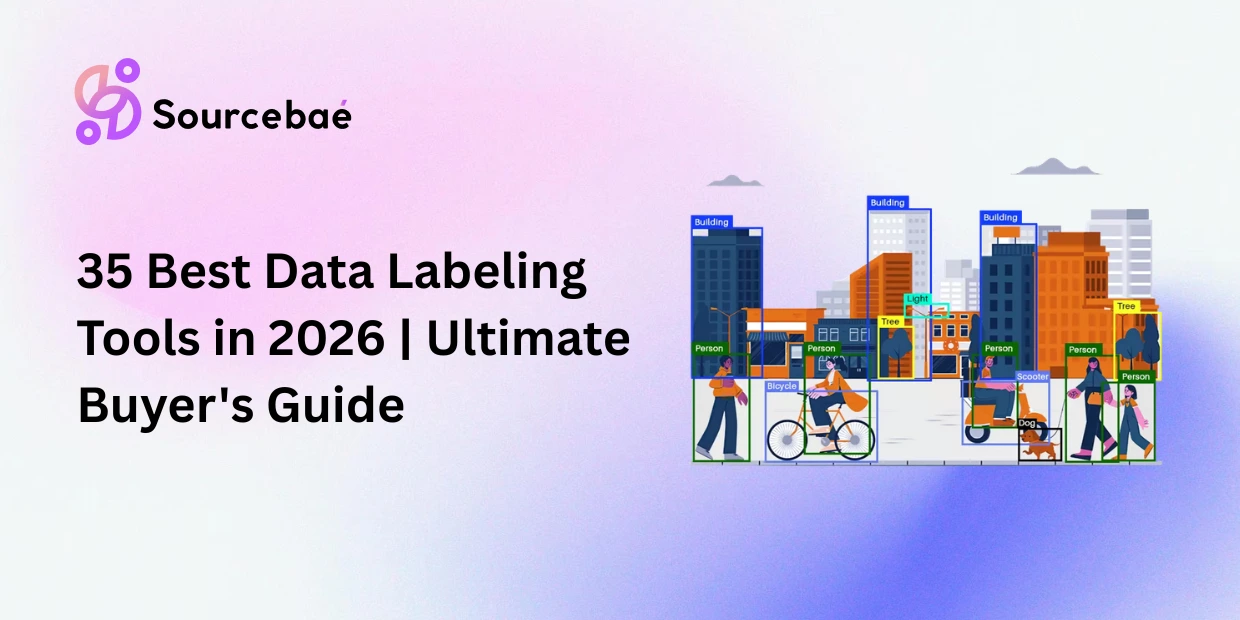

Introduction:
Artificial intelligence is only as good as the data it learns from. Behind every breakthrough in computer vision, NLP, autonomous driving, or medical imaging lies one unglamorous truth: millions of carefully labeled data points. Data labeling tools also called data annotation tools or AI data labeling platforms are the software systems that make this possible at scale.
According to industry research, ML engineers and data scientists spend over 80% of their time on data preparation and labeling, leaving only a fraction for model experimentation, training, and deployment. As AI adoption accelerates across industries, the demand for robust data labeling software has never been higher.
Whether you’re a startup building your first computer vision model, an enterprise scaling a multimodal LLM pipeline, or a research team working on medical imaging, choosing the right data labeling platform will define your project’s success.
This guide covers 35 of the best data labeling tools available in 2026, with detailed analysis of features, pricing, ideal use cases, pros, cons, and G2 ratings so you can make the best decision for your AI pipeline.
💡 This guide is updated quarterly. It covers enterprise-grade data labeling platforms, open-source tools, managed AI data labeling services, and niche labeling software for specific data types.
What Is a Data Labeling Tool?
A data labeling tool (also called a data annotation tool) is a software platform that enables users to tag, classify, annotate, or structure raw unstructured data such as images, videos, text, audio, and 3D point clouds so that it can be used to train machine learning and AI models.
Modern data labeling tools go far beyond simple annotation editors. The best data labeling platforms in 2026 combine:
- Annotation interfaces for multiple data types (image, video, text, audio, LiDAR/3D)
- AI-assisted and automated labeling to reduce manual effort
- Data management, versioning, and curation capabilities
- Quality assurance (QA) and inter-annotator agreement (IAA) tracking
- Project management and workforce tools
- MLOps integrations (SDK, webhooks, cloud storage, model training pipelines)
- Enterprise security SOC 2, GDPR, HIPAA compliance
Quick Comparison: Top 10 Data Labeling Platforms at a Glance
| Tool | Best For | Data Types | Pricing | Free Option | Rating |
| SuperAnnotate | Enterprise/Teams | Image, Video, Text, Audio, LiDAR | Custom Quote | ✅ Yes | ⭐ 4.9/5 |
| Scale AI | Enterprise | Image, Video, Text, 3D | Custom Quote | ✅ Yes | ⭐ 4.4/5 |
| Labelbox | Teams/Enterprise | Image, Video, Text, Audio | Free + Paid | ✅ Yes | ⭐ 4.5/5 |
| V7 Labs | Teams/Enterprise | Image, Video, Documents | Free + Paid | ✅ Yes | ⭐ 4.8/5 |
| Encord | Teams/Enterprise | Image, Video, Medical | Free + Paid | ✅ Yes | ⭐ 4.8/5 |
| Dataloop | Teams/Enterprise | Image, Video, Text, LiDAR | Free Trial | ✅ Yes | ⭐ 4.4/5 |
| Label Studio | All sizes | Image, Video, Text, Audio, Time | Free (OSS) | ✅ Yes | ⭐ 4.3/5 |
| CVAT.ai | Dev/Research | Image, Video, 3D | Free (OSS) | ✅ Yes | ⭐ 4.6/5 |
| Kili Technology | Teams/Enterprise | Image, Video, Text, Audio | Free + Paid | ✅ Yes | ⭐ 4.7/5 |
| Supervisely | Teams/Enterprise | Image, Video, 3D, Medical | Free + Paid | ✅ Yes | ⭐ 4.7/5 |
How to Choose the Right Data Labeling Software
With dozens of options on the market, selecting the best data labeling tool for your needs comes down to evaluating six key dimensions:
1. Data Types Supported
Not all labeling tools support all data modalities. Identify your primary data type image, video, text, audio, LiDAR/3D point cloud, or multimodal and ensure the platform supports it natively with purpose-built annotation tools, not bolt-on features.
2. Scale & Automation
If you’re labeling thousands or millions of assets, manual annotation is impractical. Look for tools that offer AI-assisted pre-labeling, active learning loops, model-assisted labeling, and automation via SDK/API. The best AI data labeling platforms reduce your labeling cost by 30–70% through automation.
3. Quality Control
Label quality directly impacts model accuracy. Evaluate tools for inter-annotator agreement (IAA) metrics, consensus workflows, review/audit modes, and honeypot quality traps to catch low-quality annotators.
Recruit the top 1% of data annotator today!
Access exceptional professionals worldwide to drive your success.
4. Managed Service vs. Self-Serve
Do you have an in-house annotation team? If not, opt for a data labeling service that provides a managed workforce of trained annotators tools like Scale AI, Appen, Keymakr, and SuperAnnotate offer this alongside their software.
5. Integrations & MLOps
Your labeling tool should integrate cleanly with your ML stack. Look for cloud storage integrations (AWS S3, Google Cloud, Azure Blob), model training platform integrations (Hugging Face, SageMaker, Vertex AI), and Python/REST SDK support for pipeline automation.
6. Security & Compliance
For enterprise and regulated industries (healthcare, finance, legal), ensure the platform is SOC 2 Type II certified, GDPR-compliant, and optionally HIPAA-compliant. On-premise deployment options are critical when dealing with sensitive proprietary data.
35 Best Data Labeling Tools in 2026 – Full Reviews
1. SuperAnnotate — Best overall enterprise data labeling platform
SuperAnnotate is consistently ranked #1 on G2 for data labeling software and is trusted by enterprises like ServiceNow and Databricks. Founded in 2018 as a PhD research project focused on semantic segmentation, it has evolved into a full-stack multimodal AI data platform that unifies data curation, annotation, evaluation, and human-in-the-loop workflows in a single environment. Backed by NVIDIA, Dell Technologies Capital, and Databricks Ventures, SuperAnnotate is the platform of choice for complex enterprise AI pipelines.
Best for: Enterprise AI teams, LLM fine-tuning, multimodal dataset creation, medical and autonomous driving annotation
Key features:
- Multimodal annotation: image, video, text, audio, LiDAR, PDF, DICOM
- Custom workflow and annotation UI builder adaptable to any use case
- AI-assisted and automated labeling with model management
- Dataset management, exploration, versioning and curation
- Expert Talent Network: 400+ vetted annotation teams worldwide
- Complete Python SDK + REST API for pipeline automation
- SOC2 Type II, ISO 27001, GDPR, HIPAA compliance
- Integrations: AWS, Databricks, Snowflake, NVIDIA, GCP, IBM
✅ Pros: #1 rated on G2 (4.9/5) • Unmatched customizability • Best-in-class security • Dedicated LLM expert workforce
⚠️ Cons: Pricing is enterprise-tier (not for individuals) • Initial setup learning curve for complex pipelines
💰 Pricing: Custom enterprise pricing. Free demo available. ⭐ Rating: 4.9/5 on G2 (168 reviews)
2. Scale AI (Scale Rapid) — Best for production-scale data labeling at speed
Scale AI, founded in 2016, is one of the most well-funded AI data companies in the world with over $600M raised. Its Scale Rapid platform enables machine learning teams to generate high-quality labeled training data for images, 3D sensors, video, text, and documents at production-level volumes. Scale AI powers data pipelines for some of the largest AI companies and government defense agencies, making it a trusted name at the very top of the market.
Best for: Large enterprises, autonomous vehicles, defense AI, production-level labeling at massive scale
Key features:
- High-precision 2D and 3D annotation (LiDAR, radar, sensor fusion)
- Real-time annotator feedback and instruction systems
- Automated quality pipelines with consensus and audit mechanisms
- API-first design for deep MLOps pipeline integration
- Support for RLHF (Reinforcement Learning from Human Feedback) datasets
- Document, image, text, and video labeling
✅ Pros: Massive scale capability • Strong QA mechanisms • API-first architecture • Trusted by top AI labs
⚠️ Cons: High cost for smaller teams • Less self-serve friendly • UI can feel dated
💰 Pricing: Scale Rapid and Enterprise tiers. No free trial. ⭐ Rating: 4.4/5 on G2
3. Labelbox — Best all-in-one data labeling and model improvement platform
Labelbox was founded in 2017 by aerospace engineers who experienced firsthand the pain of building annotation tools from scratch. Having raised $190M from top-tier investors including Andreessen Horowitz, Kleiner Perkins, and Google’s Gradient Ventures, Labelbox is one of the most established names in the data labeling platform space. It offers a comprehensive suite covering annotation, data curation, model diagnostics, and on-demand labeling services.
Best for: Data science teams, computer vision, NLP, teams that need model-in-the-loop workflows
Key features:
- Labeling tools for image, video, text, audio, and geospatial data
- AI-assisted labeling and active learning loops
- Model diagnostics and training feedback integration
- Python SDK for DataOps automation and pipeline orchestration
- Built-in annotation marketplace for on-demand labeling workforce
- Catalog for browsing, curating, and versioning datasets
✅ Pros: Well-rounded platform • Active learning built-in • Strong marketplace for labelers • 14-day free trial
⚠️ Cons: Multichannel image limitations • UI occasionally glitchy • Can run slow during updates
💰 Pricing: Free 14-day trial. Pro and Enterprise plans available. ⭐ Rating: 4.5/5 on G2 (46 reviews)
4. V7 Labs — Best for computer vision annotation and auto-segmentation
Founded in 2018 in the UK after building AIPoly an app helping the visually impaired identify objects V7 Labs pivoted to B2B AI tooling and has built a reputation as one of the fastest and most user-friendly computer vision annotation tools on the market. With $43M raised and a 4.8/5 rating on G2, V7 is known for its blazing-fast auto-segmentation and clean, intuitive UI that gets teams labeling within minutes.
Best for: Computer vision teams, document AI, research labs, teams prioritizing annotation speed
Key features:
- One-click AI auto-segmentation for images and video
- Document processing and Darwin dataset management platform
- Model management train, test, and deploy from labeled data
- Polygon, bounding box, keypoint, classification annotation
- Annotation agents AI labelers that work alongside human annotators
- 4 pricing tiers: Free, Business, Pro, Enterprise
✅ Pros: Extremely fast annotation UX • Powerful auto-segmentation • Annotation agents feature • Strong free tier
⚠️ Cons: Primarily visual data (limited text/audio) • Occasional lag on large datasets • Some billing inconsistencies reported
💰 Pricing: Free tier available. Business, Pro, and Enterprise plans. ⭐ Rating: 4.8/5 on G2 (53 reviews)
5. Encord — Best for medical imaging and active learning workflows
Encord was founded in 2020 by former quants, physicists, and computer scientists who applied ideas from quantitative finance research to the problem of training data quality. Encord’s mission is to build the most robust active learning pipeline for AI combining annotation, model training, dataset diagnostics, and bias detection in a single platform. The platform is particularly strong in healthcare and life sciences use cases.
Best for: Healthcare AI, medical imaging, active learning, teams needing tight model-data feedback loops
Key features:
- DICOM and medical image annotation (radiology, pathology, ophthalmology)
- Active learning workflows with automatic data prioritization
- Video annotation with tracking and interpolation
- Dataset quality metrics: outlier detection, class imbalance, labeling errors
- HIPAA, SOC2, GDPR, AICPA compliance
- Collaborative annotation with real-time conflict resolution
✅ Pros: Best-in-class for medical data • Active learning pipeline • Strong security certifications • Flexible pricing
⚠️ Cons: Some learning curve initially • Customization options could be wider • Minor performance issues on large datasets
💰 Pricing: Free tier available. Team and Enterprise plans. ⭐ Rating: 4.8/5 on G2 (61 reviews)
6. Dataloop — Best end-to-end platform from data annotation to GenAI deployment
Founded in 2017 and having raised around $50M, Dataloop offers one of the most comprehensive end-to-end platforms for data annotation, management, and GenAI pipeline development. Beyond annotation, Dataloop includes a full generative AI platform for building, evaluating, and deploying GenAI models making it one of the most ambitious tools in this list for teams that want a single platform from raw data to deployed model.
Best for: AI/ML teams wanting an end-to-end platform, GenAI workflows, computer vision, enterprise teams
Key features:
- Image, video, and LiDAR annotation tooling
- Generative AI platform for building and evaluating GenAI models
- Data versioning and pipeline orchestration
- Automated QA, workforce management, and project tracking
- FaaS (Functions as a Service) for custom automation pipelines
- Enterprise security and privacy compliance
✅ Pros: End-to-end scope (data to GenAI deployment) • Powerful automation features • Free trial available
⚠️ Cons: Price increases with platform updates • Slow on very large datasets • Some features require technical expertise
💰 Pricing: Free trial available. Enterprise pricing on request. ⭐ Rating: 4.4/5 on G2 (90 reviews)
7. Label Studio (Heartex) — Best open-source data labeling tool with maximum flexibility
Label Studio, developed by Heartex and later backed by HumanSignal, is the most popular open-source data labeling tool in the world with over 20,000 GitHub stars. It supports an exceptionally wide range of data types and annotation tasks, all configurable via a simple XML-based templating system. For teams with engineering resources who want full control and zero vendor lock-in, Label Studio is the gold standard.
Best for: Developers, researchers, startups, teams wanting full control, multi-task annotation projects
Key features:
- Supports images, video, text, audio, time-series, HTML, and PDF
- 100+ ready-made annotation templates out of the box
- Fully configurable annotation UI via XML templates
- Integrates with ML models for pre-labeling and active learning
- REST API + Python SDK for automation
- Label Studio Enterprise adds multi-user RBAC, SSO, analytics, and review workflows
✅ Pros: Free and open-source • Widest data type support • No vendor lock-in • Huge community
⚠️ Cons: UI is less polished than commercial tools • Enterprise features require paid tier • Self-hosting requires DevOps effort
💰 Pricing: Free open-source. Label Studio Enterprise pricing on request. ⭐ Rating: 4.3/5 on G2
8. CVAT.ai — Best open-source computer vision annotation tool
CVAT (Computer Vision Annotation Tool) was originally built by Intel’s AI team in 2017 to address their own annotation needs at scale. It has since spun off into an independent company and open-source project. CVAT is purpose-built for computer vision annotation and offers a rich set of annotation primitives bounding boxes, polygons, polylines, points, ellipses, 3D cuboids, and semantic segmentation making it a favorite among CV researchers and developers.
Best for: Computer vision researchers, developers, autonomous driving teams, open-source advocates
Key features:
- Bounding boxes, polygons, semantic and instance segmentation
- Video annotation with semi-automatic tracking
- 3D cuboid annotation for point cloud data
- CVAT Cloud (hosted) and Self-Hosted options
- Support for custom and pretrained annotation models via integration
- Team collaboration features with task assignment
✅ Pros: Free and open-source • Feature-rich for CV tasks • Active GitHub community • Self-hosted option
⚠️ Cons: Steep learning curve for beginners • Performance degrades on large datasets • Limited automation on low-end hardware
💰 Pricing: Free (open-source). CVAT Cloud has paid tiers. ⭐ Rating: 4.6/5 on G2
9. Amazon SageMaker Ground Truth — Best for AWS-native ML teams needing managed labeling at scale
Launched in 2018, Amazon SageMaker Ground Truth is AWS’s native data labeling solution, deeply integrated into the SageMaker ML ecosystem. It offers two tiers: Ground Truth (self-service) and Ground Truth Plus (fully managed). By leveraging a combination of automated labeling and a private/public human workforce, it significantly reduces the cost and time of building labeled datasets for AWS-based ML workflows.
Best for: AWS users, cloud-native ML teams, organizations already using SageMaker for model training
Key features:
- Pre-built workflows for image classification, object detection, semantic segmentation, text annotation
- Automated labeling reduces cost by reducing human review on easy samples
- Integration with Amazon Mechanical Turk for public workforce
- Ground Truth Plus fully managed end-to-end labeling service
- Works natively with SageMaker Studio and S3 data sources
- Pay-per-task pricing model
✅ Pros: Native AWS integration • Automated labeling reduces cost • Managed workforce option • Pay-per-use model
⚠️ Cons: Cost can spike without careful management • Endpoints can’t be turned off (S3 charges accumulate) • Less flexible outside of AWS ecosystem
💰 Pricing: First 500 objects/month free for 2 months. Pay-per-task after. ⭐ Rating: 4.1/5 on G2
10. Kili Technology — Best for transitioning from big data to good data
Founded in 2018 with a mission to make data quality not quantity the foundation of great AI, Kili Technology has raised $31.9M and built a reputation for combining collaborative annotation with data-centric AI workflows. Its platform supports image, video, text, audio, and OCR annotation, with a fully managed expert labeling workforce available for teams without in-house annotators.
Best for: Data-centric AI teams, NLP, OCR workflows, teams wanting managed annotation services alongside software
Key features:
- Image, video, text, audio, and OCR annotation in one platform
- Data-centric workflows: active learning, consensus labeling, curation
- Managed expert labeling workforce for any project scale
- Pre-labeling with custom ML model integration
- Analytics dashboards for quality and throughput monitoring
- Community (free), Start, and Enterprise plans
✅ Pros: Data-centric AI philosophy • Managed workforce available • Strong multi-modal support • User-friendly interface
⚠️ Cons: Struggles with massive training datasets • Video annotation could be more flexible • Project creation can be time-consuming
💰 Pricing: Free Community plan. Start and Enterprise plans available. ⭐ Rating: 4.7/5 on G2 (49 reviews)
11. Supervisely — Best platform for deploying and training neural networks alongside annotation
Since 2017, Supervisely has built a unique platform that blurs the line between a data annotation tool and a neural network training environment. Teams can annotate image, video, DICOM, and LiDAR data, then directly train high-performance neural networks within the same platform without switching tools. Its app ecosystem and open-source marketplace of annotation and training apps is a strong differentiator.
Best for: Computer vision teams, medical AI, robotics, teams that want annotation + model training in one place
Key features:
- Image, video, DICOM (medical), and LiDAR/3D annotation
- Train neural networks directly within the platform
- Community app marketplace with 100+ open-source apps
- Dataset versioning, QA, and project management
- On-premise and cloud deployment options
- Free community version available
✅ Pros: Annotation + training in one platform • Strong app ecosystem • Free community version • DICOM support
⚠️ Cons: UI has a learning curve • Platform speed needs improvement • Overwhelming for new users initially
💰 Pricing: Free Community version. 30-day free trial for Enterprise. ⭐ Rating: 4.7/5 on G2
12. Appen — Best managed data labeling service with global crowd workforce
Founded in 1996, Appen is one of the oldest and most experienced players in the AI data labeling market. Its platform covers data sourcing, data collection, data preparation, and model evaluation making it a complete managed service rather than just a software tool. Appen’s crowdsourced global workforce of over one million contractors enables it to handle data labeling projects in hundreds of languages and across virtually any domain.
Best for: Large enterprises needing managed data collection and labeling, multilingual annotation, model evaluation
Key features:
- Pre-labeled dataset marketplace and data collection services
- Synthetic data generation capabilities
- Model evaluation and red-teaming services
- Support for PII/PHI compliant workflows
- Multilingual data labeling in hundreds of languages
- Large global crowd workforce (1M+ contributors)
✅ Pros: Decades of experience • Massive multilingual workforce • Pre-labeled datasets available • End-to-end managed service
⚠️ Cons: Invoicing process can be complex • Servers have been reported to crash • Less suitable for purely self-serve use
💰 Pricing: No free trial. Enterprise pricing. ⭐ Rating: 4.2/5 on G2 (29 reviews)
13. Sama — Best ethical AI data labeling service with impact mission
Sama, founded in 2008, combines high-quality AI data labeling with a social impact mission employing workers from underserved communities in East Africa. With $70M raised for its Series B, Sama offers an end-to-end AI data platform that covers image, video, 3D point cloud, and sensor data labeling, with a particular strength in computer vision for autonomous vehicles. Its 99%+ accuracy SLAs and ethical labor practices make it a top choice for impact-conscious enterprises.
Best for: Enterprises in autonomous driving, robotics, and computer vision that care about ethical AI data sourcing
Key features:
- Image, video, 3D point cloud, and sensor fusion annotation
- Data validation and quality assurance workflows
- Full-service managed annotation no in-house team needed
- 99%+ accuracy SLA guarantees
- Ethical AI sourcing with living-wage workforce
- LiDAR/radar sensor fusion annotation for AV use cases
✅ Pros: Excellent accuracy SLAs • Ethical labor model • Strong computer vision specialization • Full managed service
⚠️ Cons: Limited self-serve software features • Cost can be high for smaller teams • Narrower data type support vs. broader platforms
💰 Pricing: Free trial for self-service tools. Enterprise pricing available. ⭐ Rating: 4.6/5 on G2
14. Segments.ai — Best multi-sensor annotation platform for autonomous driving and robotics
Founded in early 2020 by two PhD researchers with deep experience in the automotive sector, Segments.ai was purpose-built for the unique challenge of labeling multi-sensor data across autonomous vehicles and robotics systems. It received YCombinator funding in 2021, validating its technical approach. Segments.ai excels at handling complex multi-modal data from LiDAR, cameras, and radar in a single unified interface eliminating the sensor-by-sensor annotation pain common with older tools.
Best for: Autonomous driving teams, robotics companies, research labs working with multi-sensor data
Key features:
- 2D and 3D point cloud annotation in a single unified interface
- Built-in projection steps for camera-LiDAR calibration
- Segmentation, cuboids, keypoints, polygons, and polylines
- AI-powered tools for faster and more accurate labeling
- Python SDK for exporting data to training pipelines
- ISO 27001 and GDPR certified
✅ Pros: Best-in-class for multi-sensor AV annotation • AI-assisted labeling tools • Python SDK for export • Security certifications
⚠️ Cons: Steep learning curve for 3D visualization • Occasional platform integration difficulties • Relatively high price for small teams
💰 Pricing: Team ($9,600/year), Scale (custom), Enterprise (custom). ⭐ Rating: 4.5/5 on G2
15. Datasaur — Best NLP-focused data labeling platform for complex text annotation
Founded in 2019 with a mission to democratize AI through better NLP tooling, Datasaur has built the most feature-rich text annotation platform on this list. Unlike broader platforms that treat text as one of many data types, Datasaur has made NLP its core specialization offering token-level labeling, document classification, relation extraction, coreference annotation, and LLM-specific labeling workflows. SOC 2 Type 2 certified, it’s a solid choice for NLP-heavy AI teams.
Best for: NLP teams, LLM training data creation, text classification, information extraction, chatbot training
Key features:
- Token-level, sentence-level, and document-level NLP annotation
- Named Entity Recognition (NER), relation extraction, coreference
- LLM labeling workflows for RLHF and instruction tuning
- Multi-team collaboration with role-based permissions
- Automation via pre-labeling and AI-assisted workflows
- SOC 2 Type 2 certified
✅ Pros: Best for NLP annotation tasks • Complex text labeling support • LLM-specific features • SOC 2 certified
⚠️ Cons: Can be complex for beginners • Pricing is high for individuals • Limited computer vision features
💰 Pricing: Free trial for individuals. Growth and Enterprise plans. ⭐ Rating: 4.5/5 on G2 (30 reviews)
16. Roboflow — Best data labeling tool for computer vision with an integrated dataset ecosystem
Roboflow has grown into one of the most popular computer vision platforms in the world, used by over 250,000 developers and researchers. Its unique value proposition is combining data labeling with dataset hosting, preprocessing, augmentation, model training, and deployment in a single workflow. Roboflow Universe its open dataset ecosystem hosts over 200,000 public computer vision datasets, making it invaluable for bootstrapping new CV projects.
Best for: CV developers, researchers, startups, hobbyists, and teams wanting annotation + model deployment in one workflow
Key features:
- Image and video annotation: bounding boxes, polygons, segmentation, keypoints
- Roboflow Universe: access to 200,000+ open datasets
- Built-in dataset augmentation and preprocessing tools
- One-click model training with Roboflow Train
- Model deployment API and SDKs
- Free tier generous enough for small-to-medium projects
✅ Pros: Huge open dataset ecosystem • Annotation + training + deployment in one • Very generous free tier • Large developer community
⚠️ Cons: Less suited for enterprise-scale managed workflows • Limited non-image data support • Advanced customization requires paid tier
💰 Pricing: Free tier available. Starter, Growth, and Enterprise plans. ⭐ Rating: 4.6/5 on G2
17. Hive Data — Best for content moderation and pre-trained AI model labeling
Founded in 2013, Hive provides cloud-based AI and data labeling solutions with a unique focus on content understanding. Unlike tools that are purely labeling software, Hive combines a labeling platform with a library of pre-trained AI models for content moderation, visual similarity search, and digital ownership protection. Its APIs allow engineers to plug pre-built AI capabilities directly into their products, making it a compelling hybrid of labeling service and AI inference platform.
Best for: Media companies, content platforms, e-commerce, and teams needing content moderation + labeling together
Key features:
- Managed data labeling with quality control
- Pre-trained AI models for content moderation, text/image search
- Visual similarity and text-to-image search APIs
- Cross-platform sponsorship monitoring and ad inventory tools
- Rapid turnaround managed labeling services
✅ Pros: Unique combination of labeling + pre-trained AI • Strong content moderation specialization • Fast turnaround
⚠️ Cons: Pre-trained models can be hit-or-miss for niche domains • Occasional slow query performance • Limited transparency on pricing
💰 Pricing: Contact for pricing. ⭐ Rating: 4.4/5 on G2
18. Labellerr — Best data labeling platform for medical imaging and healthcare AI
Founded in 2018 by Puneet Jindal a veteran of seven years leading ML teams Labellerr was built to solve the 80% failure rate of AI projects by tackling the root cause: poor data preparation. Its patented ‘Smart Feedback Loop’ technology automates computer vision workflows with a focus on the healthcare, automotive, and manufacturing sectors. Labellerr stands out for its native support of DICOM medical imagery annotation and its superpixel segmentation tools.
Best for: Healthcare AI teams, medical imaging annotation, manufacturing quality control, automotive CV
Key features:
- DICOM medical imagery annotation (unique capability)
- Superpixel segmentation and brush tools for pixel-level accuracy
- Vector annotations: boxes, polygons, and pixel-wise masks
- Smart feedback loop for automated annotation improvement
- Scalability tools for enterprise-volume annotation projects
- Video and PDF annotation support
✅ Pros: Best for DICOM/medical annotation • Superpixel segmentation tools • Strong in healthcare/manufacturing verticals
⚠️ Cons: Limited ML tool integrations • Software stability could be improved • Premium pricing
💰 Pricing: Starter ($49/mo), Pro ($299/mo), Enterprise (custom). ⭐ Rating: 4.8/5 on G2 (20 reviews)
19. Prodigy — Best scriptable annotation tool for NLP and active learning research
Built by the creators of spaCy, Prodigy is a scriptable annotation tool designed specifically for machine learning researchers and data scientists who want tight control over their labeling workflows. Unlike GUI-heavy platforms, Prodigy is controlled through Python scripts making it exceptionally powerful for active learning experiments, custom annotation recipes, and research workflows. It is a one-time purchase with no subscription, making it extremely cost-effective for individuals and small teams.
Best for: NLP researchers, spaCy users, data scientists building custom active learning loops, academic researchers
Key features:
- Active learning: model-in-the-loop annotation by default
- 100+ built-in annotation ‘recipes’ for NLP, image, and audio
- Custom annotation workflows via Python scripts
- Tightly integrated with spaCy and Hugging Face
- Named entity recognition, text classification, image annotation
- Self-hosted, privacy-first architecture
✅ Pros: One-time purchase (no subscription) • Extremely powerful for NLP research • Active learning built-in • Privacy-first
⚠️ Cons: Steep learning curve (Python-required) • Not suitable for non-technical annotators • Limited collaborative features
💰 Pricing: One-time license: $490 (personal) / $990 (company). ⭐ Rating: 4.8/5 among NLP practitioners
20. Hasty.ai — Best AI-first annotation tool for computer vision with minimal manual labeling
Hasty.ai, based in Germany, takes an AI-first approach to image annotation its primary goal is to minimize the amount of manual labeling you need to do. Through a continuous model training loop, Hasty learns from your annotations in real-time and suggests increasingly accurate pre-labels, reducing annotation effort by up to 10x on some tasks. For computer vision teams looking to be maximally efficient with their labeling budget, Hasty is a compelling option.
Best for: Computer vision teams wanting maximum automation, startups with limited annotation budgets
Key features:
- AI-assisted annotation with real-time model training loop
- Image segmentation, object detection, classification
- Auto-labeling suggestions that improve as you annotate
- Dataset management and export to common CV formats
- Clean, intuitive web-based UI
✅ Pros: AI-first reduces annotation effort significantly • Real-time learning loop • Intuitive UI • Generous free tier
⚠️ Cons: Primarily image-only (limited modalities) • Less suitable for enterprise-scale managed workflows
💰 Pricing: Free tier. Starter and Professional plans available. ⭐ Rating: 4.5/5 on G2
21. Basic AI / Xtreme1 — Best open-source platform for autonomous driving LiDAR annotation
Established in 2019, Basic AI’s Xtreme1 is a one-stop open-source data-centric MLOps platform with standout capabilities in LiDAR 3D point cloud annotation. It is purpose-built for the autonomous driving industry, addressing object detection, lane detection, tracking, and semantic segmentation across combined image, video, and LiDAR data sources. Its open-source model and active GitHub community make it a strong option for AV teams wanting control over their annotation infrastructure.
Best for: Autonomous driving, robotics, teams needing LiDAR + image combined annotation with an open-source option
Key features:
- LiDAR 3D point cloud annotation (strongest feature)
- Camera-LiDAR sensor fusion annotation
- Object and lane detection, object tracking, semantic segmentation
- Image and video annotation tools
- Pre-trained model integration and custom model training
- Open-source with active community
✅ Pros: Best open-source LiDAR annotation • Sensor fusion support • Active community • Free to use
⚠️ Cons: Can be confusing for beginners • Image detection needs improvement • Requires good hardware for 3D tasks
💰 Pricing: Free open-source. Cloud pricing available. ⭐ Rating: 4.4/5 on G2 (36 reviews)
22. Playment (TELUS International) — Best fully-managed labeling service with strong 3D annotation capabilities
Founded in 2015 and acquired by Canadian technology company TELUS International in 2021, Playment operates as the AI data solutions arm of TELUS International. Its Ground Truth Studio self-serve platform provides ML-assisted 2D and 3D labeling tools, while its fully managed annotation services are trusted by global enterprises across automotive, retail, and healthcare sectors. Its integration into TELUS International’s larger enterprise services offering adds unique consulting and support capabilities.
Best for: Enterprise teams needing a fully managed annotation service with 2D and 3D capabilities
Key features:
- ML-assisted 2D and 3D labeling (image, video, sensor fusion)
- Ground Truth Studio self-serve labeling platform
- Fully managed annotation services with built-in QA
- Performance tracking and pipeline integration APIs
- Dataset security with demonstrated compliance
- Multi-language annotation support through TELUS workforce
✅ Pros: Fully managed service option • Strong 3D annotation capabilities • Built-in QA and tracking
⚠️ Cons: Higher pricing • Non-customizable reporting per user • No free plan
💰 Pricing: No free plan. Enterprise pricing only. ⭐ Rating: 4.7/5 on G2
23. Clarifai — Best full-lifecycle AI platform combining labeling, training, and deployment
Clarifai, founded in 2013 and one of the pioneers of commercial computer vision APIs, has evolved into a comprehensive full-lifecycle AI platform. Its platform covers data labeling, model training, evaluation, and deployment all within a single cloud environment. Clarifai is particularly well-known for its pre-trained model marketplace, which allows teams to build AI applications on top of existing state-of-the-art models with minimal labeled data.
Best for: Teams wanting end-to-end AI from labeling to deployed models in a single managed environment
Key features:
- Image, video, and text annotation tools
- Pre-trained model marketplace (1,000+ models)
- Model training, evaluation, and one-click deployment
- Computer Vision, NLP, and audio AI workflows
- Low-code/no-code AI application builder
- Enterprise-grade MLOps and security features
✅ Pros: End-to-end lifecycle platform • Rich pre-trained model library • Low-code options for non-ML users
⚠️ Cons: Annotation tools less specialized than dedicated platforms • Can be expensive at scale • Learning curve for full platform adoption
💰 Pricing: Free Community tier. Professional and Enterprise plans. ⭐ Rating: 4.4/5 on G2
24. UBIAI — Best affordable NLP annotation tool with OCR and document AI support
Founded in 2020 with a mission to democratize NLP, UBIAI is a cloud-based text annotation platform that provides a uniquely comprehensive set of NLP tools at a very accessible price point. UBIAI is particularly strong in OCR annotation and document AI workflows allowing users to annotate documents, extract entities, and train models for information extraction tasks. It has earned a ‘High Performer’ badge on G2 and is praised for its responsive support team.
Best for: NLP teams, startups, document AI projects, OCR annotation, teams with limited annotation budgets
Key features:
- NER, text classification, relation extraction annotation
- OCR annotation for document information extraction
- Auto-labeling using trained ML models
- PDF and scanned document annotation
- Team collaboration tools with role management
- Named Entity Recognition model training built-in
✅ Pros: Excellent value for NLP annotation • Strong OCR and document annotation • Very affordable pricing • Responsive support
⚠️ Cons: Not suitable for complex NLP applications • Limited modalities beyond text • Some stability issues
💰 Pricing: Basic (Free, 1 user). Team ($299/mo). Team Pro ($599/mo). Enterprise (custom). ⭐ Rating: 4.8/5 on G2 (18 reviews)
25. Datature — Best no-code AI platform for deep learning in healthcare and manufacturing
Established in 2019, Datature enables organizations to build deep-learning models without a single line of code through its cloud-based MLOps platform. It is specifically designed for healthcare, medical imaging, and manufacturing use cases sectors where deep learning has clear value but technical talent may be scarce. Its AI-powered auto-segmentation tools and visual pipeline builder make it uniquely accessible for domain experts who aren’t ML engineers.
Best for: Healthcare organizations, manufacturing teams, domain experts wanting no-code deep learning, beginners in DL
Key features:
- No-code deep learning model training and deployment
- AI-powered auto-segmentation for image annotation
- Cloud-based model training on medical and industrial imagery
- Dataset management with collaborative features
- Support for computer vision applications across multiple domains
- Visual pipeline builder for ML workflows
✅ Pros: No-code approach is highly accessible • Strong for healthcare/manufacturing • AI auto-segmentation • Excellent ratings
⚠️ Cons: Free plan has limitations • Less suited for large-scale enterprise workflows • Advanced features require paid tiers
💰 Pricing: Starter (Free), Developer ($249/mo), Professional (custom). ⭐ Rating: 4.9/5 on G2 (36 reviews)
26. Keymakr — Best managed annotation service for image, video, and document labeling
Started as a 10-person company in 2015, Keymakr has grown into a reputable data labeling company offering both a software platform and managed annotation services. It is particularly well-regarded for the quality of its human annotation workforce its G2 reviews almost universally praise Keymakr’s team for responsiveness, respect for deadlines, and commitment to quality. For teams that want expert human annotation without building their own workforce, Keymakr is a reliable partner.
Best for: Companies wanting high-quality managed annotation services for image, video, and document data
Key features:
- Image, video, and document annotation services
- Data creation and collection in dedicated studio
- Open-source data collection capabilities
- Dataset validation and quality assurance
- Automation tools to accelerate annotation
- VPN, encryption, and data expiration for security
✅ Pros: Highly responsive service team • Consistent quality and deadline adherence • Flexible service options
⚠️ Cons: Higher pricing compared to some alternatives • Time zone differences can cause communication delays • Platform documentation could be improved
💰 Pricing: Free trial available. Startup, Business, Business Pro plans. ⭐ Rating: 4.8/5 on G2 (39 reviews)
27. TrainingData.io — Best annotation platform for medical imagery and DICOM annotation
Founded in 2019 by a former Netflix engineer in Palo Alto, TrainingData.io was developed in close collaboration with healthcare clients to address the specific annotation needs of medical imaging workflows. Its standout feature is native DICOM annotation support far superior to the basic DICOM handling offered by general-purpose tools along with advanced pixel-wise annotation tools like superpixel segmentation and magnifiers that meet the precision requirements of radiology and pathology annotation.
Best for: Healthcare AI teams, radiologists, pathology AI developers, medical imaging startups
Key features:
- Native DICOM medical imagery annotation
- Superpixel segmentation, brush shapes, polygon sculpting
- Pre-labeling using purpose-built medical imaging AI models
- Video annotation and 3D point cloud annotation
- On-premise Docker installation for maximum data security
- Standard JSON annotation format and PNG mask export
✅ Pros: Best DICOM annotation capabilities • Strong medical AI specialization • On-premise deployment option • Generous free tier
⚠️ Cons: Platform can slow down with large datasets • Some advanced features require paid tier • Downtime during peak usage
💰 Pricing: Free (200 images/year, 5 collaborators). Pro ($10/mo/user). Radiology ($50/mo/user). Enterprise (custom). ⭐ Rating: 4.5/5 on G2
28. Shaip Cloud — Best human-in-the-loop ML platform for NLP and speech data labeling
Founded in 2018 when its founders met a Fortune 10 healthcare client, Shaip began with a mission to organize medical data to improve patient outcomes. It has since grown into a fully managed AI data platform addressing the most critical NLP and speech AI challenges. The Shaip Cloud platform is particularly strong in conversational AI, chatbot training, speech recognition, and healthcare data with specialty vertical solutions for finance, legal, and customer service AI.
Best for: Enterprises in healthcare, finance, or customer service building conversational AI, speech, or NLP models
Key features:
- Image, video, text, speech, and audio annotation
- Specialty solutions for healthcare, finance, and customer service AI
- Human-in-the-loop workflows with expert workforce
- Chatbot and NLP training data preparation
- Speech recognition data collection and transcription
- Custom data pipeline management tools
✅ Pros: Deep healthcare and NLP domain expertise • Strong managed service • Specialty vertical solutions
⚠️ Cons: No free trial • Pricing not publicly available • Speech recognition accuracy needs improvement in complex scenarios
💰 Pricing: No free trial. Custom enterprise pricing. ⭐ Rating: 4.3/5 on G2
29. Jaxon.ai — Best text annotation platform with semi-supervised learning for domain-specific ML
Founded in 2017, Jaxon.ai is a specialized Training Data Platform (TDP) for labeling raw text data to train domain-specific machine learning models. Its semi-supervised learning approach combining augmented annotation with active learning techniques significantly reduces the labeled data required to train production-ready NLP models. Jaxon also uses generative AI to create synthetic text data and fill coverage gaps in training datasets.
Best for: NLP teams building domain-specific models, enterprises training text classifiers or entity extractors
Key features:
- Semi-supervised learning to reduce labeling effort
- Augmented annotation with active learning
- Generative AI for synthetic text data creation
- Collaborative annotation canvas for teams
- Domain-specific ML model training integration
- Cloud and Enterprise deployment options
✅ Pros: Semi-supervised learning reduces data needed • Synthetic data generation • Clean collaborative interface
⚠️ Cons: No free trial • High cost for small teams • Limited to text data
💰 Pricing: Cloud Edition ($5/hour). Enterprise (custom). ⭐ Rating: 4.5/5 on G2
30. Cogito Tech LLC — Best ethical AI training data service with deep domain expertise
Founded in 2014, Cogito Tech LLC has established itself as a trusted provider of AI training data, specializing in human-in-the-loop workforce solutions for computer vision, NLP, content moderation, and document processing. Cogito is widely praised for its skilled and consistent annotation teams, its flexibility in adapting to evolving client requirements, and its commitment to data confidentiality through GDPR, CCPA, HIPAA, and SOC 2 Type II certifications.
Best for: Healthcare, automotive, and enterprise teams needing managed annotation services with strict QA and compliance
Key features:
- Computer vision, NLP, and content moderation annotation
- Human-in-the-loop workforce for complex annotation tasks
- Document processing and data extraction services
- GDPR, CCPA, HIPAA, and SOC 2 Type II certified
- Custom project management and quality assurance
- Competitive pricing model tailored to project scope
✅ Pros: Highly skilled annotation teams • Competitive and flexible pricing • Strong compliance certifications • Great customer service
⚠️ Cons: Occasional inconsistencies in annotations • Project management tools could be improved
💰 Pricing: Custom pricing based on project requirements. ⭐ Rating: 4.7/5 on G2
31. Toloka AI — Best crowdsourcing data labeling platform for massive-scale annotation
Originally built as Yandex’s internal data labeling platform and spun off independently, Toloka AI is one of the largest crowdsourcing annotation platforms in the world with access to over 10 million trained crowdworkers globally. Toloka’s unique value is its ability to handle massively parallel annotation tasks at extremely competitive costs, supported by sophisticated quality control tools like golden tasks, training tasks, and majority voting consensus algorithms.
Best for: Large-scale data collection and labeling projects, search relevance, classification, NLP at scale
Key features:
- 10M+ global crowdworker network for massive parallelism
- Golden task, training task, and honeypot quality controls
- Majority voting and aggregation algorithms
- API for programmatic task creation and management
- Image, text, audio, and video annotation support
- Very competitive per-task pricing
✅ Pros: Massive scale at competitive cost • Sophisticated quality control • Wide language support • API-first
⚠️ Cons: Less suited for complex expert annotation tasks • Quality variance with crowd workforce • Limited for highly specialized domains
💰 Pricing: Pay-per-task. No subscription required. ⭐ Rating: 4.5/5 on G2
32. Lightly AI — Best data curation and active learning platform to reduce labeling costs
Lightly AI takes a different approach to data labeling rather than building annotation tools, it focuses on helping you label less by curating your datasets intelligently. Its self-supervised learning algorithms identify the most informative samples in your raw dataset, allowing you to achieve the same model accuracy with 50–90% less labeled data. For teams with large unlabeled data pools and limited annotation budgets, Lightly is a powerful complement to any annotation tool.
Best for: Teams with large unlabeled datasets wanting to minimize annotation costs through intelligent data selection
Key features:
- Self-supervised learning for dataset curation
- Active learning to identify the most valuable samples to label
- Data deduplication and outlier detection
- Seamless integration with annotation tools and ML training pipelines
- On-premise deployment for enterprise data privacy
- REST API and Python SDK
✅ Pros: Dramatically reduces labeling cost • Complements any annotation tool • Self-supervised approach needs no labels to start
⚠️ Cons: Not a standalone annotation tool (requires integration) • Some technical expertise needed • Pricing at enterprise scale
💰 Pricing: Free tier. Team and Enterprise plans. ⭐ Rating: 4.7/5 on G2
33. Dataiku — Best enterprise AI platform with integrated data labeling for end-to-end AI pipelines
Dataiku is a comprehensive enterprise AI and MLOps platform used by over 600 companies including Fortune 500 enterprises. While not exclusively a data labeling tool, Dataiku’s platform includes data labeling capabilities as part of its broader data preparation, model training, and deployment ecosystem. For large enterprises already using Dataiku for their AI/ML operations, its integrated labeling features eliminate the need for a separate annotation tool.
Best for: Enterprises already using Dataiku for AI/ML operations who want integrated labeling without a separate tool
Key features:
- Integrated data labeling within a full MLOps platform
- Visual ML pipeline builder for no-code and code workflows
- Model training, evaluation, and deployment tools
- Data preparation, wrangling, and feature engineering
- Enterprise governance, compliance, and security
- Collaborative multi-team AI project management
✅ Pros: Powerful end-to-end enterprise AI platform • Integrated labeling eliminates tool switching • Strong governance features
⚠️ Cons: Labeling tools less specialized than dedicated platforms • High cost for pure annotation use cases • Overkill for small teams
💰 Pricing: Free trial. Professional and Enterprise pricing available. ⭐ Rating: 4.6/5 on G2
34. Scale Nucleus — Best dataset management and curation platform for ML teams
Scale Nucleus is Scale AI’s dataset management and curation product, separate from its labeling services. It functions as a visual data browser, quality analyzer, and model debugger rolled into one helping ML teams explore their datasets, identify labeling errors, find edge cases, and track model performance over time. It integrates seamlessly with Scale Rapid for labeling but can also be used independently with your own labeled data.
Best for: ML teams wanting to visualize, curate, and debug their training datasets after annotation
Key features:
- Visual dataset browser with filtering and search
- Automated quality analysis to detect labeling errors
- Model prediction visualization and comparison
- Data slice analysis to identify edge cases and gaps
- Integration with Scale AI labeling services
- Python SDK for programmatic dataset access
✅ Pros: Best for post-labeling dataset curation • Powerful error detection • Model debugging features • Complements any labeling workflow
⚠️ Cons: Best value when used with Scale labeling • Less useful as a standalone tool • Enterprise pricing
💰 Pricing: Free tier. Enterprise pricing available. ⭐ Rating: Typically used alongside Scale AI services
35. Argilla — Best open-source MLOps feedback and annotation platform for LLMs and NLP
Argilla is a modern open-source data annotation platform purpose-built for the LLM era. It focuses on collecting human feedback, building RLHF datasets, and creating instruction-tuning training data for large language models. Unlike older NLP annotation tools, Argilla is designed with LLM workflows in mind making it exceptionally well-suited for teams building custom LLMs, fine-tuning foundation models, or creating RLHF and preference datasets. With a growing community and Hugging Face integration, Argilla is a top choice for open-source AI developers.
Best for: LLM developers, RLHF dataset creation, NLP researchers, teams fine-tuning foundation models, open-source AI
Key features:
- Human feedback collection for RLHF and preference ranking
- Instruction-following dataset creation for LLM fine-tuning
- Text classification, NER, and information extraction annotation
- Native Hugging Face Datasets integration
- Customizable annotation interfaces via Python SDK
- Active learning and weak supervision support
- Free and open-source
✅ Pros: Purpose-built for LLM workflows • Free and open-source • Hugging Face native integration • Growing community
⚠️ Cons: Less mature than established commercial tools • Self-hosting requires setup effort • Limited computer vision support
💰 Pricing: Free open-source. Argilla Cloud with managed hosting available. ⭐ Rating: 4.6/5 on G2 among LLM practitioners
Choosing Data Labeling Tools by Use Case
Autonomous Driving & Robotics
For autonomous driving and robotics annotation, you need tools that support multi-sensor fusion (camera + LiDAR + radar), 3D point cloud annotation, object tracking, and lane segmentation. Top picks: SuperAnnotate, Segments.ai, Basic AI/Xtreme1, Sama, Scale AI.
Healthcare & Medical Imaging
Medical annotation requires DICOM support, pixel-precise segmentation tools, and strict HIPAA compliance. Annotation quality and auditability are non-negotiable. Top picks: Encord, Labellerr, TrainingData.io, Cogito Tech, SuperAnnotate.
NLP & LLM Training Data
For building LLM training data, RLHF datasets, or fine-tuning corpora, you need tools optimized for text annotation, preference ranking, and instruction tuning. Top picks: Argilla, Datasaur, UBIAI, Jaxon.ai, Prodigy, SuperAnnotate.
Computer Vision & Image Annotation
Standard computer vision tasks (object detection, segmentation, classification) are supported by virtually all tools, but the best combine fast annotation UX with AI-assisted pre-labeling. Top picks: V7 Labs, Roboflow, CVAT.ai, Hasty.ai, Labelbox.
Audio & Speech Recognition
For speech-to-text, speaker diarization, and audio event annotation, you need specialized tools with waveform visualization and time-coded annotation. Top picks: Kili Technology, Label Studio, SuperAnnotate, Shaip Cloud.
Document AI & OCR
Document processing, OCR annotation, and information extraction from PDFs require purpose-built document annotation interfaces with bounding boxes at the character, word, and region level. Top picks: UBIAI, Datasaur, V7 Labs, SuperAnnotate.
Best Free & Open-Source Data Labeling Tools
If you’re working on a budget, evaluating platforms before committing, or want full control over your annotation infrastructure, these open-source and free data labeling tools are excellent starting points:
- Label Studio — most versatile, supports all data types
- CVAT.ai — best for computer vision annotation
- Argilla — best for LLM/NLP annotation
- Basic AI/Xtreme1 — best for LiDAR/3D annotation
- Roboflow — best for computer vision with a free tier
- Prodigy — best for NLP active learning (one-time purchase)
💡 Open-source tools are ideal for prototyping, but most lack enterprise QA workflows, managed labeling services, and advanced security certifications. Plan for migration to a commercial platform as you scale.
Frequently Asked Questions (FAQs)
Q: What is the difference between a data labeling tool and a data labeling service?
A: A data labeling tool is software that provides the annotation interface and workflow management. A data labeling service provides the human workforce to do the labeling on your behalf. Many platforms like SuperAnnotate, Scale AI, Sama, and Appen offer both: you get the software platform AND access to a managed team of human annotators.
Q: What is the best data labeling tool for computer vision?
A: For computer vision annotation, the best tools are V7 Labs (best UI and auto-segmentation), Roboflow (best for developers with its open dataset ecosystem), CVAT.ai (best open-source option), and SuperAnnotate (best for enterprise-scale computer vision pipelines). The right choice depends on your scale, budget, and whether you need a managed workforce.
Q: What is the best free data labeling tool?
A: Label Studio is the best free and open-source data labeling tool it supports image, video, text, audio, and time-series data with 100+ annotation templates. CVAT.ai is the best free option for computer vision specifically. Argilla is the best free choice for LLM and NLP annotation.
Q: How much does a data labeling platform cost?
A: Pricing varies widely. Open-source tools like Label Studio and CVAT are free (though hosting and maintenance have costs). Commercial tools range from $49/month (Labellerr Starter) to $5/hour (Jaxon.ai Cloud) to custom enterprise pricing (SuperAnnotate, Scale AI, Appen). Managed labeling services are typically priced per labeled asset or hour of workforce.
Q: What features should I look for in an AI data labeling platform?
A: The six most important features are: (1) support for your data types (image/video/text/audio/3D), (2) AI-assisted and automated labeling, (3) quality control mechanisms (IAA, consensus, audit modes), (4) MLOps integrations (SDK, cloud storage, training platforms), (5) project and workforce management, and (6) security and compliance certifications relevant to your industry.
Q: Can AI automate data labeling entirely?
A: Not entirely at least not yet. AI-assisted pre-labeling can dramatically reduce manual effort (by 30–90% depending on the task), but human review and correction remains essential for high-quality training data. The best data labeling tools combine AI automation with human-in-the-loop review workflows for optimal accuracy at scale.
Conclusion: Which Data Labeling Tool Is Right for You?
The best data labeling tool depends on your specific AI workflow, data types, team size, and budget. Here’s a quick summary decision guide:
- Best overall enterprise platform: SuperAnnotate
- Best for computer vision developers: V7 Labs or Roboflow
- Best open-source: Label Studio (all types) / CVAT.ai (CV only)
- Best for medical imaging: Encord or Labellerr
- Best for NLP / LLM datasets: Datasaur, Argilla, or Prodigy
- Best fully managed service: Scale AI or Appen
- Best for autonomous driving: Segments.ai or SuperAnnotate
- Best budget pick: Label Studio (free) or UBIAI ($299/mo)
- Best no-code option: Datature
Whichever platform you choose, invest time in your annotation guidelines, quality processes, and workforce training the best data labeling software in the world can’t compensate for poor annotation standards. High-quality labeled data remains the single biggest lever for AI model performance in 2026.