
Large language models like GPT, LLaMA, and Gemini are impressive out of the box but they’re generalists. Ask them to handle medical triage, parse legal contracts, or evaluate code quality in a production codebase, and the cracks start showing fast. Hallucinations, missed context, wrong tone, inconsistent reasoning these aren’t bugs. They’re symptoms of a model that hasn’t been fine-tuned for the job.That’s where RLHF data labeling and supervised fine-tuning (SFT) enter the picture.
These two methods are the backbone of how AI teams turn a general-purpose foundation model into something that actually works in production. But they’re not interchangeable. Using the wrong one or using the right one with bad AI training data can burn months of engineering time and blow through your compute budget with nothing to show for it.
This guide breaks down both approaches, compares them head-to-head, introduces newer alternatives like DPO and RLAIF that are reshaping the landscape in 2026, and gives you a clear framework for choosing the right path based on your use case, data, and resources.
What Is Supervised Fine-Tuning (SFT)?
Supervised fine-tuning is the process of taking a pre-trained LLM and training it further on a curated, labeled dataset of input-output pairs. Think of it as showing the model thousands of examples of “when someone asks X, the correct answer looks like Y” and letting gradient descent do the rest.
The model already understands language from pre-training. SFT teaches it how to apply that understanding to a specific task.
How SFT Works: Step by Step
Step 1: Start with a pre-trained base model. Models like LLaMA 3, Mistral, or GPT-4 have already learned grammar, context, and general world knowledge from trillions of tokens. SFT builds on this foundation rather than starting from scratch.
Step 2: Build a high-quality labeled dataset. This is where the process succeeds or fails. Domain experts for AI create input-output pairs specific to the target task. For a medical chatbot, that might mean pairing patient symptoms with correct diagnostic summaries. For code evaluation, it could be pairing code snippets with quality assessments and bug annotations.
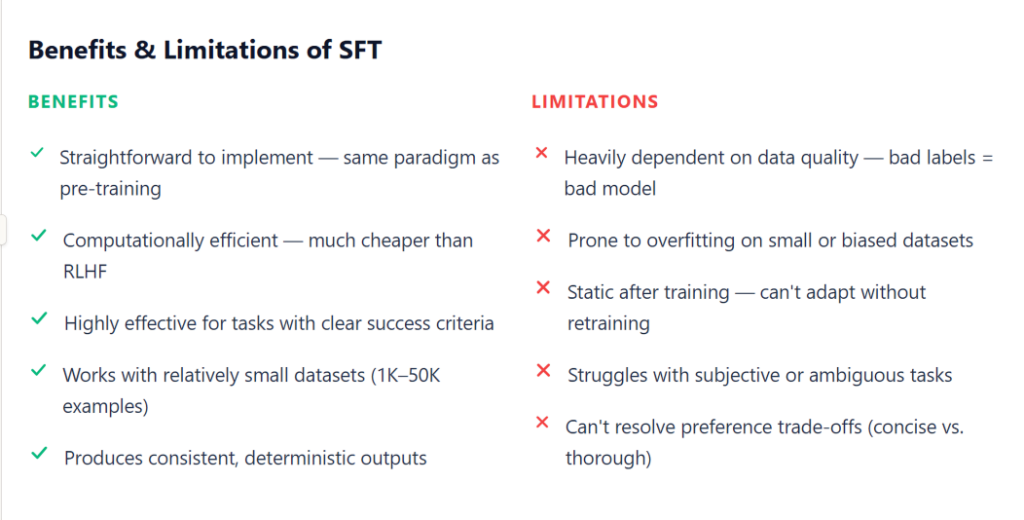
The dataset is typically much smaller than the pre-training corpus anywhere from 1,000 to 50,000 high-quality examples but the quality bar is extremely high. Bad data in, bad model out.
Step 3: Train using supervised learning. The process runs a standard training loop:
- The model generates a prediction for each input (forward pass)
- A loss function (usually cross-entropy) measures how far the prediction is from the labeled output
- Backpropagation adjusts model weights to minimize that loss
- This repeats across multiple epochs until the model converges
Step 4: Evaluate and iterate. Performance is measured against task-specific benchmarks accuracy for classification, BLEU or ROUGE scores for text generation, pass@k for code evaluation tasks.
When SFT Is the Right Choice
SFT works best when:
Need Domain Experts for Your AI Training Pipeline?
Sourcebae connects AI labs with pre-vetted experts for RLHF data labeling, model evaluation, code review, and red-teaming
- The task is well-defined with clear right/wrong answers. Classification, entity extraction, structured summarization, code evaluation tasks where “correct” isn’t subjective.
- You have access to high-quality labeled data. Either from internal logs (support transcripts, medical records, code reviews) or from domain experts who can annotate accurately.
- Speed and cost matter. SFT is computationally cheaper and simpler to implement than RLHF. You can fine-tune a 7B parameter model on a single GPU in hours.
- Consistency is more important than creativity. When the model needs to give the same right answer every time not a creative or nuanced one SFT is the tool.
Real-World SFT Use Cases
Customer support automation: Companies fine-tune models on historical support tickets to build chatbots that give brand-aligned, policy-accurate responses. The model learns not just what to say, but how to say it in the company’s voice.
Medical text analysis: Healthcare AI teams use SFT with expert-annotated clinical data to build models that can extract diagnoses from patient records, summarize research papers, or flag drug interactions. ChatDoctor, fine-tuned on doctor-patient dialogues, is one well-documented example.
Code evaluation and review: Engineering teams fine-tune models on code review datasets pairing code snippets with quality ratings, bug descriptions, and suggested fixes. This is where pre-vetted AI experts with real software engineering experience are critical, because the quality of code annotations directly determines the model’s ability to spot actual issues versus flagging false positives.
Legal document processing: Law firms use SFT to train models on contract clauses, case summaries, and regulatory filings, enabling automated extraction and classification at scale.
What Is Reinforcement Learning from Human Feedback (RLHF)?
RLHF is a fine-tuning method that uses human judgments as a reward signal to align a model with human preferences. Instead of telling the model “the right answer is Y,” you show it multiple possible answers and have humans rank which ones are better. The model then learns to produce responses that humans would prefer.
This is the technique that turned GPT-3 into ChatGPT, and it’s at the core of how Anthropic trains Claude. It’s the industry standard for making models helpful, harmless, and honest and it relies heavily on RLHF data labeling by skilled human evaluators.
How RLHF Works: Step by Step
Step 1: Start with an SFT model. RLHF doesn’t start from scratch. It begins with a model that’s already been supervised fine-tuned to follow instructions and generate coherent responses. This SFT checkpoint becomes the “policy model” that RLHF will refine.
Step 2: Collect human preference data. Human evaluators ideally domain experts for AI with subject-matter expertise review pairs of model-generated responses and rank them. “Response A is better than Response B because it’s more accurate, more helpful, and less likely to cause harm.”
This isn’t simple labeling. It requires expert judgment, and the consistency and quality of this feedback directly determine the quality of the final model. This is why companies invest heavily in building annotation teams with real domain expertise rather than relying on crowd-sourced labeling.
Step 3: Train a reward model. The human preference data trains a separate neural network the reward model that learns to predict human rankings. Given a prompt and a response, the reward model outputs a scalar score indicating how much humans would prefer that response.
Step 4: Optimize with reinforcement learning. Using the reward model as a scoring function, the policy model is fine-tuned through reinforcement learning typically using Proximal Policy Optimization (PPO). The process works in a loop:
- The policy model generates responses
- The reward model scores them
- PPO adjusts the policy model’s weights to maximize reward scores
- A KL divergence penalty prevents the model from drifting too far from the original SFT checkpoint
Step 5: Iterate. Fresh human feedback is collected on the improved model’s outputs, the reward model is updated, and the cycle repeats. This iterative loop is what makes RLHF powerful it continuously refines behavior based on evolving human preferences.
When RLHF Is the Right Choice
RLHF is the right approach when:
- Quality is subjective. Tasks where “good” depends on nuance tone, helpfulness, safety, engagement rather than a binary right/wrong.
- Safety and alignment are critical. Reducing harmful outputs, hallucinations, and biased responses requires the kind of nuanced feedback that RLHF provides.
- You’re building user-facing conversational AI. Chatbots, virtual assistants, AI copilots anywhere the user experience depends on subjective quality.
- You need the model to handle edge cases gracefully. RLHF excels at teaching models what to do in ambiguous situations that can’t be covered by labeled examples alone.
Real-World RLHF Use Cases
Conversational AI assistants: Every major AI assistant ChatGPT, Claude, Gemini uses RLHF to refine conversational quality. Human evaluators rate responses for helpfulness, accuracy, and tone, creating the preference data that makes these models feel “smart” rather than robotic.
AI safety and red-teaming AI: Red-teaming AI is one of the most critical applications of RLHF. Human red-teamers deliberately try to break the model probing for harmful outputs, jailbreaks, bias, and failure modes. Their feedback trains the reward model to penalize unsafe behavior, making the production model more robust against adversarial inputs. This is an area where hiring experienced red-team specialists with backgrounds in security, ethics, and domain-specific risks makes a measurable difference in model safety.
Content moderation at scale: Platforms use RLHF to train moderation models that adapt to evolving community standards. Unlike rule-based systems, RLHF-trained moderators handle context and nuance distinguishing between a news article about violence and an actual violent threat, for example.
AI model evaluation and benchmarking: RLHF processes generate rich preference data that serves double duty: training better models and evaluating model quality. The same human judgment pipeline used for RLHF can power systematic AI model evaluation comparing model versions, identifying regression, and measuring alignment improvements across releases.
Benefits of RLHF
- Produces models that feel natural, helpful, and aligned with human expectations
- Handles subjective quality dimensions that SFT can’t capture
- Iterative feedback loop enables continuous improvement
- Industry-proven at scale by OpenAI, Anthropic, Google, and Meta
- Reduces harmful, biased, and hallucinated outputs when done correctly
Limitations of RLHF
- Expensive and complex. Requires training multiple models (policy + reward), collecting ongoing human feedback, and significant compute for PPO optimization.
- Reward hacking. The policy model can learn to exploit the reward model producing outputs that score high but aren’t genuinely good. This is a well-documented failure mode.
- Diversity collapse. Research shows RLHF-tuned models reduce lexical diversity by up to 41%. The model converges on “safe, polished” responses at the expense of variety and creativity.
- Annotator quality is everything. Inconsistent or low-quality human feedback poisons the reward model. A 2025 study found RLHF models showed a 27% increase in demographic bias when trained on feedback from inconsistent annotators.
- Infrastructure overhead. Running PPO with a policy model, reward model, reference model, and value model simultaneously requires 4x the GPU memory of SFT.
SFT vs. RLHF: Head-to-Head Comparison
| Dimension | SFT | RLHF |
|---|---|---|
| Training data | Labeled input-output pairs | Human preference rankings |
| What the model learns | “The correct answer is Y” | “Humans prefer A over B” |
| Best for | Structured, well-defined tasks | Subjective quality, alignment, safety |
| Compute cost | Low single model training | High multiple models + RL loop |
| Data cost | Moderate (expert annotation) | High (ongoing preference collection) |
| Implementation complexity | Simple standard fine-tuning | Complex reward model + PPO pipeline |
| Time to production | Days to weeks | Weeks to months |
| Output consistency | High deterministic | Moderate optimized for preference |
| Handles ambiguity | Poorly | Well |
| Safety alignment | Basic (data-dependent) | Strong (feedback-driven) |
| Risk of overfitting | High (small datasets) | Moderate (reward hacking) |
| Scalability | Easy to scale | Requires annotation infrastructure |
The Production Reality: SFT + RLHF Together
Here’s what the competitor blogs won’t tell you: in production, it’s rarely an either/or decision. The standard pipeline at every major AI lab in 2026 looks like this:
Pre-training → SFT → Preference Optimization (RLHF/DPO) → RLVR (for reasoning)
SFT handles the first 80% teaching the model to follow instructions, produce structured outputs, and stay on-task. RLHF (or its lighter-weight alternatives) handles the last 20% calibrating tone, reducing harm, and resolving the subjective trade-offs that SFT can’t touch.
Research confirms this. A study on Meta’s OPT-350M found that an SFT+DPO combined model outperformed both SFT-only and DPO-only models across all alignment metrics helpfulness, harmlessness, and combined alignment score. The techniques are complementary, not competing.
Beyond SFT and RLHF: The 2026 Alignment Landscape
The LLM training landscape has evolved significantly. While SFT and RLHF remain foundational, several newer techniques are changing how AI teams approach alignment. If you’re making infrastructure decisions today, you need to know these.
Direct Preference Optimization (DPO)
DPO, introduced by Stanford researchers in 2023, eliminates the reward model entirely. Instead of training a separate model to predict human preferences and then running PPO, DPO optimizes the language model directly on preference pairs using a modified loss function.
Why it matters: DPO reduces compute costs by 40–75% compared to RLHF and offers substantially more stable training. By 2026, it’s become the default preference optimization method for most teams that don’t need the full complexity of RLHF. A report noted a 210% year-over-year increase in DPO adoption on Hugging Face.
The trade-off: DPO is bounded by the quality of its static preference data it can’t improve beyond what’s in the dataset. A late 2025 study also found that RLHF models produced unsafe outputs in 8% of adversarial cases versus 10% for DPO-trained models, giving RLHF a slight edge on safety.
Reinforcement Learning from AI Feedback (RLAIF)
RLAIF replaces human evaluators with AI models. Instead of having humans rank responses, a capable AI judge (like GPT-4 or Claude) evaluates outputs based on predefined criteria and rubrics.
Why it matters: RLAIF matches RLHF performance on many benchmarks at 63% lower cost. It’s particularly useful for scaling annotation in domains where human experts are scarce or expensive.
The trade-off: AI judges can inherit and amplify biases. RLAIF works best when combined with periodic human audits not as a complete replacement for human judgment.
GRPO (Group Relative Policy Optimization)
GRPO, popularized by DeepSeek’s R1 model, compares groups of model-generated responses and optimizes toward the better-ranked outputs without a separate reward model. It’s essentially RL without the reward model overhead.
Why it matters: GRPO is particularly effective for improving reasoning and multi-step problem-solving. DeepSeek-R1 demonstrated that pure RL with verifiable rewards can produce emergent reasoning capabilities that neither SFT nor standard RLHF achieves.
The Modern Post-Training Stack (2026)
The current production pattern looks less like “SFT vs. RLHF” and more like a modular stack:
| Stage | Method | Purpose |
|---|---|---|
| Stage 1 | SFT | Instruction following, format, tone |
| Stage 2 | DPO / SimPO / KTO | Preference alignment, safety |
| Stage 3 | GRPO / RLVR | Reasoning, multi-step problem-solving |
| Stage 4 | Red-teaming + evaluation | Safety validation, regression testing |
Each stage solves a different problem. Skipping stages or applying them out of order leads to predictable failures. This is why having experienced AI training data specialists people who understand not just annotation but the full pipeline is critical.
Best Practices for AI Training Data Preparation
No fine-tuning method can compensate for bad data. Here’s what separates teams that ship from teams that spin.
For SFT Data
Hire domain experts, not generalists. A medical SFT dataset annotated by doctors will outperform one labeled by crowd workers by an order of magnitude. The same applies to legal, financial, and code evaluation tasks. Pre-vetted AI experts with real domain experience aren’t a luxury they’re a requirement.
Prioritize quality over quantity. 5,000 expert-curated examples will outperform 50,000 noisy crowd-sourced ones. Clean, consistent, and representative data is the single biggest lever you have.
Build for diversity. Cover edge cases, minority scenarios, and adversarial inputs in your training data. Overfitting to the “happy path” is the most common SFT failure mode.
Version and audit everything. Track dataset versions, annotation guidelines, annotator agreement rates, and quality metrics. You’ll need this for debugging and for compliance.
For RLHF / Preference Data
Define evaluation criteria before you start. What does “better” mean for your use case? Helpfulness? Safety? Factual accuracy? Tone? Without clear rubrics, annotator disagreement will poison your reward model.
Use trained specialists, not crowd labor. RLHF data labeling requires consistent, high-quality judgments. An experienced AI training data provider will maintain annotator calibration, inter-rater reliability, and continuous quality audits things that generic crowdsourcing platforms don’t do.
Build in adversarial testing. Your preference dataset should include adversarial prompts and edge cases. This is where red-teaming AI becomes part of the data preparation process, not just a post-deployment audit.
Scale with RLAIF, validate with humans. Use AI judges for the bulk of preference labeling, but maintain a human validation layer for safety-critical and ambiguous cases. This is the cost-effective path that most AI labs now follow.
How to Choose: A Decision Framework
Use this framework to match your use case to the right method:
SFT when:
- Your task has clear, objective success criteria
- You have or can build a high-quality labeled dataset
- You need fast, cost-effective deployment
- Consistency and determinism matter more than nuance
- Examples: code evaluation, entity extraction, classification, structured summarization, medical coding
Choose RLHF when:
- Quality is subjective and context-dependent
- Safety, alignment, and harm reduction are critical
- You’re building user-facing conversational products
- You need the model to handle ambiguity and edge cases gracefully
- Examples: AI assistants, content moderation, conversational agents, AI safety systems
DPO when:
- You need preference alignment without RLHF’s infrastructure complexity
- Your preference data is high-quality but static
- Budget and compute are constrained
- Examples: tone calibration, style alignment, moderate safety requirements
SFT + RLHF/DPO when:
- You’re building a production system that needs both accuracy and alignment
- The task involves both structured correctness and subjective quality
- You have the budget for a two-stage pipeline
- Examples: enterprise AI assistants, healthcare AI, financial advisory tools
The Human Expert Bottleneck: Why AI Training Data Quality Determines Everything
Every method described in this guide SFT, RLHF, DPO, RLAIF depends on one thing: the quality of human input at the data layer. Whether it’s labeled examples for SFT or preference rankings for RLHF, the humans creating that data determine the ceiling of your model’s performance.
This is the bottleneck most teams underestimate. Hiring domain experts for AI people with actual subject-matter expertise in medicine, law, engineering, finance, or security and deploying them through a structured annotation pipeline with quality controls is the difference between a model that works in demos and one that works in production.
At Sourcebae, we connect AI labs and enterprises with pre-vetted AI experts who specialize in RLHF data labeling, AI model evaluation, code evaluation, and red-teaming AI. Our network of 200,000+ domain experts screened through a 5-stage vetting process with an 8% pass rate provides the human intelligence layer that powers model training pipelines for the world’s leading AI teams.
Whether you need annotators for SFT dataset curation, evaluators for preference ranking, or red-team specialists for adversarial testing, Sourcebae delivers expert profiles within 24–48 hours complete with AI-generated Report Cards that validate domain expertise and task readiness.
Frequently Asked Questions
What is the difference between SFT and RLHF?
Supervised fine-tuning (SFT) trains an LLM on labeled input-output pairs to teach it specific tasks the model learns “the correct answer is Y.” RLHF (Reinforcement Learning from Human Feedback) uses human preference rankings to train a reward model, then optimizes the LLM to produce responses humans would prefer. SFT is simpler, cheaper, and best for structured tasks. RLHF is more complex but excels at subjective quality, safety alignment, and handling ambiguity.
Can you use SFT and RLHF together?
Yes and most production systems do. The standard pipeline in 2026 is SFT first (to teach instruction following and task-specific skills), followed by RLHF or DPO (to align the model with human preferences and safety requirements). Research consistently shows that combining both methods outperforms using either one alone.
What is DPO and how does it compare to RLHF?
Direct Preference Optimization (DPO) is a simpler alternative to RLHF that eliminates the need for a separate reward model. It optimizes the LLM directly on preference pairs, reducing compute costs by 40–75%. DPO is easier to implement and more stable, but RLHF retains a slight edge in safety-critical applications. Most teams in 2026 use DPO as their default preference optimization method and reserve full RLHF for high-stakes safety alignment.
How much data do you need for SFT vs. RLHF?
For SFT, 1,000–50,000 high-quality labeled examples are typically sufficient, depending on task complexity. For RLHF, you need thousands of preference comparisons usually 10,000–100,000 ranked pairs to train a reliable reward model. In both cases, data quality matters far more than quantity. A small, expert-curated dataset will outperform a large, noisy one.
What is RLAIF and when should you use it?
RLAIF (Reinforcement Learning from AI Feedback) replaces human evaluators with AI judges for preference ranking. It’s useful for scaling annotation when human experts are scarce or expensive, and benchmarks show it matches RLHF performance in many tasks at roughly 63% lower cost. Best practice is to use RLAIF for bulk annotation with periodic human validation for safety-critical cases.
Why do domain experts matter for LLM fine-tuning?
The quality of fine-tuning data directly determines model performance. Domain experts for AI doctors, lawyers, engineers, security researchers produce more accurate, consistent, and nuanced annotations than generalist crowd workers. This is true for both SFT (where expert-labeled input-output pairs define the model’s knowledge) and RLHF (where expert preference rankings shape the reward model). Hiring pre-vetted AI experts with verified domain credentials is the single highest-ROI investment in any fine-tuning pipeline.
What is red-teaming AI and why is it important for RLHF?
Red-teaming AI involves deliberately probing a model for harmful outputs, biases, jailbreaks, and failure modes. In RLHF pipelines, red-team data is used to train the reward model to penalize unsafe behavior. Effective red-teaming requires specialists who understand both AI systems and domain-specific risks not generalist annotators. It’s an essential part of any production alignment pipeline.
How do you evaluate a fine-tuned LLM?
AI model evaluation depends on the fine-tuning method. For SFT models, use task-specific benchmarks accuracy, F1 score, BLEU, ROUGE, or pass@k for code. For RLHF-tuned models, evaluation typically includes human preference ratings, safety benchmarks (like TruthfulQA), and adversarial testing. Many teams also use LLM-as-a-judge evaluation, where a capable AI model scores outputs against rubrics.
Glossary
Active Learning —
A technique where the model identifies which unlabeled data would be most valuable for human annotation, reducing labeling costs while maximizing improvement.
AI Training Data —
The datasets used to train, fine-tune, or align AI models. Includes labeled examples for SFT, preference pairs for RLHF/DPO, and adversarial prompts for red-teaming.
Annotation —
The process of labeling data with information an AI model can learn from. In SFT, annotators provide correct answers. In RLHF, they rank competing responses.
Constitutional AI —
An alignment approach developed by Anthropic where AI systems are trained to follow a set of principles (“constitution”) using self-critique and revision, reducing reliance on human preference data.
Direct Preference Optimization (DPO) —
A preference optimization method that trains the LLM directly on preference pairs without a separate reward model, offering 40–75% compute savings over RLHF.
GRPO (Group Relative Policy Optimization) —
An RL method that ranks groups of model-generated responses without a reward model, used by DeepSeek-R1 for reasoning improvement.
KL Divergence —
A mathematical measure of how much one probability distribution differs from another. In RLHF, it’s used to prevent the policy model from drifting too far from the SFT baseline.
Overfitting —
When a model memorizes training data rather than learning generalizable patterns, leading to poor performance on new inputs.
PPO (Proximal Policy Optimization) —
The most commonly used RL algorithm in RLHF, designed to update model weights while preventing large, destabilizing changes.
Preference Data —
Pairs or rankings of model outputs collected from human evaluators, used to train reward models in RLHF or directly optimize models in DPO.
Reward Model —
A neural network trained on human preferences to predict how humans would rate a given response. Used in RLHF to provide the optimization signal.
RLAIF (Reinforcement Learning from AI Feedback) —
A variant of RLHF where AI models replace human evaluators for preference ranking, reducing costs while maintaining competitive quality.
RLHF (Reinforcement Learning from Human Feedback) —
A fine-tuning method that uses human preference rankings to train a reward model, then optimizes the LLM via reinforcement learning to align with those preferences.
RLVR (Reinforcement Learning with Verifiable Rewards) —
An RL method for tasks where correctness can be automatically checked (math, code execution), eliminating the need for human feedback.
SFT (Supervised Fine-Tuning) —
A method that adapts a pre-trained LLM to specific tasks using labeled input-output pairs created by domain experts.
Sourcebae is an AI-powered expert platform that connects AI labs and enterprises with on-demand domain experts for RLHF data labeling, AI model evaluation, code evaluation, red-teaming AI, and technical hiring. Our AI recruiter Saira matches you with pre-vetted AI experts from a network of 200,000+ specialists delivered in 24–48 hours with AI-generated Report Cards. Talk to us