
Data annotation for AI is the process of labeling raw data images, text, audio, video, or 3D point clouds with structured, machine-readable tags so supervised machine learning models can learn from it. Every labeled image of a pedestrian, every tagged sentence in a support ticket, every preference ranking of an AI response teaches a model what “correct” looks like. Without annotation, AI models have no ground truth to learn from.
The data annotation market crossed $2 billion in 2026 and is growing at over 27% CAGR. That growth reflects a hard reality: data quality, not model architecture, is now the primary bottleneck in AI development. Improving label accuracy from 90% to 99% on training data consistently outperforms switching to a larger model at a fraction of the compute cost.
This guide covers every dimension of data annotation for AI: what it is, how it works, which methods exist, how quality is measured, what it costs, and how to build an annotation strategy that scales. Whether you need data annotation explained for beginners joining your ML team or a reference for experienced practitioners evaluating methodology options, this is the starting point.
Why Is Data Annotation Important for AI and Machine Learning?
Data annotation for AI is important because supervised machine learning, which powers the vast majority of production AI systems, cannot learn without labeled examples. A self-driving car’s perception model needs millions of labeled LiDAR frames to distinguish pedestrians from lampposts. A medical AI needs thousands of expert-annotated X-rays to detect lung nodules. A large language model needs hundreds of thousands of human preference rankings to align its outputs with what people actually find helpful and safe.
The quality of annotations directly determines model performance. In computer vision benchmarks, improving label quality from 90% to 99% accuracy has been shown to produce larger performance gains than upgrading from a smaller to a larger model architecture at a fraction of the computational cost. Conversely, a 5% annotation error rate can degrade model F1 scores by 10–25%, trigger costly retraining cycles, and, in safety-critical applications, create real liability risk.
From 2023 to 2024, data labeling costs surged with a growth factor of 88x, while compute costs grew only 1.3x. This inversion confirms what leading ML teams already know: annotation quality is the highest-leverage investment in the AI development pipeline.
How Does Data Annotation Work?
At its core, annotation follows a four-stage cycle: define, label, review, iterate.
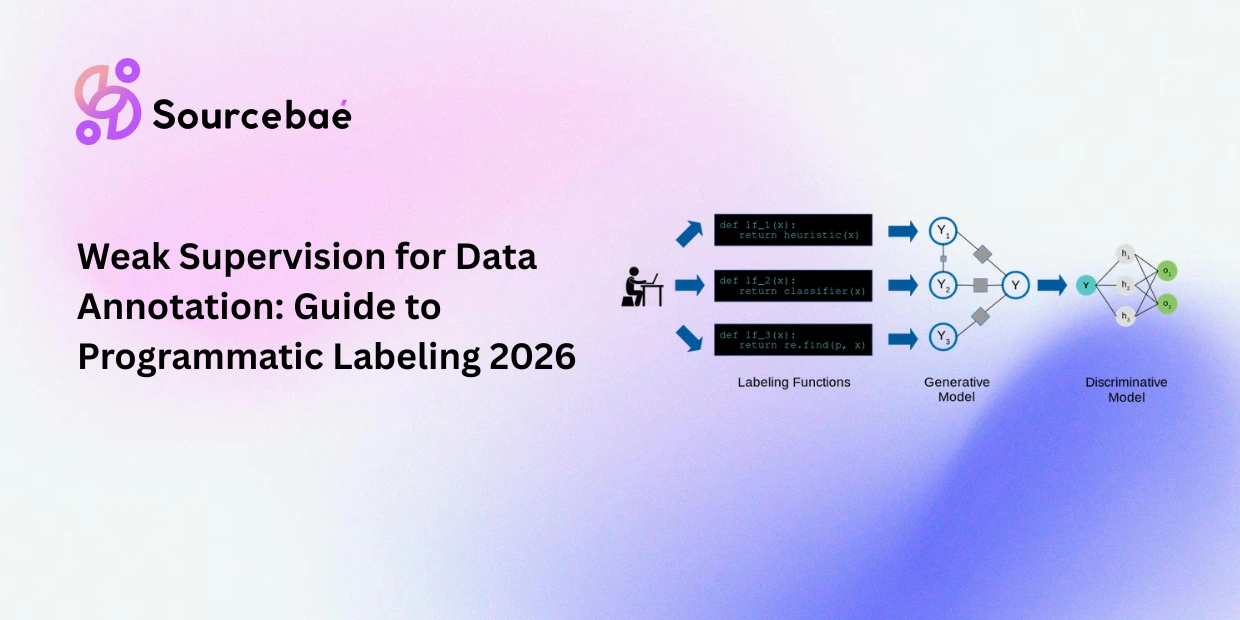
Define the annotation task. This means specifying what to label (objects, entities, sentiments, preferences), building a label taxonomy (the complete list of categories), and writing annotation guidelines with examples. The guidelines are the single most important document in any annotation project. Ambiguous instructions produce inconsistent labels, and inconsistent labels produce unreliable models.
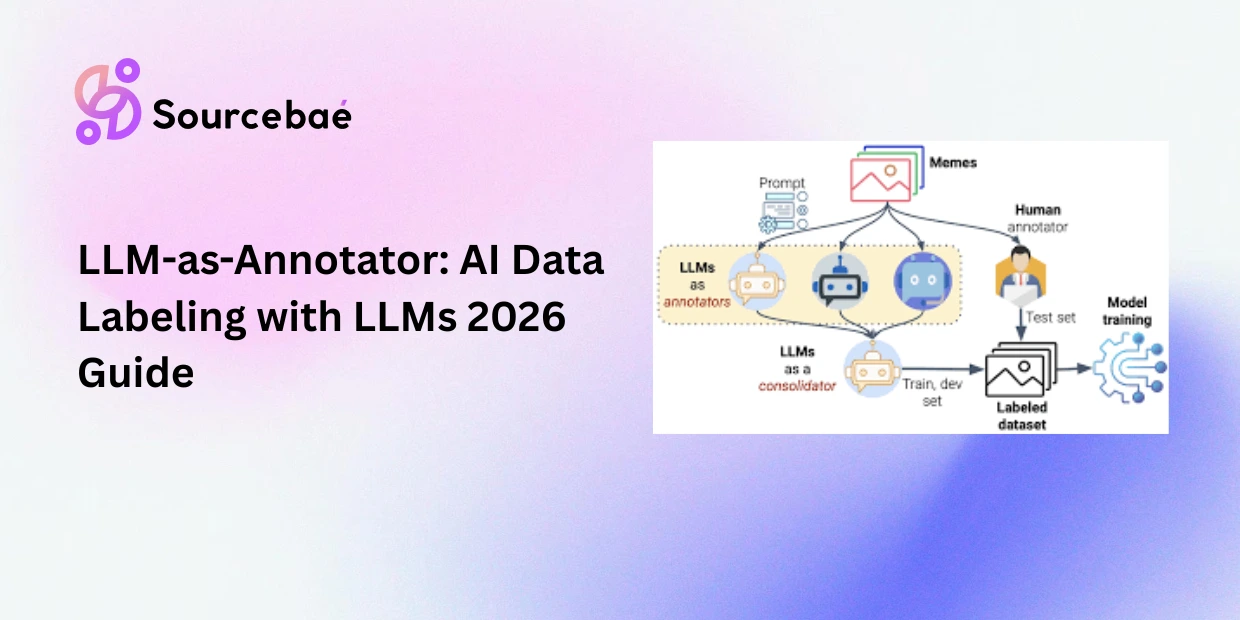
Label the data. Human annotators or a combination of AI pre-labeling and human review apply structured tags to raw data. A radiologist draws a boundary around a lung nodule on a CT scan. A linguist tags named entities in a Hindi news article. An RLHF evaluator ranks two AI-generated responses by helpfulness and accuracy. Each labeled sample becomes a training signal the model learns from.
Review for quality. No annotation project ships without quality assurance. The standard QA framework includes gold-set monitoring (injecting pre-labeled test samples to track annotator accuracy), inter-annotator agreement measurement (checking if different annotators produce the same labels), and expert adjudication (senior reviewers resolving disagreements on edge cases).
Iterate on guidelines. Every batch of annotations reveals new edge cases and guideline gaps. The best annotation teams treat their guidelines like software versioned, updated regularly, and improved through structured feedback loops.
Data Labeling vs Annotation: Is There a Difference?
The data labeling vs annotation debate comes up often, but the terms are used interchangeably across most of the industry. Some practitioners draw a soft distinction: “labeling” for simpler categorization tasks (assigning a single class to an image or document) and “annotation” for more complex tasks that involve spatial, relational, or evaluative labeling (drawing bounding boxes, extracting entity relationships, ranking AI outputs).
In practice, whether you call it data labeling or data annotation matters far less than whether your process produces consistent, accurate, well-documented training data that your model can learn from reliably. Throughout this guide and the broader series, we use both terms; the methodology, quality standards, and best practices apply equally regardless of which term your team prefers.
What Are the Main Types of Data Annotation?
The types of data annotation span every modality that machine learning models consume, including images, text, audio, video, 3D point clouds, and LLM outputs. Each data type requires different labeling techniques, tools, and annotator skills. For a deeper technical reference, see Sourcebae’s Data Labeling & Annotation: The Complete Expert Guide.
Image annotation
It involves labeling visual data with bounding boxes, polygons, segmentation masks, keypoints, or 3D cuboids. It powers computer vision applications from autonomous driving to medical imaging to retail product recognition. Bounding boxes are the fastest and cheapest method; semantic segmentation is the most precise and most expensive. The choice depends on whether your model needs to know roughly where an object is (detection) or exactly what shape it takes (segmentation).
Text annotation
labels unstructured language data with entity tags, sentiment scores, intent categories, or semantic relationships. Named entity recognition (NER), sentiment analysis, intent classification, and relation extraction are the primary techniques. Text annotation is particularly sensitive to cultural and linguistic context; the same word can carry opposite sentiment in different domains.
Audio and speech annotation
It covers transcription, speaker diarization (who spoke when), emotion tagging, sound event detection, and pronunciation labeling. Audio is inherently time-intensive: one minute of audio typically requires four to ten minutes of annotation time, depending on complexity.
Video annotation
extends image labeling across sequential frames, adding temporal consistency requirements. Frame-by-frame labeling is the most accurate but slowest approach. Key-frame interpolation, labeling selected frames, and auto-filling between them reduces annotation time by 50–80% for most tracking tasks.
3D point cloud and LiDAR annotation
It labels three-dimensional spatial data from LiDAR sensors with 3D bounding boxes, semantic segmentation, or tracking IDs. It is essential for autonomous vehicles, robotics, and geospatial mapping, and is 3–10x more expensive than 2D annotation due to the spatial reasoning required. 3D point cloud annotation is the fastest-growing annotation segment, expanding at over 22% CAGR.
LLM output annotation (RLHF)
It is the newest and fastest-growing category. It includes preference ranking (comparing AI responses), safety evaluation (red teaming), instruction-following assessment, and factuality verification. This type of annotation requires skilled evaluators, often domain experts, commanding $50–$200 per hour because the judgments are subjective and directly shape model behavior.
What Are the Core Annotation Methods and How Do They Compare?
Understanding the types of data annotation above tells you what data you’re labeling. The methods below tell you how. Annotation methods range from fast and approximate to slow and highly precise. The right method depends on what your model needs to learn, your accuracy requirements, and your budget. For a detailed decision framework, see How to Choose an Annotation Methodology.
| Method | How It Works | Speed | Precision | Typical Cost/Label | Best For |
| Bounding Box | A rectangular box drawn around the object | Very fast | Low includes background | $0.02–$0.08 | Object detection, counting |
| Polygon | Irregular shape traced around the object boundary | Moderate | Medium | $0.05–$0.20 | Irregular shapes, product cutouts |
| Semantic Segmentation | Per-pixel class label across the entire scene | Slow | High | $0.15–$1.00 | Scene understanding, autonomous driving |
| Instance Segmentation | Per-pixel label + unique object ID | Very slow | Highest | $0.30–$2.00 | Object counting, multi-object tracking |
| Keypoint | Specific landmark points on objects | Fast | Variable | $0.05–$0.30 | Pose estimation, facial landmarks |
| Named Entity Recognition (NER) | Span-level tags on text entities | Moderate | High | $0.05–$0.30/doc | Information extraction, knowledge graphs |
| Preference Ranking (RLHF) | Pairwise comparison of model outputs | Slow | Subjective | $0.50–$50/comparison | LLM alignment, safety training |
Choosing between methods is a strategic decision, not a technical default. A general rule: start with the simplest method that meets your model’s accuracy requirement, then upgrade only if performance plateaus.
How Is Annotation Quality Measured?
Quality measurement in data annotation rests on one foundational metric: inter-annotator agreement (IAA). IAA measures how consistently different annotators label the same data — and it’s the most reliable signal of whether your guidelines are clear, your annotators are calibrated, and your dataset is trustworthy.
The three standard IAA metrics are Cohen’s Kappa (for two annotators), Fleiss’ Kappa (for three or more), and Krippendorff’s Alpha (for any number of annotators, handles missing data). All three adjust for agreement that would happen by random chance, making them more reliable than simple percentage agreement.
| Score Range | Interpretation | Recommended Action |
| Below 0.40 | Low agreement | Redesign guidelines from scratch. Add visual examples. Retrain annotators. |
| 0.40–0.60 | Moderate agreement | Targeted fixes on specific high-disagreement categories. Add boundary definitions. |
| 0.60–0.80 | Substantial agreement | Production is viable with monitoring. Refine edge case rules. |
| 0.80–1.00 | Near-perfect agreement | Excellent. Watch for false consensus (annotators defaulting to one label). |
Beyond IAA, production annotation pipelines use gold-set monitoring (pre-labeled test samples injected into every batch to track per-annotator accuracy), multi-pass review (independent re-annotation by a second annotator on a sample), and automated anomaly detection (statistical flags for label distribution shifts or annotation speed outliers). For a complete QA implementation guide, see Quality Assurance in Data Annotation.
Quality assurance should consume 15–25% of the total annotation budget. Less than 15% creates quality gaps that compound through the ML pipeline. More than 25% suggests process inefficiency.
Need help building a quality-first annotation pipeline?
Sourcebae’s 200,000+ vetted domain experts deliver 95%+ accuracy with 48-hour deployment across 33+ languages.
Talk to an annotation strategist →
What Does Data Annotation Cost?
Annotation costs vary by orders of magnitude depending on task complexity, annotator expertise, and quality requirements.
General annotation (simple classification, bounding boxes, basic text tagging) ranges from $0.02 to $0.50 per label when using managed annotation workforces. This covers the majority of image classification, object detection, and text categorization tasks.
Specialized annotation (medical imaging, legal document review, scientific data) costs $0.50 to $10+ per label or $50 to $200 per hour for domain experts. The premium reflects the irreplaceable judgment that only trained professionals can provide; a crowd worker cannot label a chest X-ray, and a general annotator cannot evaluate whether a legal AI response contains accurate case law.
RLHF and alignment annotation sit at the highest cost tier: $0.50 to $50 per pairwise comparison for general evaluators, and up to $200 per hour for domain-specific expert evaluators. The subjectivity of preference judgments and the direct impact on model behavior justify the premium.
The most expensive annotation is not the kind that costs the most per label. It’s the kind that costs the least per label but produces errors that compound through training, evaluation, and deployment, triggering retraining cycles that cost 10–100x more than getting labels right the first time.
What Roles Do Humans Play in Modern Annotation?
The annotation workforce is stratifying. The era of treating all annotation as undifferentiated crowd work is over.
Crowd annotators handle high-volume, low-complexity tasks: image classification, simple bounding boxes, and basic text categorization. They work at scale but require robust QA systems because individual quality varies widely.
Trained evaluators are the backbone of most production annotation. They complete task-specific training, pass calibration tests, and work within managed teams with dedicated project leads. They handle moderate-complexity tasks: multi-class NER, sentiment annotation, video tracking, and standard QA review.
Domain experts provide the judgment that neither crowd workers nor trained evaluators can replicate. Radiologists annotate medical images. Lawyers review legal AI outputs. Engineers evaluate code generation. Linguists handle nuanced multilingual text. Their hourly rates reflect their expertise and the stakes of getting their labels wrong.
Red teamers are a specialized subset focused on adversarial testing of AI models. They probe for harmful outputs, jailbreak vulnerabilities, bias, and hallucinations. Red teaming requires creative adversarial thinking, understanding of model behavior patterns, and psychological resilience for exposure to harmful content.
The shift from crowd to expert is the defining workforce trend in annotation. Traditional crowdsourcing platforms are declining for quality-sensitive tasks, replaced by managed expert networks that combine vetting, domain matching, and calibration of a model. Sourcebae has built around 200,000+ vetted domain experts with an 8% candidate pass rate.
How Do You Build an Annotation Strategy That Scales?
An annotation strategy that works at 1,000 labels and collapses at 100,000 labels was never a strategy; it was a pilot. Scaling requires deliberate phase transitions.
Phase 1: Pilot (500–1,000 labels). Validate your annotation methodology. Test guidelines with 3–5 annotators. Measure IAA. Identify edge cases. This phase is about learning, not production.
Phase 2: Proof of concept (1,000–10,000 labels). Stress-test guidelines. Refine your label taxonomy based on real-world data patterns. Establish QA baselines. Decide whether to build in-house, outsource, or go hybrid.
Phase 3: Growth (10,000–100,000 labels). Build workforce redundancy. Introduce model-assisted pre-labeling if your model achieves >80% accuracy. Automate QA where possible. Implement gold-set monitoring and per-annotator performance tracking.
Phase 4: Scale (100,000–1,000,000+ labels). Pipeline orchestration becomes critical. Multi-team coordination, continuous quality monitoring, automated anomaly detection, and structured feedback loops between annotators, QA reviewers, and ML engineers.
The most common failure mode in scaling? Skipping Phase 1. Teams that jump from zero to 100K labels without piloting their guidelines and measuring IAA waste 30–50% of their annotation budget on labels that need rework.
What Trends Are Shaping Data Annotation in 2026?
Eight trends are converging to reshape data annotation for AI. For a deeper analysis, see Annotation Methodology Trends for 2026.
AI-assisted pre-labeling is becoming standard. Models generate draft annotations; humans review and correct. This reduces annotation time by 30–60% but introduces automation bias risk; some annotators may accept incorrect pre-labels without sufficient scrutiny.
RLHF is evolving beyond simple pairwise comparisons. Multi-axis scoring, best-of-N ranking, critique generation, and constitutional AI approaches are expanding the annotation tool kit for LLM alignment. RLHF data quality is the single largest differentiator between frontier and average model performance.
Synthetic data supplements but doesn’t replace human annotation. AI-generated training data reduces cost for well-defined tasks, but human validation remains essential for edge cases, safety-critical domains, and subjective judgments.
Domain expert annotators command 3–10x premiums. Medical, legal, code, and scientific annotations require judgment that general annotators cannot provide. Expert hourly rates of $50–$200+ are now standard for high-value tasks.
Regulatory compliance is driving documentation requirements. The EU AI Act, NIST AI Risk Management Framework, and emerging state-level AI laws require auditable annotation records guidelines, quality metrics, annotator qualifications, and data governance documentation.
Multimodal annotation is becoming table stakes. Models that process text, image, and audio simultaneously need annotation pipelines that handle cross-modal labeling.
Annotation quality metrics are becoming a market differentiator. Buyers now ask for IAA scores, gold-set accuracy, and annotator qualification data before contracting with annotation providers.
On-demand expert networks are replacing traditional crowdsourcing. Managed platforms with vetting, calibration, and domain matching are displacing the undifferentiated crowd model for any task requiring quality above commodity level.
Frequently Asked Questions
What is data annotation in machine learning?
Data annotation is the process of labeling raw data with structured tags, category labels, bounding boxes, entity markers, and preference rankings that supervised machine learning models use as training signals. It creates the “answer key” that teaches AI models what correct outputs look like.
Why is data annotation important for AI?
Because supervised ML models cannot learn without labeled examples. Annotation quality directly determines model accuracy, reliability, and safety. Improving label quality from 90% to 99% produces larger performance gains than upgrading model architecture.
What is the difference between data labeling and annotation?
The data labeling vs annotation distinction is mostly semantic. The terms are used interchangeably across the industry. Some practitioners reserve “annotation” for complex spatial or relational labeling and “labeling” for simple classification, but there is no formal industry standard separating the two.
How long does data annotation take?
It varies by task: simple image classification takes 2–5 seconds per label, bounding boxes take 5–30 seconds, semantic segmentation takes 1–5 minutes per image, and RLHF preference evaluation takes 2–10 minutes per comparison.
Can AI replace human annotators?
Not in 2026. AI-assisted pre-labeling reduces human effort by 30–60% on well-defined tasks, but human judgment remains essential for edge cases, subjective evaluations, safety assessments, and novel domains where no pre-trained model exists.
From pilot to production, Sourcebae 200,000+ vetted domain experts scale with you.
48-hour deployment. 33+ languages. 8% candidate pass rate.