
Content moderation annotation is the process of labeling user-generated content text, images, video, and audio with safety classifications such as toxicity, hate speech, NSFW material, policy violations, and misinformation, so that AI systems can detect and filter harmful content at scale across social media platforms, marketplaces, gaming communities, and messaging applications.
Every major platform Facebook, YouTube, TikTok, X, Amazon, Reddit depends on annotation for content moderation AI to train the classifiers that review billions of posts, comments, images, and videos daily. Human annotators create the ground truth labels that teach these systems what constitutes “harmful,” “hateful,” “explicit,” or “misleading” within each platform’s specific policy framework.
Trust and safety annotation operates at a unique intersection of technical precision and human judgment. Unlike annotation for object detection (where a car is objectively a car), content moderation requires annotators to make nuanced, culturally situated, and sometimes deeply subjective decisions about what constitutes harm. Research consistently shows that inter-annotator agreement on hate speech classification is among the lowest of any annotation discipline Fleiss’ Kappa scores as low as 0.26 have been reported in academic studies because reasonable people genuinely disagree about where the line falls between offensive speech and protected expression.
Content moderation data labeling is also one of the most psychologically demanding annotation disciplines. Annotators are exposed to the worst content the internet produces graphic violence, child exploitation references, extreme hate speech, and disturbing imagery for hours at a time. Any responsible approach to content moderation annotation must address annotator well-being as seriously as it addresses labeling accuracy.
This guide covers every major method in content moderation annotation, the quality challenges unique to safety labeling, the critical topic of annotator psychological safety, and the cultural and linguistic complexities that make this discipline fundamentally different from other annotation types.
Toxicity Annotation: Classifying Harmful Language on a Spectrum
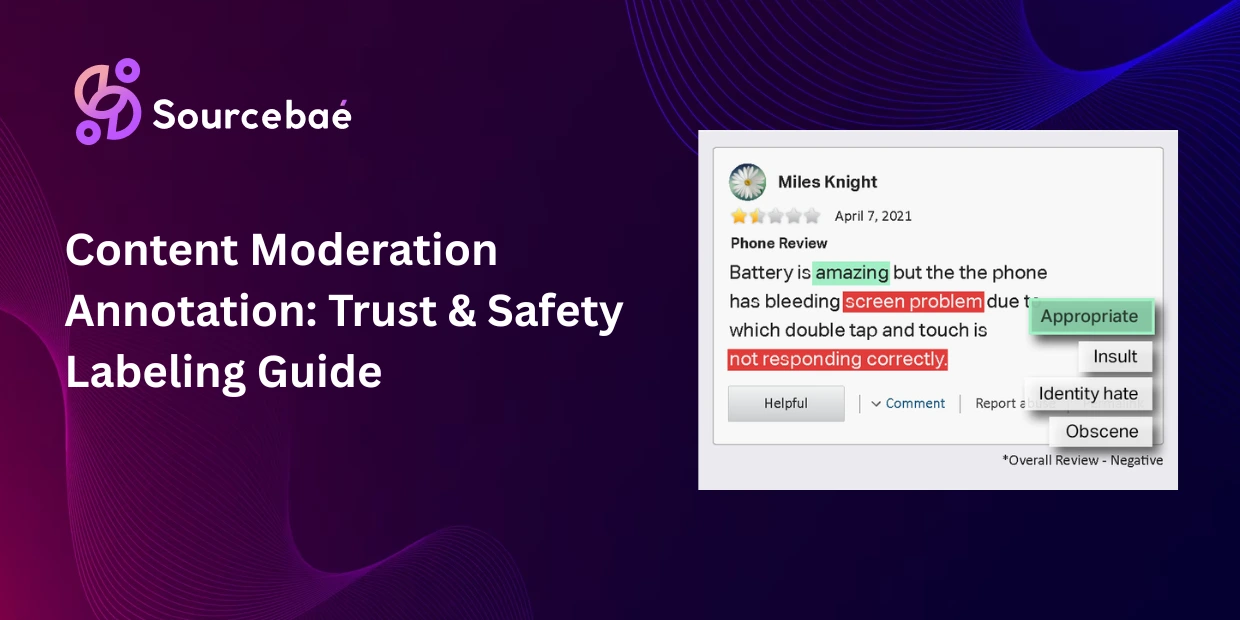
Toxicity annotation labels text, comments, or messages on a spectrum from benign to severely harmful. It is the broadest category of content moderation labeling and serves as the first layer of automated safety filtering for most platforms.
How it works
Annotators evaluate user-generated text and assign a toxicity score or classification. Common schemas range from binary (toxic / not toxic) to multi-level scales (not toxic / mildly toxic / moderately toxic / severely toxic). More granular taxonomies classify the type of toxicity insult, threat, obscenity, identity attack, sexually explicit, or general rudeness.
Google’s Perspective API, one of the most widely deployed toxicity annotation tools, scores text on a continuous scale from 0 to 1 representing the probability that a reader would perceive the content as toxic. This API was trained on millions of human-annotated examples and is used by news organizations, social platforms, and community forums to flag potentially harmful content.
Common pitfalls
Context dependency is the primary challenge in toxicity annotation. The sentence “I’m going to kill you if you leave the dishes for me again” is figurative and benign in a domestic context, yet models like ToxicBERT flag it as toxic and threatening because they cannot differentiate literal from figurative language. Annotation guidelines must address context explicitly and annotators need access to conversation threads, not just isolated messages.
Reclaimed language and in-group usage creates annotation complexity. Words that are slurs when used by outsiders may be terms of affection or identity within a community. Toxicity annotation guidelines must define how to handle reclaimed language and annotators should be culturally matched to the communities whose content they are labeling.
Evolving language means that new slurs, coded terms, and dogwhistles emerge continuously. Annotators and guidelines must be updated regularly to capture terms that did not exist when the original taxonomy was designed. Static toxicity annotation schemas degrade over time as harmful users adapt their language to evade detection.
Hate Speech Annotation: Labeling Identity-Based Attacks
Hate speech annotation specifically labels content that attacks, demeans, or incites violence against individuals or groups based on protected characteristics race, ethnicity, religion, gender, sexual orientation, disability, national origin, or other identity markers. It is distinct from general toxicity because it targets identity rather than simply being rude or offensive.
How it works
Annotators classify content using schemas that typically include not hate speech (offensive but not identity-targeted), weak/implicit hate speech (coded language, stereotypes, dehumanizing comparisons), and strong/explicit hate speech (direct slurs, calls to violence, dehumanization). Advanced schemas also capture the target group (which identity characteristic is being attacked), the speaker’s apparent intent (to offend, to incite, to dehumanize, to recruit), and whether the content is reporting/quoting hate speech versus endorsing it.
Hate speech annotation datasets are notoriously imbalanced. The hatEval dataset contains approximately 43% hate content and 57% non-hate one of the more balanced distributions. Many real-world datasets contain less than 5% hate speech, creating severe class imbalance that affects both annotation workflows and model training.
Common pitfalls
Inter-annotator agreement is exceptionally low for hate speech annotation. Academic studies report Fleiss’ Kappa scores ranging from 0.26 to 0.84 depending on the task, dataset, and annotator pool. The highly subjective nature of hate speech where cultural background, personal experience, and political perspective all influence judgment makes consistent annotation an ongoing challenge.
Annotation labels are not neutral technical descriptors. As 2026 research from Wiley’s WIREs journal observed, labels like “hate,” “offensive,” and “toxic” reflect normative, culturally situated judgments. The choice of what to label “hate speech” versus “offensive but protected speech” is a sociotechnical decision with implications for fairness and free expression. Hate speech annotation taxonomy design must involve policy experts, legal counsel, and community stakeholders not just ML engineers.
Coded language and dogwhistles evolve rapidly. Hate groups deliberately use coded terms, emoji combinations, and memes that appear innocuous to outsiders but carry hateful meaning to insiders. Hate speech annotation guidelines require continuous updating as coded language evolves, and annotators need training on current dogwhistle patterns.
NSFW Classification Annotation: Detecting Explicit and Inappropriate Content
NSFW classification annotation labels content that is sexually explicit, graphically violent, or otherwise inappropriate for general audiences. It trains the classifiers that blur, hide, or block explicit content across social media feeds, advertising platforms, user-generated content sites, and communication tools.
How it works
Annotators review images, videos, and text and assign classifications from a platform-specific taxonomy. Common labels include safe for work, suggestive (provocative but not explicit), explicit (nudity, sexual acts, graphic violence), illegal (child exploitation, non-consensual imagery), and graphic violence categories.
NSFW classification annotation for images requires annotators to evaluate visual content nudity detection, violence classification, and drug-related imagery. For text, it involves identifying sexually explicit descriptions, graphic violence narratives, and solicitation content. Multi-modal platforms increasingly require NSFW classification annotation across text, image, and video simultaneously.
Common pitfalls
Cultural variation in NSFW thresholds is significant. Content considered acceptable in one culture may be classified as explicit in another. Breastfeeding imagery, artistic nudity, medical content, and cultural dress standards vary enormously across regions. Annotation guidelines must define NSFW thresholds relative to the platform’s target audience and operating jurisdictions.
Adversarial content manipulation specifically targets NSFW classifiers. Users employ image modifications (slight blurring, overlay text, color shifts) to evade automated detection. Training data for NSFW classification annotation must include these adversarial variants alongside straightforward examples.
Policy Violation Annotation: Platform-Specific Rule Enforcement
Policy violation annotation labels content against a specific platform’s community guidelines rules that go beyond general toxicity or hate speech to include platform-specific prohibitions. Each platform defines its own policy framework, making this the most customized form of trust and safety annotation.
How it works
Annotators receive the platform’s policy documentation a detailed rulebook defining prohibited content categories and evaluate user content against those specific rules. A gaming platform’s policies may prohibit cheating promotion, real-money trading, and account selling. A marketplace’s policies may prohibit counterfeit goods, misleading product claims, and review manipulation. A social platform’s policies may prohibit coordinated inauthentic behavior, spam networks, and manipulation campaigns.
Each policy violation receives a specific category label: which rule was violated, the severity level, and the recommended enforcement action (content removal, warning, account suspension, permanent ban).
Common pitfalls
Policy ambiguity causes annotation inconsistency. When a platform’s written rules contain phrases like “content that could be considered harmful,” annotators interpret the boundary differently. Effective trust and safety annotation requires policies translated into annotation guidelines with explicit examples of what does and does not violate each rule including borderline cases with documented resolution decisions.
Misinformation and Disinformation Annotation
Misinformation annotation labels content that contains false or misleading claims from health misinformation and election disinformation to conspiracy theories and manipulated media. This is one of the most rapidly evolving and politically sensitive areas of content moderation annotation.
How it works
Annotators evaluate claims within content against verified factual sources and label them as accurate, misleading (partially true but presented in a deceptive context), false (factually incorrect), satire/parody (intentionally fictional but potentially mistaken for fact), or unverifiable (insufficient evidence to determine accuracy).
Misinformation annotation often requires fact-checking expertise annotators must research claims, verify sources, and distinguish between genuine misinformation and legitimate disagreement on contested topics.
Common pitfalls
The boundary between misinformation and opinion is contested. Statements about evolving scientific topics, political predictions, and contested policy claims may not have a clear “true” or “false” label. Annotation guidelines must define which claims are within scope (verifiable factual assertions) and which are out of scope (opinions, predictions, interpretive disagreements).
Multi-Label vs. Multi-Class Approaches in Content Moderation
Content moderation annotation schema design must address whether content receives a single label (multi-class) or multiple simultaneous labels (multi-label).
Multi-class annotation assigns each piece of content to exactly one category from a set of mutually exclusive options: “hate speech” OR “spam” OR “misinformation” OR “safe.” This is simpler to annotate and train on but fails when content violates multiple policies simultaneously a comment that is both hateful and misinformative can only receive one label.
Multi-label annotation allows content to receive multiple simultaneous labels: “hate speech” AND “misinformation” AND “identity attack.” This captures the reality that harmful content often violates multiple policies at once. Multi-label content moderation data labeling is more complex to annotate (each label requires an independent judgment) and more complex to train on, but it produces richer training signals and more accurate classifiers.
Most production content moderation annotation systems in 2026 use multi-label schemas because the real world does not sort harmful content into neat, mutually exclusive categories.
Annotator Well-Being and Psychological Safety
Content moderation annotation
It exposes human annotators to the most harmful content on the internet graphic violence, child exploitation material, extreme hate speech, self-harm content, and disturbing imagery. Research published through ACL (Association for Computational Linguistics) has documented that prolonged exposure to this content causes measurable psychological harm, including symptoms consistent with PTSD, compassion fatigue, anxiety, and burnout.
Any responsible content moderation data labeling operation must implement systematic protections for annotator mental health.
Exposure limits
It restrict the number of hours per day and per week that any individual annotator spends reviewing harmful content. Many organizations cap exposure at 4–6 hours per day with mandatory breaks, rotating annotators between moderation tasks and less psychologically demanding annotation work.
Psychological support services
It provide annotators with access to counseling, mental health professionals, and peer support groups. These services should be proactive (regular check-ins, not just reactive to reported distress) and confidential.
Content preprocessing and filtering
It reduces unnecessary exposure. Blurring or downsizing graphic images during initial triage, providing text-only previews before image exposure, and using AI pre-filtering to route the most extreme content to specialized teams with additional support structures all help limit psychological impact.
Fair compensation
It reflects the psychological toll of the work. Trust and safety annotation that exposes annotators to harmful content should command premium compensation not the lowest per-unit rates available. Ethical annotation practices treat annotator well-being as a non-negotiable operational requirement, not an afterthought.
Informed consent and opt-out rights
It ensure annotators understand the nature of the content they will encounter before accepting assignments and can opt out of specific content categories without penalty.
The annotation industry has historically underinvested in annotator well-being, treating content moderators as interchangeable labor rather than skilled professionals performing psychologically hazardous work. In 2026, regulatory pressure (including EU AI Act provisions on human oversight) and growing public awareness are driving improvements but the gap between best practice and common practice remains significant.
Cultural and Linguistic Nuance in Content Moderation
Content moderation data labeling for global platforms must contend with the reality that harm is culturally and linguistically situated what constitutes hate speech, offensive content, or misinformation varies across languages, regions, and communities.
Monolingual bias is pervasive. Research consistently finds that content moderation datasets overwhelmingly focus on English-language content from U.S. and European contexts. Models trained on these datasets fail to detect harmful content in other languages and cultural contexts or they over-flag content that is benign in its original cultural context.
Code-mixing and translingual content challenges annotation tools. A message that switches between Hindi and English, uses Roman-script Hindi, or combines local slang with global internet culture requires annotators with genuine bicultural competence not just bilingual capability.
Regional legal frameworks affect what constitutes prohibited content. Blasphemy laws, lèse-majesté protections, political speech restrictions, and defamation standards vary dramatically across jurisdictions. Annotation for content moderation AI deployed globally must account for these jurisdictional differences in its labeling taxonomy and annotator training.
Effective content moderation annotation at global scale requires diverse annotator pools matched to target communities, culturally adapted guidelines (not just translated guidelines), region-specific policy frameworks, and continuous engagement with local fact-checkers and community moderators who understand the nuances that outsiders miss.
Frequently Asked Questions
What is content moderation annotation?
Content moderation annotation is the process of labeling user-generated content with safety classifications toxicity, hate speech, NSFW, policy violations, misinformation so that AI systems can detect and filter harmful content at platform scale. It trains the classifiers behind every major social media platform, marketplace, and online community. Unlike most annotation types, content moderation annotation requires annotators to make culturally situated, subjective judgments about harm, making inter-annotator agreement particularly challenging.
What is toxicity annotation?
Toxicity annotation labels text on a spectrum from benign to severely harmful classifying insults, threats, obscenity, identity attacks, and general rudeness. It is the broadest content safety labeling category and typically the first layer of automated filtering. The primary challenges are context dependency (figurative vs. literal language), reclaimed in-group terminology, and continuously evolving slang and coded language. Google’s Perspective API, trained on millions of human toxicity annotation examples, is one of the most widely deployed tools.
What is hate speech annotation?
Hate speech annotation labels content that attacks individuals or groups based on protected identity characteristics race, religion, gender, sexual orientation, disability, and other markers. It is the most subjectively challenging annotation type, with academic studies reporting inter-annotator agreement as low as Kappa 0.26. Hate speech annotation taxonomy design requires input from policy experts and community stakeholders because labels reflect normative judgments about harm, not objective technical classifications.
What is NSFW classification annotation?
NSFW classification annotation labels content that is sexually explicit, graphically violent, or otherwise inappropriate for general audiences. Annotators classify images, video, and text into categories ranging from safe to explicit to illegal. The main challenges are cultural variation in NSFW thresholds (acceptable content varies dramatically across regions), adversarial content manipulation (users modify images to evade classifiers), and the need for multi-modal NSFW classification annotation across text, image, and video simultaneously.
How does content moderation data labeling address annotator well-being?
Responsible content moderation data labeling requires several key protections. Exposure time limits should be set at 4–6 hours per day for harmful content. Mandatory breaks are essential. Annotators must have access to psychological support services. Content preprocessing such as blurring graphic imagery during triage reduces direct harm. Fair compensation should reflect the psychological toll of the work. Annotators must also receive informed consent and opt-out rights for specific content categories. Research confirms that prolonged exposure to harmful content causes measurable psychological harm. The EU AI Act’s human oversight provisions are now accelerating improvements in annotator protections.
What is trust and safety annotation?
Trust and safety annotation labels content against platform-specific community guidelines and policy frameworks. Unlike general toxicity or hate speech classification, it evaluates content against a platform’s own rules. These rules may include prohibitions on cheating promotion, coordinated manipulation, counterfeit goods, or account trading. Every platform is different. Customized annotation guidelines are essential because policy frameworks vary across social media, gaming, marketplace, and communication platforms.
How much does annotation for content moderation AI cost?
Costs for annotation for content moderation AI depend on content type, policy complexity, and annotator expertise requirements. Basic binary toxicity labeling (toxic / not toxic) costs approximately $0.03–$0.10 per item. Multi-label content moderation annotation with detailed category classification costs $0.10–$0.50 per item. Hate speech annotation requiring cultural expertise costs $0.20–$0.80 per item. Misinformation labeling with fact-checking research costs $1–$5 per claim due to verification time. All pricing should include annotator well-being program costs as a non-negotiable overhead these typically add 15–25% to base annotation costs.