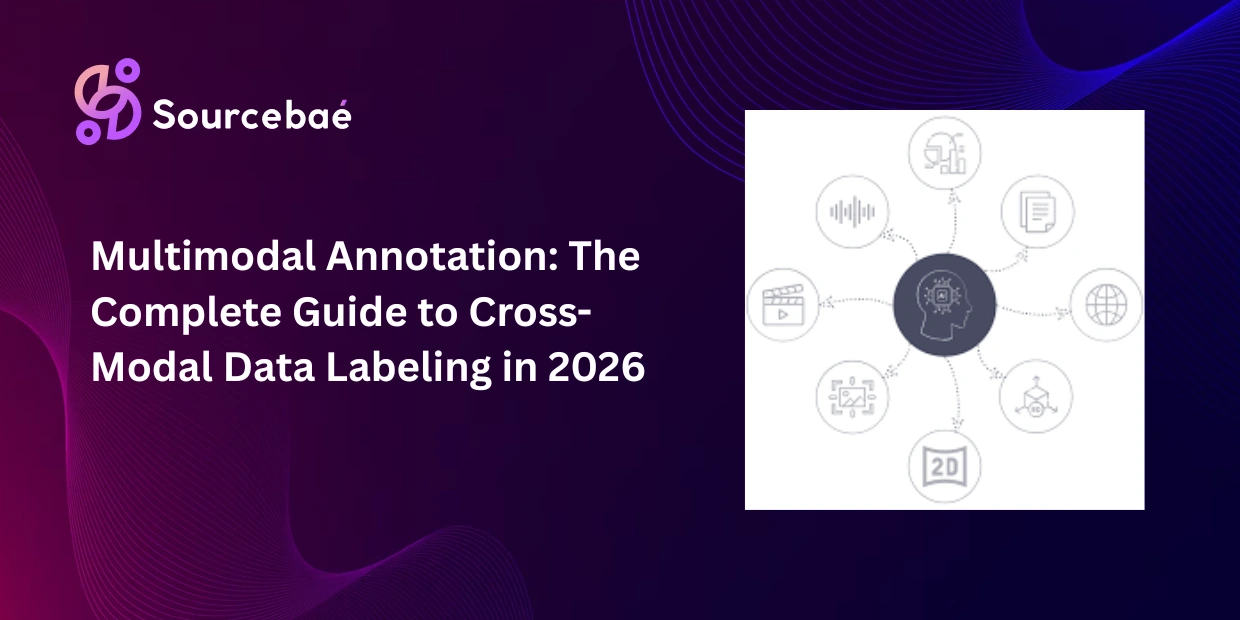

Multimodal annotation is the practice of labeling two or more data types text, image, audio, video, or sensor streams within a single, coordinated workflow so that the relationships between modalities are preserved for AI model training. In 2026, this discipline has moved from a niche concern to a foundational requirement: the data annotation tools market is valued at approximately $3.07 billion and is growing at a 32.27% CAGR, with multimodal data pipelines cited as one of the primary demand drivers (Mordor Intelligence, January 2026). As models like GPT-4o, Gemini, and open-source vision-language architectures process text, images, audio, and video simultaneously, the teams labeling their training data must operate with the same cross-modal fluency.
This post explains what makes annotation genuinely multimodal, walks through the alignment and synchronization challenges that distinguish it from single-modality labeling, and provides a practical framework for building unified annotation environments that maintain consistency across every data type your models consume.
What Makes Annotation “Multimodal”?
A common misconception conflates multimodal annotation with multi-format annotation. Labeling images in one tool, transcribing audio in another, and tagging text in a third is multi-format work it handles several data types, but each modality lives in its own silo. True multimodal data labeling goes further. It captures the relationships between modalities, not just the content within each one.
Consider an autonomous vehicle system. A single moment in time might involve a LiDAR point cloud showing an object at twelve meters, a camera frame showing a pedestrian at a crosswalk, an audio clip capturing a car horn, and a CAN-bus log recording a braking event. Annotating each of these independently produces four correctly labeled data points.
Annotating them multimodally produces one richly connected training example where the model learns that the pedestrian in the image corresponds to the cluster of points in the LiDAR scan, the horn blast coincides with the braking event, and all of these occur at the same timestamp.
That relational structure is what large multimodal models actually learn from. A vision-language model, for instance, does not simply learn what a dog looks like and what the word “dog” means separately. It learns the correspondence that this region of pixels and this span of text refer to the same concept.
Without annotation workflows that explicitly capture these cross-modal links, models develop what researchers call cross-modal hallucination: they generate text that conflicts with their visual input, or produce audio descriptions that misrepresent what is happening on screen. This failure mode traces directly back to weak or absent alignment in the training data, not to architectural flaws in the model.
The shift toward multimodal annotation reflects a broader industry reality. According to ICLR 2026 coverage, multimodal alignment has become one of the conference’s core themes, with researchers noting that creating aligned multimodal datasets is substantially more labor-intensive than assembling single-modality corpora because the cross-modal correspondences do not come for free they must be deliberately constructed through careful annotation.
Cross-Modal Alignment: The Core Challenge
Cross-modal annotation is the process of establishing explicit correspondences between elements in different modalities. It is also, by a wide margin, the hardest part of multimodal data labeling.
Why alignment is difficult
Each modality represents information differently. An image encodes spatial relationships in a pixel grid. Text encodes meaning in a sequence of tokens. Audio encodes temporal patterns in a waveform. Video combines spatial and temporal dimensions. When an annotator draws a bounding box around an object in a frame and then writes a caption describing that object, they are implicitly performing cross-modal alignment linking a spatial region to a linguistic description. The challenge is making that implicit link explicit, consistent, and verifiable at scale.
Alignment failures take several forms, each with distinct consequences for model behavior:
Incorrect pairing
It is the most straightforward failure. An image gets paired with a caption that describes a different image. A transcript gets linked to the wrong segment of video. The model learns a false correspondence.
Partial alignment
It is subtler and more common. A caption accurately describes some elements of an image but omits others. A transcript is textually correct but corresponds to a slightly different temporal window than the video it accompanies. The model learns an imprecise correspondence that degrades its reliability on edge cases.
Semantic drift
It occurs when annotation standards for different modalities evolve independently. If image annotators start using more granular categories (distinguishing “sedan” from “hatchback”) while text annotators continue using a coarser label (“car”), the cross-modal alignment degrades over time even though each modality’s labels are internally consistent.
Preventing these failures requires what the annotation industry now calls a unified ontology a single taxonomy that governs label definitions across every modality in the project. When the same entity appears in an image, a text transcript, and an audio clip, it should receive the same label, drawn from the same controlled vocabulary, regardless of which modality the annotator is working in. This principle sounds obvious, but implementing it across distributed teams labeling different data types on different timelines is one of the harder operational challenges in multimodal AI training data production.
For teams already familiar with single-modality approaches, the key mental shift is this: in multimodal annotation, the relationship between labels across modalities is itself a label that must be explicitly annotated, reviewed, and quality-checked. It is not a byproduct of getting each modality right individually. (For foundational context on building annotation taxonomies, see our guide to [annotation project design fundamentals Pillar Page].)
Temporal Synchronization: When Time Is a Modality
Temporal synchronization is a specific and particularly demanding form of cross-modal alignment that arises whenever video, audio, or sensor data is involved. A video is not a collection of independent frames. It is a sequence where the relationship between what happens at time T and what happens at time T+1 carries meaning that neither frame conveys alone.
The synchronization problem. Different sensors and data sources operate at different sampling rates and latencies. A camera might capture 30 frames per second. A LiDAR unit spins at 10 Hz. A microphone samples at 16,000 Hz. An inertial measurement unit (IMU) logs at 100 Hz. Aligning these streams so that an annotation placed at timestamp 14.327 seconds refers to the same real-world instant across all modalities is a non-trivial engineering and annotation challenge.
There are two layers to this problem:
Hardware-level synchronization
It uses shared clocks or protocols like Precision Time Protocol (PTP) to ensure that sensors record timestamps from the same reference. Some modern datasets, like OmniHD-Scenes and NTU4DRadLM, include hardware synchronization by default, making them a strong foundation for fusion-ready annotations. When hardware synchronization is not available which is common with legacy sensor rigs or when combining data from different collection sessions software-based alignment using timestamp interpolation, often aided by GPS or IMU signals, becomes necessary.
Annotation-level synchronization
It is the human side of the problem. Even when the underlying data streams are time-aligned, annotators must place temporal boundaries accurately. In action recognition, for example, an annotator must mark the exact frame where a “reaching” motion begins and the exact frame where it transitions into a “grasping” motion. If these boundaries are off by even a few frames, the model learns imprecise action dynamics that can cause failures in real-time applications.
The 2026 trend toward embodied AI and autonomous systems has intensified this challenge. In an autonomous cockpit scenario, the system must synchronize a driver’s voice command with their eye movement and the external road environment. Each of these data streams carries its own temporal granularity, and the annotation must capture not just what is happening in each stream but when each event occurs relative to events in the other streams.
Practical approaches to temporal annotation
It include key-frame-first workflows (annotate sparse key moments, then interpolate between them), audio-anchored alignment (use speech or sound events as temporal reference points that other modalities align to), and segment-level consensus (have multiple annotators independently mark temporal boundaries, then reconcile disagreements using inter-annotator agreement metrics). (For a deeper dive into video-specific temporal challenges, see our post on .)
Unified Annotation Environments: Moving Beyond Tool Silos
The operational backbone of multimodal annotation is the annotation environment the platform or workflow configuration where annotators actually interact with the data. Historically, most annotation tools were built for a single modality. Image tools offered bounding boxes and polygons. Text tools offered entity tagging and classification. Audio tools offered transcription and speaker diarization interfaces. Teams working on multimodal projects stitched these tools together, often losing cross-modal consistency in the gaps between systems.
In 2026, the industry has largely recognized that this stitched-together approach does not scale. A unified annotation environment is one where an annotator can view, label, and link data from multiple modalities within a single interface, governed by a shared ontology and a shared quality assurance (QA) pipeline. The practical requirements include:
Simultaneous multi-pane display
The annotator should be able to see an image (or video frame), its associated text (caption, transcript, or metadata), and its audio waveform in the same workspace. When they select a region in the image, the corresponding text and audio segments should be highlighted or navigable without switching tools.
Cross-modal linking primitives
The interface must support explicit link annotations for example, a “refers-to” relationship between a text span (“the red car”) and a bounding box in the image, or a “synchronized-with” relationship between an audio event (a spoken command) and a video segment (a gesture). These links are first-class annotation objects, not metadata afterthoughts.
Shared ontology enforcement
When an annotator labels an entity in one modality, the available label set should match the labels available in every other modality. If the taxonomy is updated a new entity class is added, or a label definition changes the update should propagate across all modalities simultaneously.
Unified version control
Changes to annotations in any modality should be tracked in a single versioning system. If an image annotation is revised, the linked text and audio annotations should be flagged for review, since a change in one modality’s labels may invalidate the cross-modal relationship.
This is not about a single tool doing everything; it is about the workflow enforcing consistency regardless of how many tools contribute to it. Some teams achieve this with a monolithic platform. Others build it by connecting specialized tools through shared APIs, a common data schema, and automated cross-modal validation scripts. The architecture matters less than the outcome: every annotated example should be internally consistent across every modality it spans.
(For teams already using modality-specific workflows, our posts on , [image annotation Post 3], and [3D point cloud annotation Post 11] cover the single-modality best practices that form the building blocks of a unified environment.)
Tools Supporting Multimodal Annotation Workflows
The tool landscape for multimodal data labeling has matured significantly. While no single platform handles every possible modality combination with equal depth, several categories of tooling have emerged to address different operational models.
Platform-first tools
It provide a single interface designed from the ground up for multi-modality support. These platforms typically handle image, video, text, audio, and sometimes 3D point cloud or document annotation within one workspace. They emphasize built-in QA workflows, shared ontologies, and native cross-modal linking. The tradeoff is that they may not match the depth of a specialized single-modality tool in every area.
Service-led providers
It combine annotation tooling with managed human workforces. For teams that need to scale multimodal annotation without building an internal annotator team, these providers handle recruitment, training, and QA. The key evaluation criteria here are whether the provider’s workforce has experience with cross-modal tasks (not just individual modalities) and whether their QA processes check cross-modal consistency, not just within-modality accuracy.
Hybrid approaches
It connect specialized tools through middleware, APIs, or common data formats. A team might use a best-in-class computer vision tool for image and video labeling, a specialized NLP tool for text annotation, and a custom script to generate and validate the cross-modal links between them. This approach offers maximum depth per modality but requires engineering investment to maintain consistency.
When evaluating any multimodal annotation tool or service, the most telling capability is not what modalities it supports but how it handles the relationships between modalities. Ask specifically: Can annotators create explicit cross-modal links? Does the QA pipeline verify those links, or does it only check each modality in isolation? Can the tool enforce a shared ontology across data types? Can it flag when a change in one modality’s annotation may have invalidated a related annotation in another modality?
(For context on how annotation tooling integrates with model-in-the-loop and active learning workflows, see our post on [AI-assisted pre-labeling Post 24]. For a broader view of how annotation quality connects to model alignment, see our discussion of [RLHF annotation Post 17].)
Quality Assurance Across Modalities
QA for multimodal annotation is fundamentally different from QA for single-modality work because there is an additional quality dimension that single-modality checks cannot detect: cross-modal consistency.
A standard QA pipeline might verify that bounding boxes are tight and correctly classified (image QA), that named entities are correctly tagged (text QA), or that transcriptions match the audio (audio QA). Each of these checks can pass with perfect scores while the multimodal dataset still contains critical alignment errors a correctly drawn bounding box linked to the wrong text entity, or a perfectly accurate transcript synchronized to the wrong video segment.
Multi-layered QA architecture.
Effective multimodal QA operates at three levels:
Within-modality
QA checks each data type against its own quality standards. Bounding box precision, text label accuracy, transcription word error rate, temporal boundary consistency for video these are the baseline checks, and they should be conducted using the same inter-annotator agreement (IAA) metrics your team already uses for single-modality work. (See our post on [annotation quality metrics Post 14] for IAA benchmarking methods.)
Cross-modal consistency
QA checks the relationships between modalities. Does the text caption accurately describe what the bounding box contains? Does the audio event occur within the temporal window of the corresponding video segment? Is the same entity labeled consistently across every modality in which it appears? These checks often require specialized review either by senior annotators trained in cross-modal evaluation or by automated validation scripts that flag mismatches for human review.
Holistic sample
QA evaluates entire multimodal examples as training units. A reviewer examines a complete data point — the image, its text, its audio, and all cross-modal links together. The goal is to assess whether the example would teach the model the correct relationships. This is the most expensive QA layer. However, it is also the most important for catching compound errors that slip through modality-specific and cross-modal checks.
Automated cross-modal validation
Several practical techniques can reduce the manual burden of cross-modal QA. Embedding-based consistency checks use pretrained multimodal models (like CLIP or ALIGN) to verify that an image and its paired text produce similar embeddings a large divergence suggests a potential alignment error. Temporal overlap checks automatically verify that linked audio and video annotations share overlapping timestamps. Ontology conformance checks scan all annotations across modalities to flag instances where the same entity received different labels in different modalities.
These automated techniques do not replace human review, but they efficiently surface the most likely errors for human attention. In a well-designed pipeline, automated checks handle the first pass, and human reviewers focus their time on the flagged examples and on holistic sample QA.
Common Multimodal Annotation Workflows by Use Case
Different applications demand different multimodal annotation configurations. Here is how the principles discussed above apply to three of the most common use cases in 2026:
Vision-language model training. The primary annotation task is establishing accurate correspondences between image regions and text descriptions. Annotators draw bounding boxes or segmentation masks on images and write or validate captions that describe the contents of each annotated region. Cross-modal QA focuses on caption fidelity does the text accurately and completely describe the visual content? Partial alignment (captions that describe some but not all elements) is the most common error mode. (See our posts on [image annotation Post 3] and [text annotation for NLP Post 8] for the single-modality techniques underlying this workflow.)
Autonomous systems and sensor fusion. Annotators work across LiDAR point clouds, camera frames, radar returns, and sometimes audio and IMU data. The core challenge is spatial and temporal alignment across sensors with different sampling rates, resolutions, and coordinate systems. Cross-modal QA must verify that a 3D bounding cuboid in the point cloud corresponds to the same object as a 2D bounding box in the camera frame, at the same timestamp. (For detailed coverage of sensor fusion annotation, see our post on [3D and point cloud annotation Post 11].)
Conversational AI and dialogue systems. Training data combines text transcripts, audio recordings, and sometimes video of the speaker. Annotators label intent and entities in the text. They also tag speaker identity and emotion in the audio, and gestures or expressions in the video. Cross-modal QA must verify that a spoken utterance labeled as “frustrated” matches the corresponding video and text segments. The video annotator should have marked a “frown” expression, and the text annotator should have tagged a complaint intent. (For the text side of this workflow, see our post on [dialogue and conversational annotation Post 18].)
Building a Multimodal Annotation Practice: Where to Start
For teams transitioning from single-modality to multimodal annotation, the shift is as much operational as it is technical. Here is a practical starting sequence:
Step 1: Audit your current modality coverage. Map the data types your models consume and the annotation workflows that produce their training data. Identify where modalities are currently labeled in isolation and where cross-modal relationships are implied but not explicitly annotated.
Step 2: Define your cross-modal ontology. Before selecting tools or designing workflows, establish a unified taxonomy that governs labels across all modalities. This is the single most impactful decision you will make. An inconsistent ontology cannot be fixed by better tooling.
Step 3: Start with the highest-value cross-modal link. Do not try to annotate every possible relationship between every modality simultaneously. Identify the one cross-modal correspondence that matters most for your model’s performance (e.g., image-text alignment for a VLM, or LiDAR-camera alignment for an autonomous system) and build your workflow around that link first.
Step 4: Implement cross-modal QA from day one. Do not add cross-modal consistency checks as an afterthought. Build them into your initial workflow. An early investment in cross-modal QA prevents the accumulation of alignment errors that become exponentially more expensive to fix at scale.
Step 5: Measure cross-modal IAA. Extend your inter-annotator agreement metrics to cover cross-modal relationships, not just within-modality labels. If two annotators produce different cross-modal links for the same data point, that disagreement signals an ambiguity in your guidelines that must be resolved before scaling.
Frequently Asked Questions
What is multimodal annotation?
Multimodal annotation is the process of labeling two or more data types within a coordinated workflow. These data types include text, images, audio, and video. The workflow captures the relationships between modalities, not just the content within each one. It produces training data for AI models that process multiple input types simultaneously.
How is multimodal annotation different from annotating each data type separately?
Single-modality annotation labels each data type in isolation. Multimodal annotation additionally captures the cross-modal correspondences which text describes which image region, which audio event corresponds to which video segment that multimodal models need to learn integrated representations.
Why is cross-modal alignment so important for multimodal AI training data?
Poor cross-modal alignment is the primary cause of cross-modal hallucination. This is when a model generates text that contradicts its visual input. It can also produce audio descriptions that misrepresent on-screen events. Alignment quality in the training data directly determines how reliably the model integrates information across modalities.
What is temporal synchronization in multimodal annotation?
Temporal synchronization ensures that annotations on time-based data streams refer to the same real-world instant across all modalities. These streams include video, audio, and sensor logs. Synchronization accounts for differences in sampling rates, latencies, and temporal granularity.
What tools support multimodal data labeling in 2026?
The market offers three categories of tools. Platform-first tools provide native multi-modality support in a single interface. Service-led providers pair annotation tooling with managed workforces experienced in cross-modal tasks. Hybrid approaches connect specialized single-modality tools through APIs and shared data schemas. The key differentiator is how well any tool handles cross-modal relationships, not just individual modality coverage.
How do you measure quality in multimodal annotation?
Effective QA operates at three levels. The first is within-modality checks, which apply standard per-data-type quality metrics. The second is cross-modal consistency checks, verifying alignment between modalities. The third is holistic sample reviews, evaluating complete multimodal examples as training units.
What is the biggest mistake teams make when starting multimodal annotation?
Treating it as parallel single-modality annotation. The most common failure is labeling each data type independently and assuming the cross-modal relationships will emerge automatically. They do not cross-modal links must be explicitly annotated, reviewed, and quality-checked.
How does the EU AI Act affect multimodal annotation workflows?
The EU AI Act’s Article 14 provisions for high-risk systems require effective human oversight. For multimodal AI systems, this has clear implications. Annotation workflows must produce documented, auditable training data with clear provenance across all modalities. This reinforces the need for unified environments with comprehensive version control and QA trails.