
AI-assisted annotation is a data labeling methodology that uses machine learning models throughout the process. These models generate initial labels, prioritize data points for human review, and verify annotation quality. Human annotators focus their expertise on the cases where it matters most. Rather than replacing human judgment, AI-assisted labeling restructures the annotation workflow. Humans correct and refine machine predictions instead of labeling from scratch.
In 2026, this approach has become the default for production annotation pipelines. Industry reporting shows that integrating AI agents into labeling workflows can cut manual effort by roughly 50%. It can also reduce annotation costs by up to 4× while maintaining high accuracy. LLM-assisted workflows in document annotation reduce annotation time by 40–70%.
This happens when humans verify low-confidence predictions and handle edge cases. Machine pre-annotation in clinical NER saves between 13.9% and 21.5% of annotation time. This holds true even in highly specialized medical domains. For teams processing large datasets, the ROI of AI-assisted pipelines is no longer debatable. The question is how to implement them effectively.
This post explains the three core techniques behind AI-assisted annotation. These are pre-labeling, active learning, and model-in-the-loop verification. It covers how foundation models like SAM power auto-segmentation. It also provides concrete cost and time benchmarks. Finally, it highlights where automation fails and human expertise remains irreplaceable.
What Is AI-Assisted Annotation?
The term AI-assisted annotation encompasses any annotation workflow where a machine learning model participates in the labeling process not as the sole labeler, but as an accelerator that amplifies human annotator productivity. The model handles the volume; the human handles the judgment.
This paradigm sits between fully manual and fully automated annotation. Manual annotation, humans label every data point from scratch. In automated annotation, a model generates all labels without human review. In practice, fully automated annotation rarely meets production quality standards. This is especially true for tasks involving ambiguity, subjectivity, or domain complexity. Fully manual annotation also falls short. It cannot scale economically for the dataset sizes that modern models require. AI-assisted labeling occupies the practical middle ground.
The shift toward AI-assisted workflows reflects a broader industry reorientation from “labeling everything” to “labeling strategically.” As one industry analysis framed it: the most effective setups treat domain experts and human-in-the-loop review as precision tools, not bulk labor. Automation handles the routine; humans handle the exceptions. (For the foundational principles of annotation workflow design, see our [comprehensive guide to data annotation Pillar Page].)
Three distinct techniques compose the AI-assisted annotation toolkit, and production pipelines typically combine all three.
Pre-Labeling with Model Predictions
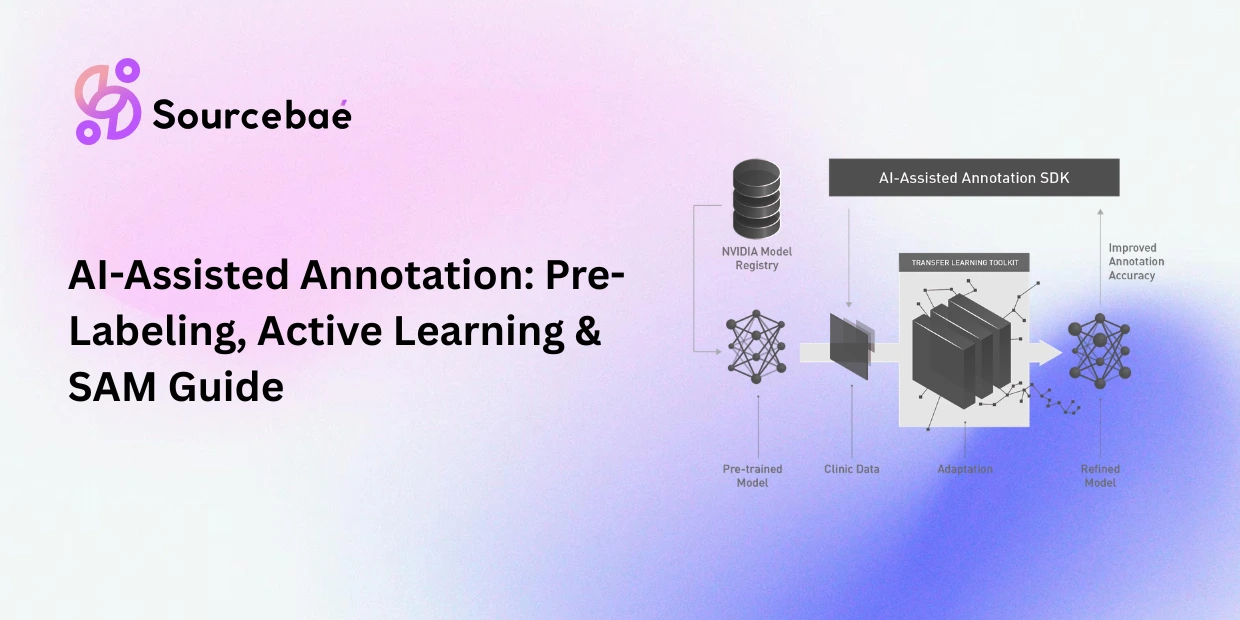
Pre-labeling (also called auto annotation or model-assisted labeling) is the most straightforward form of AI-assisted annotation. A trained model generates initial labels for unlabeled data, and human annotators then review, correct, and approve those predictions rather than creating labels from scratch.
How pre-labeling works
The workflow is simple. First, run a pretrained or task-specific model on the unlabeled dataset. Then, convert the model’s predictions into draft annotations like bounding boxes, segmentation masks, text labels, or entity tags. Load these drafts into the annotation tool alongside the raw data. Human annotators then correct inaccuracies and fill gaps. The annotator’s task shifts from creation to verification. Instead of drawing a bounding box around every car, they check whether the existing box is correct. They adjust it if needed and add any cars the model missed.
Why verification is faster than creation
The speed advantage is substantial because human cognitive effort for confirmation is lower than for generation. Recognizing that a bounding box is correctly placed takes less time than deciding where to place one. Recognizing that an entity tag is wrong and selecting the correct one takes less time than reading through text to find entities in the first place. This asymmetry means that pre-labeled annotation is consistently faster than from-scratch annotation, even when the pre-labeling model is only moderately accurate.
Model selection for pre-labeling
The pre-labeling model does not need to be the final production model. In many workflows, teams use a general-purpose pretrained model for initial pre-labels. Examples include YOLO for object detection, a BERT variant for NER, or an off-the-shelf sentiment classifier. This applies even if the final model will be a specialized architecture trained on the resulting dataset.
The pre-labeling model’s accuracy determines the correction effort. A model with 85% accuracy means annotators only need to fix roughly 15% of labels. A model with 60% accuracy means fixing 40%. The break-even point typically falls around 50–60% model accuracy for most annotation tasks. Beyond that threshold, pre-labeling saves time compared to from-scratch annotation.
Iterative pre-labeling
The most efficient pipelines run pre-labeling iteratively. The first batch of data is pre-labeled with a general model and human-corrected. Those corrected annotations are used to fine-tune the model. The improved model pre-labels the second batch with higher accuracy, requiring less human correction. Each cycle improves the model’s pre-labeling quality, progressively reducing human effort. (For how this iterative approach connects to programmatic labeling, see our post on [weak supervision Post 20].)
Active Learning Annotation: Labeling Only What Matters
Active learning annotation is a strategy in which the model identifies which unlabeled data points would be most valuable to annotate next, and human effort is directed exclusively to those high-value examples. Instead of labeling randomly or sequentially, the annotation process is guided by the model’s own uncertainty.
The active learning loop
The process follows a cycle. First, train an initial model on a small labeled dataset. Then, use the model to score all unlabeled data points by uncertainty or informativeness. Select the highest-scoring points — those the model is most confused about. Send those points to human annotators for labeling. Add the new labels to the training set and retrain the model. Repeat this cycle until performance targets are met or the annotation budget is exhausted.
Sampling strategies
The method used to select data points determines how efficiently the budget is spent. Uncertainty sampling selects points where the model’s confidence is lowest the examples closest to the decision boundary. Diversity sampling selects points that are maximally different from what the model has already seen, ensuring broad coverage of the data distribution. Query-by-committee uses an ensemble of models and selects points where the models disagree most. Dynamic strategies, like those studied in PMC research on clinical NER (2024), can switch between diversity-based and uncertainty-based selection as the annotation progresses starting with diversity to build broad coverage, then shifting to uncertainty to refine the decision boundary.
The cost impact
Active learning’s efficiency gains are well-documented: teams typically reach target accuracy with 30–70% fewer labels than random sampling. For a project that would otherwise require 10,000 labeled examples, active learning can achieve equivalent model performance with 3,000–7,000 examples. At typical annotation costs, this translates directly into substantial budget savings. (For the annotation quality metrics used to track model improvement during active learning cycles, see our post on [annotation quality and inter-annotator agreement Post 4].)
When to stop
Knowing when to end the active learning loop is as important as knowing how to run it. The practical signals include: model performance plateauing (adding more labeled data produces diminishing accuracy gains), overall uncertainty dropping below a threshold (the model is confident on most remaining unlabeled data), and budget exhaustion. A well-planned stopping criterion prevents over-labeling spending annotation budget on data points that no longer improve the model.
Model-in-the-Loop Verification
Model-in-the-loop annotation uses a trained model not to generate labels but to verify the quality of human-generated labels in real time. The model acts as an automated QA layer that flags potential annotation errors for review before they enter the training set.
How it works in practice
As a human annotator completes each label, the model immediately evaluates the annotation against its own prediction. If the human label and the model prediction agree, the annotation passes through. If they disagree, the annotation is flagged for review either by a senior annotator or by a second model check. The model does not override the human; it surfaces disagreements that may indicate either a human error or an edge case that deserves closer attention.
The two-way benefit
This architecture improves data quality in two directions. When the model catches a genuine human error (a mislabeled entity, a bounding box that drifts off the object boundary), it prevents that error from entering the training set. When the human correctly labels something the model gets wrong, the disagreement identifies an edge case that the model has not yet learned valuable information for model improvement. The disagreement log itself becomes a curated dataset of hard cases.
Confidence-calibrated routing
Advanced model-in-the-loop systems use the model’s confidence score to route annotations through different QA paths. High-agreement, high-confidence annotations are auto-accepted with minimal review overhead. High-disagreement or low-confidence annotations are escalated to senior reviewers or domain experts. This tiered approach allocates expensive expert review time to the cases that need it most, while routine confirmations pass through efficiently.
Integration with annotation platforms
Major annotation platforms in 2026 Encord, Labelbox, SuperAnnotate, Label Studio offer native model-in-the-loop capabilities, allowing teams to connect their own models via APIs and configure disagreement thresholds, escalation rules, and review workflows without custom engineering. (For how model-in-the-loop connects to the broader human-in-the-loop paradigm, see our post on [human-in-the-loop annotation Post 25].)
SAM and SAM 2 for Auto-Segmentation
The Segment Anything Model (SAM) family SAM, SAM 2, and SAM 3 has transformed the SAM annotation tool landscape by providing zero-shot segmentation that works on objects the model was never specifically trained to recognize.
What SAM provides
It accepts prompts points, bounding boxes, or rough masks and generates precise segmentation masks for the indicated object. SAM 2 extends this to video, using a streaming memory mechanism that tracks objects across frames in real time, processing approximately 44 frames per second. SAM 3, released by Meta in November 2025, introduces Promptable Concept Segmentation (PCS), which can segment all instances of a visual concept (like “every chair” or “every vehicle”) across images or video without per-instance prompting.
It as a pre-labeling engine
In annotation workflows, SAM serves as a powerful pre-labeling tool for segmentation tasks. Instead of manually tracing object boundaries pixel by pixel (the most time-consuming annotation task in computer vision), annotators place a single click or draw a rough bounding box, and SAM generates a precise mask. The annotator then corrects any errors in the mask adjusting boundaries, adding missed regions, removing false inclusions. This click-to-mask workflow has been reported to reduce segmentation annotation time by up to 90% on certain tasks compared to fully manual polygon drawing.
SAM 2 for video annotation
Video segmentation traditionally required annotating key frames and then manually verifying or correcting interpolated labels across intermediate frames. SAM 2’s memory-based tracking allows annotators to prompt the model on a single frame and have it automatically propagate the mask through subsequent frames, correcting for motion, deformation, and occlusion. Annotators review the tracked masks and intervene only where the model loses the object a dramatic reduction in per-frame effort.
Domain-specific adaptations
The SAM architecture has been adapted for specialized domains: Path-SAM2 combines SAM 2 with the UNI pathology encoder for medical slide annotation, while other variants address satellite imagery, industrial inspection, and RGB-thermal segmentation. These adaptations demonstrate that the foundation model provides the segmentation backbone, while domain-specific encoders and fine-tuning handle the specialized visual characteristics of each field. (For how SAM integrates into broader computer vision annotation pipelines, see our post on [annotation project management and scaling Post 6].)
SAM’s limitations
SAM’s auto-segmentation is not perfect. It struggles with fine structures (thin or intricate boundaries), camouflaged objects, and semantics (it can segment an object but does not inherently know what the object is). In fully automatic mode, SAM 2 can be overly aggressive in pruning low-confidence proposals, missing small or ambiguous objects. These limitations mean SAM accelerates annotation but does not eliminate the need for human review consistent with the AI-assisted paradigm.
Cost and Time Savings Benchmarks
The ROI of AI-assisted annotation is supported by converging evidence across industry and academic sources.
Pre-labeling benchmarks
Model-assisted labeling with human correction consistently delivers 40–70% time reduction compared to from-scratch annotation for well-suited tasks (object detection, text classification, entity recognition). One industry report found that integrating AI agents into labeling pipelines cut manual effort by approximately 50% and reduced costs by 4× while maintaining accuracy.
Active learning benchmarks
Active learning typically achieves target model performance with 30–70% fewer labeled examples than random sampling. A clinical NER study using dynamic active learning strategies on medical datasets demonstrated that switching from diversity-based to uncertainty-based sampling during the annotation process reduced annotation cost by significant margins while meeting target effectiveness levels.
Segmentation acceleration
SAM-based segmentation workflows reduce per-object annotation time from minutes (manual polygon drawing) to seconds (click-and-correct). For video annotation, SAM 2’s frame-to-frame tracking eliminates the need to annotate most intermediate frames, with annotators only correcting the 10–20% of frames where tracking fails.
Combined pipeline ROI
When pre-labeling, active learning, and model-in-the-loop verification are combined in a unified pipeline, the cumulative savings typically exceed 60%. A project that would cost $100,000 and take 8 weeks with fully manual annotation can often be completed for $30,000–$40,000 in 2–3 weeks with an AI-assisted pipeline while maintaining comparable or better label quality because the model-in-the-loop verification layer catches errors that manual-only QA processes miss.
Where savings are highest
The cost advantage is most dramatic for large-scale, repetitive tasks with well-defined label schemas (object detection in autonomous driving, document classification, product categorization). For small datasets (under 1,000 examples), the setup overhead of AI-assisted pipelines may not justify the investment. For highly specialized tasks (medical imaging, legal document review), the time savings from pre-labeling are real but the cost savings are partially offset by the higher per-hour rates of expert reviewers. (how LLM-based labeling functions fit into this pipeline, see our post on [LLM-as-annotator Post 21].)
When Automation Fails: Edge Cases and Human Judgment
AI-assisted annotation amplifies human capability, but it does not replace it. Understanding where automation breaks down is essential for designing pipelines that produce reliable training data.
Ambiguous boundaries
When the correct label is genuinely uncertain a partially occluded object that could be a pedestrian or a sign, a sentiment that is both positive and negative, a tissue region that may or may not be cancerous the pre-labeling model’s guess is no more reliable than a coin flip. These cases require human judgment informed by context, domain expertise, and annotation guidelines.
Novel categories and distribution shift
Pre-labeling models produce labels based on patterns in their training data. When the unlabeled data contains objects, categories, or patterns that the model has never seen, its pre-labels are unreliable or absent entirely. Active learning partially addresses this by surfacing unusual examples, but the initial labeling of truly novel data still requires human annotators working from guidelines rather than correcting model predictions.
Systematic model biases
If the pre-labeling model has learned biases from its own training data (under-detecting small objects, misclassifying certain demographic groups, over-labeling common classes at the expense of rare ones), those biases propagate into the pre-labels. Human annotators may correct individual instances but may not notice systematic patterns. Model-in-the-loop monitoring, combined with regular bias audits, is the safeguard.
Complex reasoning and subjectivity
Tasks that require multi-step reasoning, cultural context, ethical judgment, or subjective evaluation remain firmly in the human domain. Content moderation, creative quality assessment, and nuanced clinical interpretation are tasks where AI-assisted pre-labeling provides a starting point but human review cannot be reduced without compromising quality.
The operational principle is straightforward: use automation for volume, reserve human effort for judgment. The best AI-assisted pipelines are not the ones that minimize human involvement they are the ones that maximize the value of every minute a human annotator spends.
Frequently Asked Questions
What is AI-assisted annotation?
AI-assisted annotation is a labeling methodology where machine learning models generate initial labels, prioritize data for human review, and verify annotation quality with humans focusing on correction and judgment rather than labeling from scratch.
What is pre-labeling in machine learning?
Pre-labeling uses a trained model to generate draft annotations on unlabeled data. Human annotators then review and correct these predictions, which is consistently faster than creating labels from scratch typically reducing annotation time by 40–70%.
What is active learning annotation?
Active learning is an iterative strategy where the model identifies which unlabeled data points would be most valuable to annotate, directing human effort to the examples that will most improve model performance. It typically reaches target accuracy with 30–70% fewer labels.
What is model-in-the-loop annotation?
Model-in-the-loop annotation uses a trained model to verify human annotations in real time, flagging disagreements between the human label and the model’s prediction for review. It improves data quality by catching errors and identifying edge cases.
How does SAM help with annotation?
Meta’s Segment Anything Model (SAM) generates precise segmentation masks from minimal prompts (single clicks or bounding boxes), reducing segmentation annotation from manual polygon drawing (minutes per object) to click-and-correct workflows (seconds per object). SAM 2 extends this to video with memory-based object tracking.
How much does AI-assisted annotation save?
Combined pipelines using pre-labeling, active learning, and model-in-the-loop verification typically reduce annotation costs by 60%+ and timeline by 50–75% compared to fully manual workflows, while maintaining comparable or better label quality.
When should you not rely on auto annotation?
Automation is unreliable for ambiguous boundaries, novel categories, tasks requiring cultural context or ethical judgment, and domains with systematic model biases. These scenarios require human expertise that cannot be shortcut.