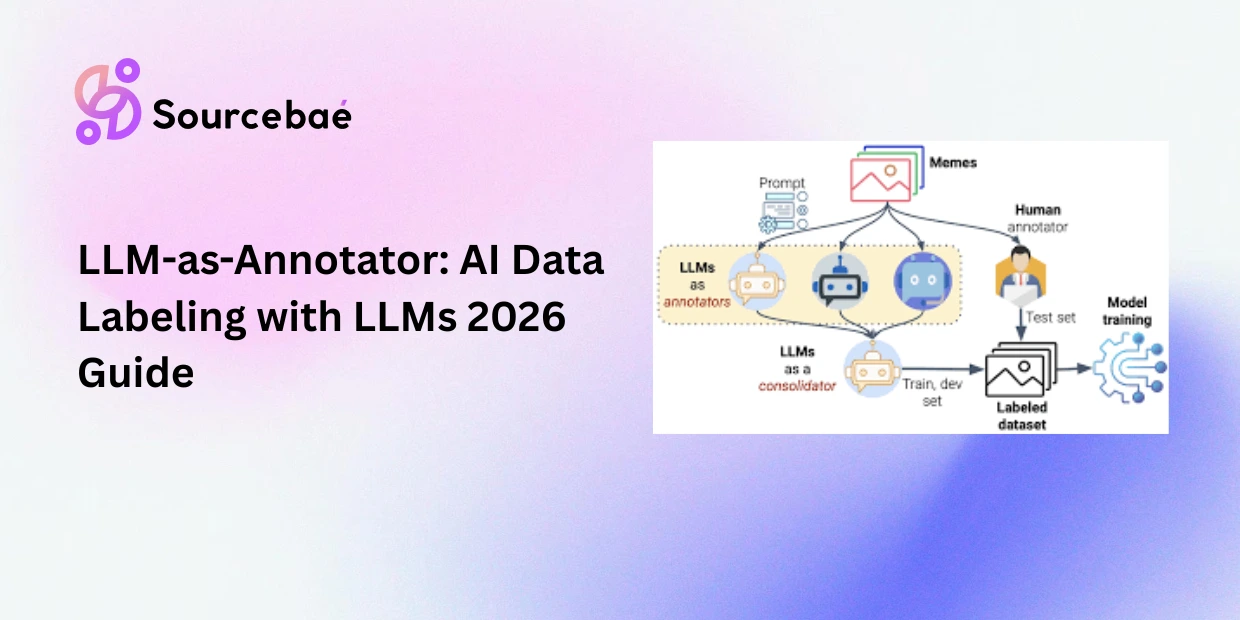

Using an LLM as an annotator means deploying a large language model GPT-4, Claude, Gemini, Llama, or similar to automatically assign labels to data by following natural language instructions, rather than requiring a human to examine and label each data point individually.
In 2026, this methodology has moved from experimental curiosity to mainstream practice: research published in Scientific Reports found that GPT-4 achieved 88.4% agreement with ground truth labels across multiple text classification datasets, compared to 86.2% for skilled human annotators, while costing roughly one-seventh as much and completing the work approximately twenty times faster. A separate CHI 2024 study found that GPT-4 annotation cost $122 for a task that required $4,508 in crowdsourced human labor.
These numbers are compelling, but they come with critical caveats. LLMs perform well on tasks with clear decision boundaries and explicit textual evidence, but research consistently shows they struggle with nuanced, subjective, or culturally dependent judgments precisely the categories where annotation quality matters most. The emerging consensus in the field, supported by studies from ACL 2025, Nature, and the Strategic Management Journal, is that LLM labeling vs human labeling is not an either-or choice. The most effective annotation strategies in 2026 treat LLMs as powerful but imperfect labeling partners within human-oversight pipelines.
This post explains how to use LLMs for data labeling across zero-shot and few-shot settings, covers multi-prompt voting strategies for improving reliability, maps out the architecture of human-LLM hybrid pipelines, and identifies the specific failure modes that make human review essential for production-quality AI generated labels.
What Is the LLM-as-Annotator Paradigm?
The LLM-as-annotator approach uses a large language model to perform data labeling tasks that were traditionally handled by human annotators. Instead of writing code-based labeling functions (as in programmatic weak supervision) or manually reviewing each data point (as in traditional annotation), the practitioner writes a natural language prompt that describes the labeling task and passes data points through the model’s API.
The model reads the prompt, examines the data point, and returns a label a classification, a sentiment score, an entity tag, a relevance judgment, or any other structured annotation that the prompt specifies. The fundamental appeal is clear: a well-crafted prompt can encode annotation guidelines in a form the model can apply at scale, without per-item human labor.
This paradigm sits at the intersection of two trends that define 2026’s annotation landscape. The first is the shift toward data-centric AI, where model performance improvements come from better training data rather than better architectures. The second is the maturation of foundation models themselves LLMs have become reliable enough on many tasks that their outputs can serve as training data for smaller, cheaper production models. This workflow, known as knowledge distillation through labeling, allows teams to leverage a frontier model’s capability to generate labeled datasets, then train a specialized model that runs at a fraction of the inference cost.
The connection to weak supervision is direct: an LLM generating labels from a prompt is functionally a labeling function in the programmatic weak supervision framework. It produces noisy but scalable labels that can be aggregated, denoised, and combined with other signal sources. Teams increasingly treat LLM outputs as one labeling function among many alongside heuristic rules, pretrained model outputs, and knowledge base lookups within a unified label model that produces the final training labels. (For the full programmatic weak supervision framework, see our post on [weak supervision and programmatic labeling Post 20].)
Zero-Shot Annotation: Labeling Without Examples
Zero-shot annotation is the simplest form of automated annotation with LLM. The model receives a prompt describing the task and the label schema, then classifies data points without ever seeing labeled examples. The prompt alone its clarity, specificity, and structure determines performance.
How it works in practice
A zero-shot prompt for sentiment classification might read: “You are a data annotator. Classify the following customer review as POSITIVE, NEGATIVE, or NEUTRAL. Return only the label, nothing else.” The model applies its pretrained knowledge of language, sentiment, and context to produce a classification.
When zero-shot works well
Tasks where the label categories map closely to concepts the model already understands are natural candidates. Sentiment analysis, topic classification, language identification, spam detection, and simple entity recognition often achieve strong zero-shot performance. These tasks align with patterns the model encountered extensively during pretraining. Research comparing LLMs with human annotators in latent content analysis supports this. GPT-4 achieved internal consistency scores (Krippendorff’s alpha of 0.95) matching human reliability levels for sentiment evaluation in zero-shot settings.
When zero-shot falls short
Domain-specific tasks, fine-grained taxonomies, and labels that require specialized knowledge degrade zero-shot performance quickly. Your label schema may distinguish between “Contractual Obligation” and “Regulatory Compliance” in legal documents. Without examples that demonstrate the boundary, the model may apply those labels inconsistently. Research in political science annotation found that LLM choice and prompt formulation can significantly alter downstream findings. This is especially true when performing latent or implicit classification tasks. Zero-shot outputs should be validated carefully before being trusted.
Prompt engineering as annotation design
In zero-shot settings, the prompt is equivalent to annotation guidelines. The same principles that make human annotation guidelines effective also make LLM prompts effective. These include clear definitions, explicit boundary conditions, and unambiguous label descriptions. Teams that invest in structured prompt development produce more reliable zero-shot labels. This means documenting design choices and testing multiple variations. The Strategic Management Journal emphasized this in a 2026 methodological paper. Researchers should develop families of related prompts rather than seeking a single optimal formulation. Systematic variation helps reveal which aspects of prompt construction most affect output quality.
Few-Shot Annotation: Learning from Examples
Few-shot annotation extends the prompt with a small set of labeled examples, typically 3 to 20. These examples demonstrate the desired labeling behavior. The model uses them as in-context demonstrations. It learns the pattern from the examples and applies it to new data points.
Why few-shot improves quality
Examples communicate information that definitions alone cannot. They show the model how to handle edge cases. They clarify where label boundaries fall in ambiguous territory. It also demonstrate what level of granularity the task requires. In the ACL 2025 Alternative Annotator Test study, few-shot prompting improved LLM-human alignment across multiple annotation tasks. It outperformed zero-shot baselines consistently.
Selecting effective examples
The examples included in a few-shot prompt have an outsized impact on output quality. Effective example selection follows several principles. First, examples should be representative of the data distribution if 70% of your data is straightforward and 30% is ambiguous, your examples should include both easy and hard cases. Second, examples should cover every label class, including rare classes that the model might otherwise underpredict. Third, examples should demonstrate boundary cases explicitly the data points where two labels are closest in meaning, which is where the model is most likely to make errors.
The calibration trade-off
More examples generally improve performance. However, each example consumes tokens from the model’s context window. This increases per-call cost and reduces the space available for the data point being labeled. Most practical deployments find that 5–10 carefully selected examples provide the best balance between quality and token efficiency. Beyond 15–20 examples, the marginal quality gain typically flattens.
Few-shot as a bridge to fine-tuning
For teams that need GPT data annotation at the highest possible quality, few-shot labeling can serve as a stepping stone to supervised fine-tuning. The workflow starts with using few-shot prompting to generate an initial labeled dataset. A sample is then human-reviewed for quality. Finally, a smaller model is fine-tuned on the validated labels. This fine-tuned model can often match or exceed the few-shot frontier model’s labeling quality at dramatically lower inference cost.
Multi-Prompt Voting and Self-Consistency
One of the most effective strategies for improving LLM-generated label reliability is to ask the same question multiple ways. The answers are then aggregated. This approach is known as multi-prompt voting or self-consistency checking. It directly addresses a core weakness of LLM annotation: sensitivity to prompt formulation.
The problem
Research has consistently demonstrated that small changes in prompt wording can meaningfully shift the model’s output distribution. These changes include rephrasing a question, reordering instructions, or changing the label order in a multiple-choice format. A model that classifies a review as “negative” under one prompt may classify the identical review as “neutral” under a slightly different one. This sensitivity means that any single prompt provides only one noisy “vote” on the correct label.
The solution: ensemble across prompts
Multi-prompt voting works by designing 3–5 semantically equivalent prompts for the same task. Each data point is then run through all of them. The final label is determined by majority vote, weighted vote, or probabilistic aggregation. In weighted voting, prompts with historically higher accuracy get more weight. Data points where all prompts agree are labeled with high confidence. Data points where prompts disagree are flagged as uncertain candidates for human review.
Self-consistency extends this logic
Rather than varying the prompt, self-consistency sampling generates multiple responses from the same prompt by sampling with a non-zero temperature setting. If the model produces the same label across, say, five independent samples, confidence is high. If the samples split across multiple labels, the data point is uncertain. This approach requires no additional prompt engineering only multiple API calls and provides a direct confidence signal.
Connection to weak supervision
Multi-prompt voting is structurally identical to the labeling-function-plus-label-model architecture from programmatic weak supervision. Each prompt variant is a labeling function. The voting or aggregation step is a label model. Teams already using weak supervision infrastructure can slot LLM prompt variants directly into their existing pipeline alongside heuristic and model-based labeling functions. (See our post on [weak supervision Post 20] for the full label model aggregation framework.)
Human-LLM Hybrid Pipelines: The Operational Architecture
The most robust ChatGPT for data annotation workflows (and LLM annotation workflows more broadly) are not fully automated. They are hybrid architectures where LLMs handle the volume and humans handle the judgment.
The standard hybrid architecture has four layers:
Layer 1: LLM pre-labeling
The LLM generates an initial label for every data point in the dataset, along with a confidence signal (from self-consistency scoring, logit probabilities, or multi-prompt agreement). This layer produces labels for the full dataset in hours rather than weeks.
Layer 2: Confidence-based routing
The pipeline splits data points into two streams based on the LLM’s confidence. High-confidence items (where the model remains consistent across prompts or samples and the task is straightforward) pass through as labeled. Low-confidence items (where the model disagrees with itself, the task is ambiguous, or the data point is unusual) route to human reviewers.
Layer 3: Human review and correction
Human annotators examine the routed data points and either confirm the LLM’s label or correct it. This step accomplishes two things: it produces high-quality labels for the hardest cases, and it generates a gold-standard dataset that can be used to calibrate the LLM’s performance and identify systematic biases.
Layer 4: Feedback and iteration
The human-corrected labels feed back into the pipeline. They improve prompt design by revealing error patterns. They refine confidence thresholds by calibrating which confidence levels correspond to which accuracy levels. It also accumulate a growing validation set that makes each subsequent iteration more reliable.
Research supports this architecture’s effectiveness. A published study in BMC Medical Research Methodology (2025) demonstrated the value of human-LLM collaborative annotation. The LLM performed initial screening and humans verified positive cases. This balanced efficiency and accuracy in a way that neither approach achieved alone. LLM-assisted workflows in document annotation reduce annotation time by 40–70%. Quality is maintained when humans verify low-confidence predictions.
The economic logic is straightforward. Let the LLM label the 70–80% of data points where it is confident and accurate. Invest human time exclusively in the 20–30% where human judgment adds genuine value. One emerging approach, RL from Targeted Human Feedback (RLTHF), supports this model. It achieved the same alignment quality as full human labeling while requiring human annotation on only approximately 6% of the data.
Provenance Tracking and Audit Trails
As LLM-generated annotations enter production training pipelines, provenance the documented record of how each label was produced becomes a critical operational and regulatory requirement.
Why provenance matters. When a model makes an error in production, teams need to trace backward from the prediction to the training data to the labeling process. For human-annotated labels, the trail is clear. Annotator #47 applied label X to data point Y on date Z, using guideline version 3.2. For LLM-generated labels, the equivalent trail must include more detail. It should record the model used (including version or checkpoint) and the prompt text (including any examples). The raw model output before post-processing and the confidence score are also essential. Finally, it must note whether the label was accepted automatically or reviewed by a human, and the reviewer’s decision.
Regulatory drivers. The EU AI Act’s Article 14 provisions for high-risk systems require teams to design AI systems for effective human oversight. For training data produced with LLM assistance, this means maintaining demonstrable records that show which labels humans generated, which the LLM generated, and which the LLM generated before a human verified them. Teams that cannot produce these records face compliance risk.
Practical implementation. Every label in the pipeline should carry a metadata object recording its provenance. This is not just good practice it is the mechanism that enables continuous improvement. When you discover that a specific prompt variant produces systematically biased labels on a certain category, you need to identify and re-examine every label produced by that variant. Without provenance tracking, this is impossible.
Cost Comparison: LLM Annotation vs. Manual Annotation
The cost economics of using LLM for data labeling are dramatic, but the comparison requires nuance.
Direct per-label costs. Human annotation for text classification typically ranges from $0.03 to $1.00 per label depending on complexity. Specialized domains like medical, legal, and financial sit at the higher end. Simple classification tasks fall at the lower end. LLM API costs for the same task range from fractions of a cent (for smaller models) to a few cents (for frontier models like GPT-4). The CHI 2024 study found a direct cost ratio of roughly 37:1. That is $4,508 for crowdsourced human annotation vs. $122 for GPT-4 on the same task.
Hidden costs of LLM annotation. The per-label comparison understates the true cost of LLM pipelines. It omits prompt engineering time, which typically takes hours to days for a new task. API costs for multi-prompt voting and self-consistency multiply the base per-label cost by 3–5×. Human review costs for the low-confidence subset can cover 20–30% of the dataset. Infrastructure costs for provenance tracking and pipeline management add further overhead.
Hidden costs of manual annotation. Similarly, the per-label cost of human annotation understates the true cost of traditional pipelines. It omits annotator recruitment and training. Quality assurance overhead, typically 15–25% of annotation cost, is also excluded. Other hidden costs include guideline development and iteration, and project management for distributed annotation teams.
The honest comparison. For straightforward text classification tasks at scale (10,000+ data points), LLM-based pipelines with human review typically cost 5–10× less than fully manual pipelines. They also complete 10–20× faster. For complex, specialized, or subjective tasks, the cost advantage narrows. The human review fraction increases and prompt engineering becomes more intensive. For small datasets (under 1,000 data points), the upfront prompt engineering cost can make LLM pipelines comparable to or more expensive than direct manual annotation.
When LLMs Fail as Annotators
Understanding where LLMs break down as annotators is essential for designing pipelines that produce trustworthy AI generated labels.
Implicit and latent concepts
LLMs excel at tasks where the labeling decision depends on explicit textual evidence keywords, phrases, stated facts. They struggle when the decision requires inferring latent meaning, reading between the lines, or interpreting unstated cultural context. A political science annotation study found that LLMs performed well on detecting explicit sentiment but poorly on identifying implicit political criticism the kind of nuanced judgment that depends on understanding what is not said as much as what is.
Subjective and culturally dependent labels
Labels that depend on cultural norms, regional context, or subjective interpretation are unreliable when produced by LLMs. Sarcasm detection is a particularly well-documented failure mode. Human annotators achieved only a 0.25 Krippendorff’s alpha on sarcasm detection, reflecting the task’s inherent difficulty. LLMs did not meaningfully improve on this. Content moderation for culturally specific toxicity similarly resists automated annotation. A phrase might be offensive in one dialect but entirely benign in another.
Label schema sensitivity
LLMs are sensitive to how labels are presented in the prompt. Changing the order of options in a multiple-choice classification can shift the model’s label distribution. The same applies to rephrasing label definitions or altering the expected output format. This means LLM annotation outputs can be artifacts of prompt design as much as reflections of the data. This is especially true for ambiguous cases.
Overconfidence and calibration
LLMs tend to produce confident-sounding outputs even when uncertain. A model that returns “NEGATIVE” without hedging may be genuinely confident. It may also simply be generating the most likely next token in a sequence. Without explicit confidence estimation, there is no reliable way to distinguish high-quality labels from hallucinated ones. Confidence estimation methods include logit probabilities, self-consistency, or multi-prompt disagreement.
Temporal and knowledge cutoff effects
LLMs’ training data has a cutoff date. Labels that depend on current events, recent terminology, or evolving norms may be incorrect or outdated. More subtly, model updates can shift labeling behavior. A study in Scientific Reports found that GPT-3.5-turbo’s consistency across different time periods was lower than its within-period consistency. This suggests that model updates introduce labeling drift.
Domain expertise gaps
For tasks requiring specialized knowledge medical coding, financial regulation classification, legal clause analysis LLMs may produce labels that are plausible-sounding but technically incorrect. Domain experts can identify errors that the model’s general knowledge cannot detect. (For more on human-in-the-loop approaches that address these gaps, see our post on [AI-assisted pre-labeling and active learning Post 24]. For how LLM annotation connects to model alignment, see our post on [RLHF annotation Post 17].)
Getting Started: A Practical Implementation Framework
Step 1: Define the task and validate feasibility. Before committing to LLM annotation, test whether the task is LLM-suitable. Run a small pilot (50–100 examples) with zero-shot prompting and manually evaluate the output against gold-standard labels. If zero-shot accuracy exceeds 75%, the task is a strong LLM candidate. If it falls below 60%, the task likely requires heavy human involvement.
Step 2: Engineer and test prompts systematically. Develop 3–5 prompt variants and test each on a labeled validation set. Document every prompt version, its performance metrics, and the rationale for design choices. Select the best-performing variant(s) for production.
Step 3: Build confidence estimation. Implement multi-prompt voting or self-consistency sampling to produce a confidence score for each label. Calibrate confidence thresholds against your validation set determine what confidence level corresponds to what accuracy level for your specific task and data.
Step 4: Design the human review pipeline. Route low-confidence data points to human reviewers. Define clear escalation criteria, review interfaces, and feedback mechanisms. Ensure that human corrections are captured with full provenance metadata.
Step 5: Deploy with monitoring. Track label distribution, confidence scores, and human override rates over time. A sudden increase in human overrides or a shift in label distribution may signal prompt degradation, data drift, or model behavior changes that require pipeline adjustment.
Frequently Asked Questions
What is the LLM-as-annotator approach?
LLM-as-annotator uses large language models to assign labels to data by following natural language prompt instructions. It replaces or supplements traditional human annotation for tasks like text classification, entity recognition, and sentiment analysis.
How does zero-shot annotation with LLMs work?
The model receives a prompt describing the labeling task and label schema, then classifies data points using only its pretrained knowledge without seeing any labeled examples. Performance depends entirely on prompt quality and the task’s alignment with the model’s training.
What is the difference between LLM labeling and human labeling?
LLMs are faster (10–20×) and cheaper (5–10× in hybrid pipelines). However, they produce noisier labels, especially on subjective, culturally dependent, or domain-specific tasks. Humans are slower and more expensive but provide nuanced judgment. The most effective approach combines both.
Can ChatGPT or GPT-4 be used for data annotation?
Yes. GPT-4 achieved 88.4% agreement with ground truth across multiple text classification benchmarks, exceeding skilled crowd worker performance (86.2%). However, human review remains essential for edge cases, implicit reasoning, and domain-specific tasks.
What is multi-prompt voting for LLM annotation?
Multi-prompt voting runs each data point through 3–5 semantically equivalent prompt variants and aggregates the results. Data points where all prompts agree are labeled with high confidence; disagreements flag uncertainty and trigger human review.
How much cheaper is LLM annotation than manual annotation?
Direct per-label costs can be 7–37× lower for LLMs. Full pipeline costs include prompt engineering, multi-prompt voting, and human review of low-confidence items. These typically land at 5–10× lower for well-suited text classification tasks at scale.
When should you not use LLMs as annotators?
Avoid LLM-only annotation for tasks requiring cultural nuance, implicit reasoning, specialized domain expertise, or subjective judgment. Also avoid it when label precision requirements are extremely high (safety-critical applications) or when your task involves concepts the model was not trained on.
What is provenance tracking in LLM annotation?
Provenance tracking records how each label was produced. This includes the model version, prompt text, raw output, and confidence score. It also records whether the label was accepted automatically or reviewed by a human. This tracking is essential for debugging, compliance, and continuous improvement.