
Weak supervision is a machine learning paradigm that uses noisy, imprecise, or programmatically generated labels. These labels replace or drastically reduce the need for hand-annotated training data. Rather than having human annotators manually label every data point, teams write labeling functions. These are small programs that encode heuristics, patterns, knowledge bases, or pretrained model outputs to assign labels at scale.
A label model then aggregates the overlapping, conflicting outputs of these functions into a single probabilistic training label per data point. The result is a training set produced in hours or days instead of weeks or months, at a fraction of the cost.
This approach was pioneered by the Snorkel project at Stanford. It is now deployed across enterprises from healthcare to financial services. What began as an academic curiosity has evolved into a core component of modern annotation strategy. In 2026, the data annotation tools market is valued at approximately $3.07 billion and growing at over 32% CAGR (Mordor Intelligence). These economics are forcing teams to reconsider how they produce training data.
Weak supervision offers a fundamentally different operating model one where domain expertise is encoded in reusable programs rather than consumed in one-off labeling sessions.
This post explains how weak supervision works, from labeling functions through label model aggregation to end-model training. It maps the evolution from manual annotation to programmatic labeling to LLM-powered approaches, clarifies the often-confused boundary between weak supervision and semi-supervised learning, and provides a practical framework for building hybrid pipelines that combine programmatic and manual methods.
What Is Weak Supervision?
At its core, weak supervision in machine learning addresses a simple economic problem: high-quality labeled data is the primary bottleneck in deploying AI systems, but producing it through manual annotation is slow, expensive, and does not scale with the speed at which modern models need to iterate. The Snorkel research team at Stanford found that subject matter experts using labeling functions built models 2.8× faster and improved predictive performance by an average of 45.5% compared to seven hours of hand labeling.
In a traditional supervised learning workflow, every training example requires a human annotator to examine the data point and assign a label. This process is expensive because it consumes expert time, static because the labels do not update when task requirements change, and fragile because it cannot easily adapt to new domains or label schemas without starting over.
Weak supervision inverts this workflow. Instead of asking experts to label individual data points, it asks them to express their knowledge as programs specifically, as labeling functions. These functions encode the rules, heuristics, and domain knowledge that experts already carry in their heads. The functions are then applied across the entire unlabeled dataset to produce noisy but scalable labels. Because the functions are programs, they can be versioned, tested, debugged, shared, and rerun whenever the data or task changes.
The term “weak” does not mean “bad.” It means that the individual supervision sources are noisy any single labeling function will make mistakes, cover only a subset of the data, or conflict with other functions. The power of the approach comes from combining many weak sources intelligently, using statistical models that learn which sources to trust, when, and by how much. This denoising step is what separates weak supervision from a simple rule-based classifier. (For foundational context on how annotation produces training data, see our [comprehensive guide to data annotation Pillar Page].)
Labeling Functions: The Building Blocks of Programmatic Annotation
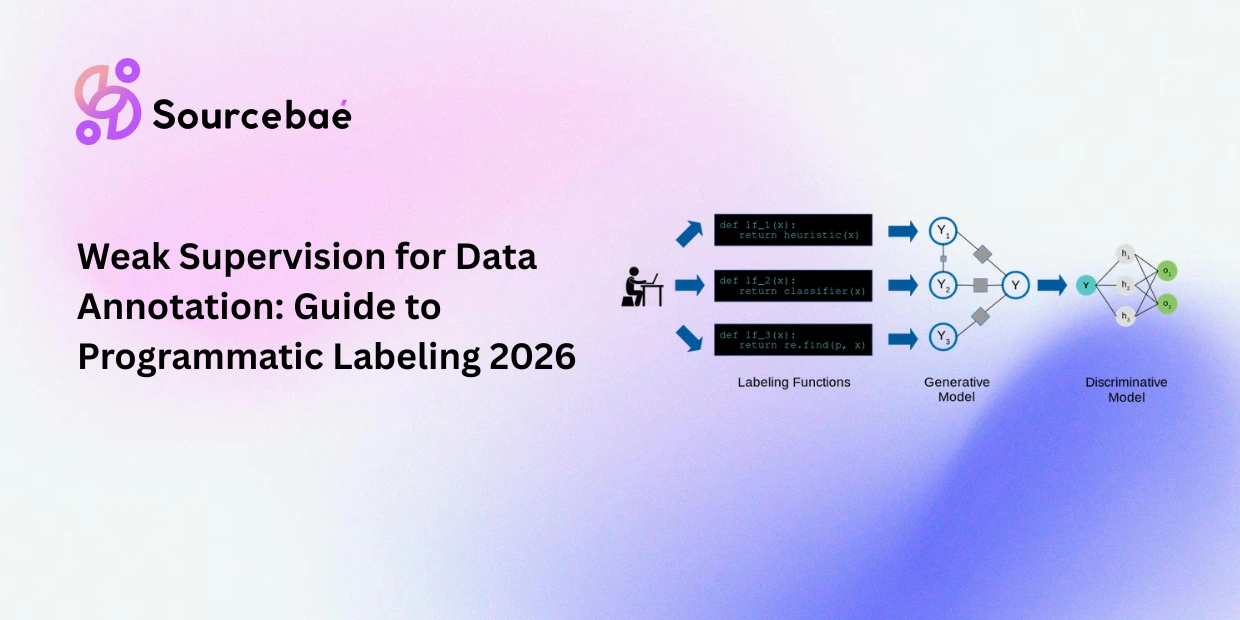
A labeling function is a small program typically a Python function that takes a data point as input and either assigns a label or abstains (returns nothing). Labeling functions are the atomic unit of programmatic labeling, and understanding how to write effective ones is the core skill that distinguishes a productive weak supervision workflow from a frustrating one.
Labeling functions draw on several categories of supervision signal:
Pattern-based heuristics
are the simplest form. A labeling function might check whether a customer review contains the word “terrible” and assign a negative sentiment label, or whether an email subject line contains “invoice” and classify it as a billing inquiry. These functions are narrow they only fire on data points matching the pattern but when they fire, they tend to be accurate.
Knowledge base lookups
use external structured data as a supervision source. A labeling function might check whether an entity mentioned in a text appears in a medical ontology and, if so, label the text as health-related. A product classification function might look up a UPC code in a catalog database.
Pretrained model outputs
use the predictions of an existing model as a labeling signal. A sentiment classifier trained on one domain can serve as a labeling function for a related domain. An object detection model can provide bounding box labels that are “good enough” for a downstream task, even if they are not perfect.
Distant supervision
leverages aligned external datasets. If a knowledge graph records that two entities are related, any sentence mentioning both entities can be heuristically labeled as expressing that relationship. This was one of the earliest forms of weak supervision, used heavily in relation extraction.
Domain expert rules
encode specific expert knowledge. A cardiologist might write a function that labels ECG patterns based on waveform characteristics. A fraud analyst might write a function that flags transactions matching known suspicious patterns. These functions operationalize the tacit knowledge that would otherwise only exist in an expert’s head.
The critical insight about labeling functions is that each individual function does not need to be comprehensive or even highly accurate. A function that achieves 80% accuracy but only covers 15% of the data is perfectly useful in a weak supervision pipeline, as long as other functions cover different subsets with different error patterns. The system derives its power from the diversity and complementarity of its labeling functions, not from the perfection of any single one. In practice, effective weak supervision pipelines use anywhere from a handful to several dozen labeling functions, with most projects finding a sweet spot between 10 and 30. (For more on how domain expertise shapes annotation design, see our post on [annotation quality and guidelines Post 4].)
Label Model Aggregation: From Noisy Votes to Probabilistic Labels
The core technical challenge in programmatic weak supervision is this: given a set of labeling functions that overlap, conflict, and abstain in complex patterns, how do you produce a single reliable label for each data point?
The answer is the label model a statistical model that learns the accuracy and correlation structure of the labeling functions without access to ground truth labels. This is the mathematical heart of the Snorkel paradigm, and it is what elevates weak supervision from “just a bunch of rules” to a principled machine learning methodology.
How the label model works
Each labeling function can be thought of as a noisy voter. For any given data point, some functions will vote for one class, others for another, and many will abstain. The label model observes these voting patterns across the entire dataset and infers two things. First, how accurate each labeling function is, both globally and conditional on different data subsets. Second, how the labeling functions correlate with each other. Two functions that always agree might be drawing on the same signal, so their votes should not be double-counted.
The mathematical machinery behind this inference is a generative probabilistic model. In Snorkel’s original formulation, this is a factor graph that models the relationships between the true (unobserved) labels and the observed labeling function outputs. The model learns these relationships using maximum likelihood estimation over the labeling function agreement and disagreement patterns crucially, without ever seeing the ground truth labels. Once trained, the label model outputs a probabilistic label for each data point: not just “positive” or “negative,” but a calibrated probability, like “82% positive.”
Why probabilistic labels matter
These probabilistic labels are far more useful than hard labels because they carry uncertainty information. A data point labeled 51% positive and 49% negative is one the system is uncertain about a downstream model can weight it accordingly, or it can be routed to a human reviewer. A data point labeled 99% positive is one the system is confident about. This uncertainty-aware labeling is one of the key advantages of weak supervision over manual annotation, where every label looks equally confident regardless of the annotator’s actual certainty.
From label model to end model
The probabilistic labels produced by the label model are used to train a discriminative end model this can be any standard ML model (logistic regression, BERT, a convolutional network). The end model learns to generalize beyond the specific patterns captured by the labeling functions, using the richer feature space available in the raw data. In Snorkel’s user studies, the end model consistently outperformed the labeling functions alone because it could capture patterns that no individual function encoded.
Recent advances have improved this pipeline. Confident Programmatic Weak Supervision (CPWS), published in ACM Transactions on Information Systems in 2025, introduced a Dual Evaluation Mechanism that explicitly evaluates the quality of both labeling functions and individual data points, pruning low-quality items before aggregation to produce cleaner training sets. The FABLE framework (2023) incorporated instance features into the label model itself, using Gaussian Process classifiers to adjust aggregation based on the characteristics of each data point, rather than treating all data points identically.
Snorkel and the Programmatic Weak Supervision Paradigm
The Snorkel project, which originated at the Stanford AI Lab and later became Snorkel AI (the company), established programmatic weak supervision as a recognized paradigm in data-centric AI. Understanding Snorkel’s architecture provides a blueprint for how any team can implement weak supervision.
The Snorkel pipeline has three stages:
Stage 1: Writing labeling functions
Subject matter experts and data scientists write labeling functions in Python that encode their domain knowledge. Snorkel provides a library of primitives and decorators that simplify common patterns (keyword matching, regex, entity recognition, etc.). The functions are applied to the unlabeled dataset to produce a matrix of noisy labels one row per data point, one column per labeling function, with abstains represented as a special value.
Stage 2: Label model training
The label model takes this matrix and learns the accuracy and correlation structure of the labeling functions. It outputs a probabilistic label for each data point. Snorkel Flow (the enterprise platform) includes multiple label model variants optimized for different problem types.
Stage 3: Discriminative model training
The probabilistic labels are used to train a downstream model on the full feature space of the data. This model generalizes beyond the labeling functions’ coverage and achieves performance that, in many published deployments, comes within a few percentage points of models trained on large hand-curated datasets.
Snorkel’s design rests on three principles that remain relevant to any team adopting weak supervision. First, bring all sources to bear the system should enable opportunistic use of every available supervision signal. Second, training data is the interface to machine learning the system should produce a single, probabilistic label per data point and let any standard classifier consume it. Third, supervision should feel like interactive programming the cycle of writing a function, seeing its coverage and accuracy, and iterating should be fast enough to feel like a REPL (read-evaluate-print loop), not a batch job.
In 2025 and 2026, Snorkel AI has expanded beyond its original weak supervision focus. The company now addresses agentic AI evaluation. It uses programmatic weak supervision to develop specialized evaluators that grade AI agent performance against custom metrics and expert judgment. This demonstrates that the paradigm’s utility extends well beyond training data creation.
The Evolution: From Manual Annotation to Programmatic to LLM-Powered Labeling
The history of annotation methodology can be mapped to three overlapping generations, each building on and partially replacing the last:
Annotation 1.0: Manual labeling
The original paradigm. Human annotators examine each data point and assign a label. This approach delivers the highest per-label quality but is the slowest and most expensive to scale. It remains indispensable for tasks that require subjective judgment, cultural nuance, or complex reasoning, but it is increasingly unsustainable as the sole data production method for teams training modern models. (See our post on [image annotation techniques Post 3] for manual labeling best practices.)
Annotation 2.0: Programmatic weak supervision
The paradigm described in this post. Domain experts encode their knowledge as labeling functions, and a label model aggregates noisy outputs into probabilistic training labels. This approach trades per-label quality for dramatic gains in speed and cost-efficiency. A weak supervision pipeline can operate effectively with as few as 100–200 manually annotated examples (used for validation, not training), compared to the thousands or tens of thousands required for fully supervised approaches. The labeled examples serve as a development set to measure labeling function accuracy, tune the label model, and validate the end model but the training set itself is generated programmatically.
Annotation 3.0: LLM-powered labeling
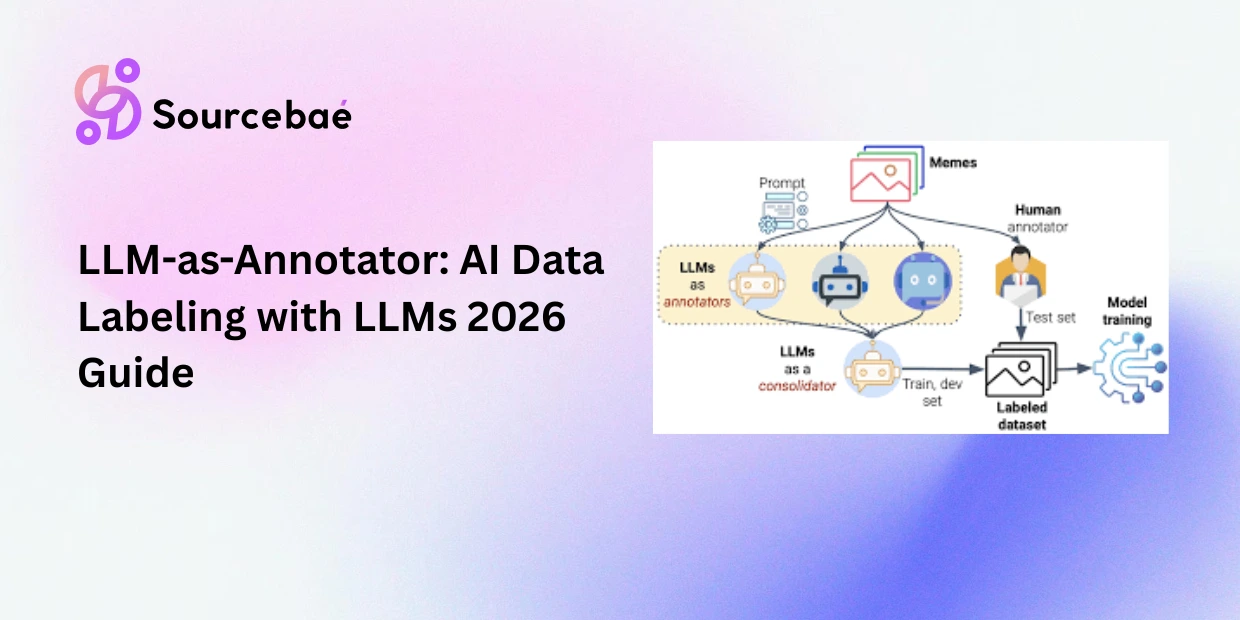
The emerging paradigm. Large language models serve as labeling functions themselves given a prompt and a data point, an LLM can assign a label with surprising accuracy on many tasks. This approach combines the scalability of programmatic labeling with the flexibility of natural language instructions: instead of writing code, a domain expert writes a prompt. The LLM’s output is then treated as a noisy label, subject to the same aggregation and denoising techniques used in traditional weak supervision.
In practice, the most effective annotation strategies in 2026 are hybrids. LLM-generated labels serve as one set of labeling functions alongside traditional heuristics, pretrained model outputs, and knowledge base lookups. The label model aggregates all of these sources together, leveraging the diversity of signal types to produce labels that are more accurate than any single source alone. A small set of expert-annotated examples anchors the system, providing ground truth for validation and calibration. (For a deep dive into LLM-as-annotator strategies, see our upcoming post on [LLM-powered labeling Post 21].)
Semi-Supervised Learning vs. Weak Supervision: Clarifying the Confusion
These two approaches are frequently confused because both deal with scenarios where labeled data is scarce. However, they solve fundamentally different problems and operate on different assumptions.
Semi-supervised data labeling
It starts with a small set of labeled examples and a large set of unlabeled examples. It uses assumptions about the data’s structure smoothness, clustering, or low-dimensional manifold structure to propagate labels from the labeled set to the unlabeled set. The label generation is driven by the data’s geometry, not by external knowledge. Common techniques include self-training (where a model trained on the labeled subset generates pseudo-labels for unlabeled points), consistency regularization, and co-training.
Weak supervision in machine learning
It starts with external knowledge sources heuristics, rules, pretrained models, knowledge bases and uses them to generate noisy labels for unlabeled data. The label generation is driven by domain knowledge encoded in labeling functions, not by the data’s statistical structure. The label model then denoises these programmatic labels using the agreement and disagreement patterns across functions.
The practical distinction matters for pipeline design. Semi-supervised learning assumes you already have some high-quality labeled data and want to extend its value. Weak supervision assumes you have domain knowledge that can be operationalized as programs, and potentially no labeled data at all (though a small validation set dramatically improves development). Semi-supervised methods tend to work well when the data has clean cluster structure and the labeled examples are representative. Weak supervision tends to work well when domain experts can articulate rules that capture meaningful patterns, even if those rules are imperfect.
As Stanford’s SAIL blog summarized the distinction: semi-supervised learning leverages assumptions about data structure to propagate labels, while weak supervision leverages higher-level, noisier input from subject matter experts. They are complementary, not competing and the Epoxy system from the Snorkel team demonstrated that combining weak supervision with semi-supervised techniques (specifically, using pretrained embeddings to extend labeling function votes to nearby data points) can outperform either approach alone.
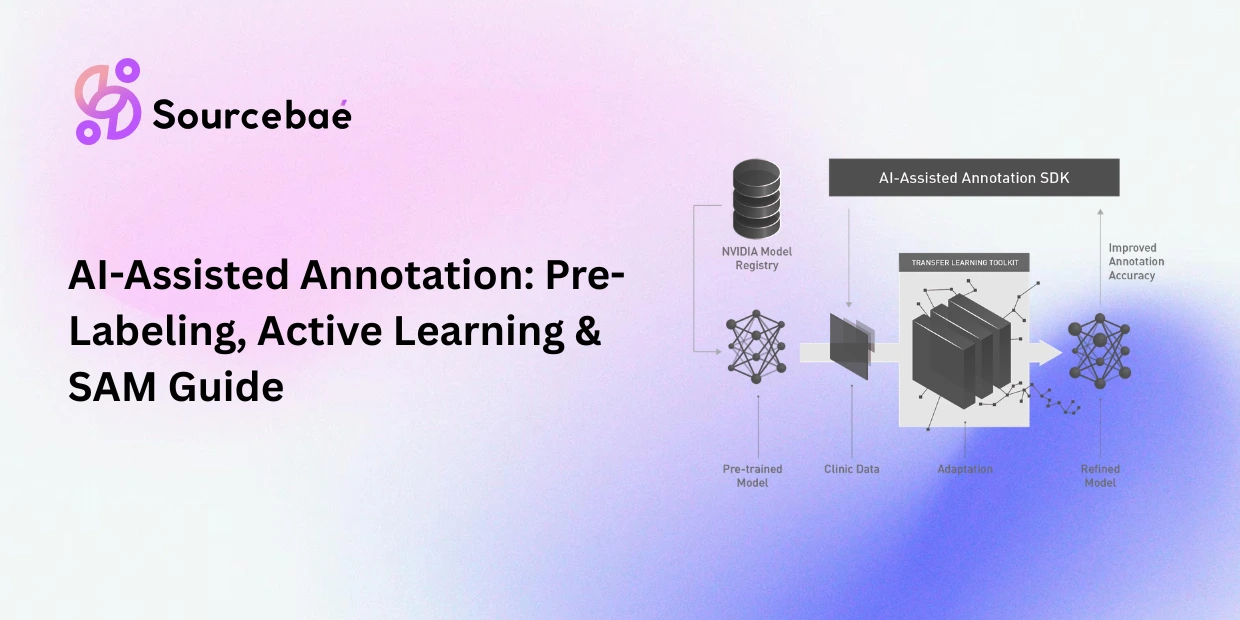
Active Learning Integration: Strategic Manual Labeling Within Weak Supervision
Active learning and weak supervision are natural complements. Where weak supervision generates labels at scale without human annotation, active learning optimizes the value of whatever human annotation you do invest in.
In a hybrid pipeline, the integration works as follows. The weak supervision pipeline generates probabilistic labels for the entire dataset. The label model’s uncertainty estimates identify data points where the system is least confident these are the points where the labeling functions disagree most, where coverage is lowest, or where the probabilistic label is closest to 50/50. Active learning then routes these high-uncertainty points to human annotators for manual labeling.
This integration serves two purposes. First, the manually labeled points improve the label model itself they provide ground truth that helps calibrate labeling function accuracy estimates and identify systematic biases. Second, the manually labeled points can be added directly to the training set, filling gaps in the regions of the data space where programmatic labeling is weakest.
The economic efficiency of this combination is compelling. Instead of annotating thousands of examples uniformly, you annotate hundreds strategically. Human effort focuses on the data points that will most improve the system. Research from Snorkel’s team confirmed this approach. Performance gains from active learning within a weak supervision pipeline far exceeded gains from random manual labeling of the same volume. (For a detailed treatment of active learning methods and uncertainty sampling strategies, see our post on [AI-assisted pre-labeling and active learning Post 24].)
When Weak Supervision Works and When It Doesn’t
Weak supervision is powerful, but it is not universally applicable. Understanding its failure modes is as important as understanding its strengths.
Weak supervision works well when:
The task can be decomposed into articulable rules. Domain experts can say “emails containing X are usually category Y” or “images with feature Z are typically class W.” Those rules can be encoded as labeling functions. Tasks with clear, pattern-based decision logic are natural fits. These include text classification, entity extraction, document routing, fraud detection, and content moderation.
Labeled data is scarce or expensive but unlabeled data is abundant. Weak supervision shines when you have millions of unlabeled examples and domain experts who can write labeling functions in hours, but cannot afford to manually annotate thousands of examples.
The task requirements change frequently. Labeling functions are programs, so they can be updated, versioned, and rerun easily. This applies when label schemas change, new categories are added, or domain definitions evolve. A manually labeled dataset would require expensive relabeling; a programmatic pipeline requires editing a few functions.
Speed of iteration matters more than absolute label perfection. If your goal is to get a working model into production quickly and improve it iteratively, weak supervision’s ability to produce a training set in hours rather than weeks is a decisive advantage.
Weak supervision struggles when:
The labeling task requires holistic subjective judgment. Tasks like aesthetic quality assessment, creative writing evaluation, or complex ethical content moderation involve reasoning that is difficult to decompose into discrete rules. These tasks are better served by manual annotation, often with inter-annotator agreement protocols to manage subjectivity. (See our discussion of content moderation annotation challenges in [Post 3].)
The domain is so novel that no heuristics exist. The team has no prior knowledge about what patterns distinguish one class from another. There are no rules, no existing models, and no knowledge bases to encode as labeling functions. In this case, an initial round of manual annotation is needed before weak supervision can be applied. Active learning can guide this process.
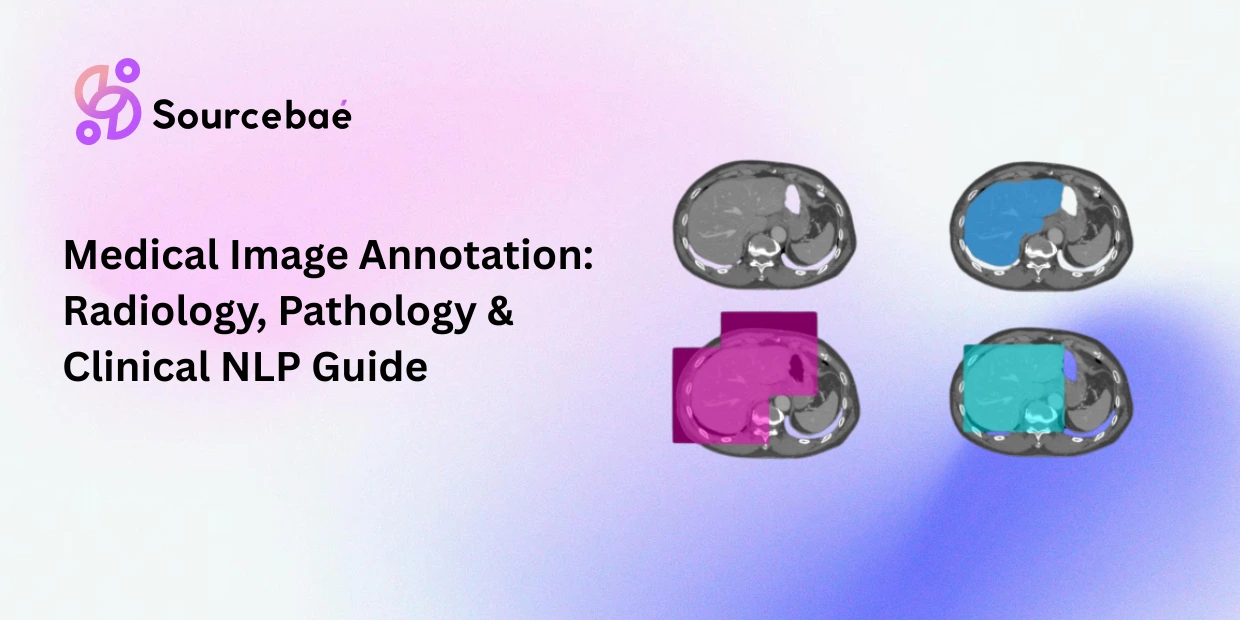
Label precision requirements are extremely high. In safety-critical applications, a single mislabeled training example could have downstream consequences. This applies to certain medical imaging tasks and autonomous driving edge cases. The noise inherent in programmatic labels may be unacceptable without additional human-in-the-loop verification layers.
The data is highly multimodal or unstructured in ways that resist programmatic rules. Weak supervision has been applied to image and audio tasks. However, the richest labeling function libraries exist for text-based problems. Extending programmatic labeling to complex visual or audio tasks often requires more sophisticated approaches (pretrained model outputs as labeling functions, rather than simple heuristics).
Building Hybrid Pipelines: Combining Programmatic and Manual Approaches
The most robust annotation strategies in 2026 do not choose between weak supervision and manual annotation. They combine both in a structured pipeline where each method handles the tasks it does best.
A practical hybrid architecture looks like this:
Layer 1: Programmatic base layer. Labeling functions handle the bulk of the dataset the “easy” examples where patterns are clear and heuristics are reliable. This layer might cover 60–80% of the data with acceptable quality. The label model aggregates outputs and produces probabilistic labels, flagging low-confidence data points for escalation.
Layer 2: Active learning triage. The system identifies data points where programmatic labeling is weakest. This includes low coverage (few labeling functions fired), high conflict (functions disagree), or low confidence (probabilistic label near the decision boundary). These points are routed to human annotators.
Layer 3: Expert manual annotation. Human annotators label the routed examples. Their labels serve dual purposes. They enter the training set directly as high-confidence ground truth. They also feed back into the label model to improve labeling function accuracy estimates. Over time, this feedback loop improves the programmatic layer’s performance. It reduces the volume of manual work needed in subsequent iterations.
Layer 4: Continuous monitoring. As the end model is deployed and encounters new data, its confidence scores and error patterns are monitored. Systematic errors feed back into the pipeline as signals for new labeling functions or updated guidelines for human annotators.
This architecture mirrors the industry’s broader shift from batch labeling to continuous data development. Batch labeling means annotate once, train once. Continuous data development means annotate iteratively, improve continuously. The programmatic layer provides the speed and scalability foundation. The manual layer provides precision and judgment on the cases that matter most. The feedback loops keep the system improving over time.
Getting Started: A Practical Implementation Sequence
For teams new to programmatic labeling, here is a phased approach:
Phase 1: Assemble a small validation set. Before writing any labeling functions, manually annotate 100–200 examples to serve as a development and validation set. This set is used to measure labeling function accuracy, tune the label model, and evaluate the end model. It does not need to be large, but it must be representative of the data distribution.
Phase 2: Write initial labeling functions. Start with the most obvious patterns. Ask domain experts: “What are the easy rules? What keywords or features almost always indicate a specific class?” Write 5–10 labeling functions based on these high-confidence heuristics. Run them against the validation set and measure their individual precision and coverage.
Phase 3: Train the label model. Aggregate the labeling function outputs using a label model. Evaluate the resulting probabilistic labels against the validation set. If accuracy is below your threshold, iterate on the labeling functions add new ones, refine existing ones, or remove ones with low accuracy.
Phase 4: Train the end model. Use the label model’s outputs to train a downstream discriminative model. This model should outperform the label model because it has access to the full feature space of the data. Evaluate it against the validation set and, if possible, against a held-out test set.
Phase 5: Add active learning and human review. Identify the data points where the pipeline is least confident and route them for manual annotation. Use the manual labels to improve the label model and expand the validation set. Repeat the cycle.
Phase 6: Integrate LLM labeling functions. As you mature the pipeline, experiment with LLM-generated labels as additional labeling functions. Treat them exactly as you would any other noisy source subject to the same aggregation, denoising, and validation.
Frequently Asked Questions
What is weak supervision?
Weak supervision is a machine learning approach that uses noisy, programmatic, or imprecise label sources. These include heuristics, pattern matching, pretrained models, and knowledge bases. They replace or reduce the need for hand-annotated training data. A label model aggregates these noisy sources into probabilistic training labels.
What are labeling functions in annotation?
Labeling functions are small programs (typically Python functions) that take a data point as input and either assign a label or abstain. They encode domain knowledge as reusable, testable code and form the building blocks of programmatic weak supervision.
How does Snorkel’s labeling functions approach work?
Snorkel applies multiple labeling functions to an unlabeled dataset, producing a matrix of noisy, overlapping, and conflicting labels. A generative label model learns each function’s accuracy and correlation structure without ground truth, then outputs a single probabilistic label per data point. A discriminative end model is trained on these labels to generalize beyond the labeling functions’ coverage.
What is the difference between weak supervision and manual annotation?
Manual annotation produces high-confidence labels by having humans examine each data point individually. Weak supervision produces noisier but far more scalable labels by encoding domain knowledge as programs. Manual annotation is slower and more expensive per label but higher in quality; weak supervision is faster and cheaper but requires statistical denoising to be useful.
How is weak supervision different from semi-supervised learning?
Semi-supervised learning uses the statistical structure of unlabeled data (clusters, manifolds, smoothness) to propagate labels from a small labeled set. Weak supervision uses external knowledge sources to generate noisy labels. These sources include heuristics, rules, and pretrained models. A label model then denoises the outputs. They are complementary approaches that address the labeled-data scarcity problem from different angles.
How many labeled examples do you need for weak supervision?
Weak supervision can operate with as few as 100–200 manually annotated examples. These are used as a validation set rather than as training data. They help measure labeling function accuracy, tune the label model, and evaluate the end model. The training set itself is generated programmatically.
What is programmatic weak supervision (PWS)?
PWS is the specific paradigm of using labeling functions and a label model to produce training labels at scale. It is the methodology formalized by the Snorkel project and represents the most widely adopted framework for implementing weak supervision.
When should you not use weak supervision?
Weak supervision is less effective in several scenarios. It struggles when the labeling task requires holistic subjective judgment. It also falls short when no domain heuristics exist. High label precision requirements, such as in safety-critical applications, can make it unsuitable. The same applies when data resists decomposition into rule-based patterns.