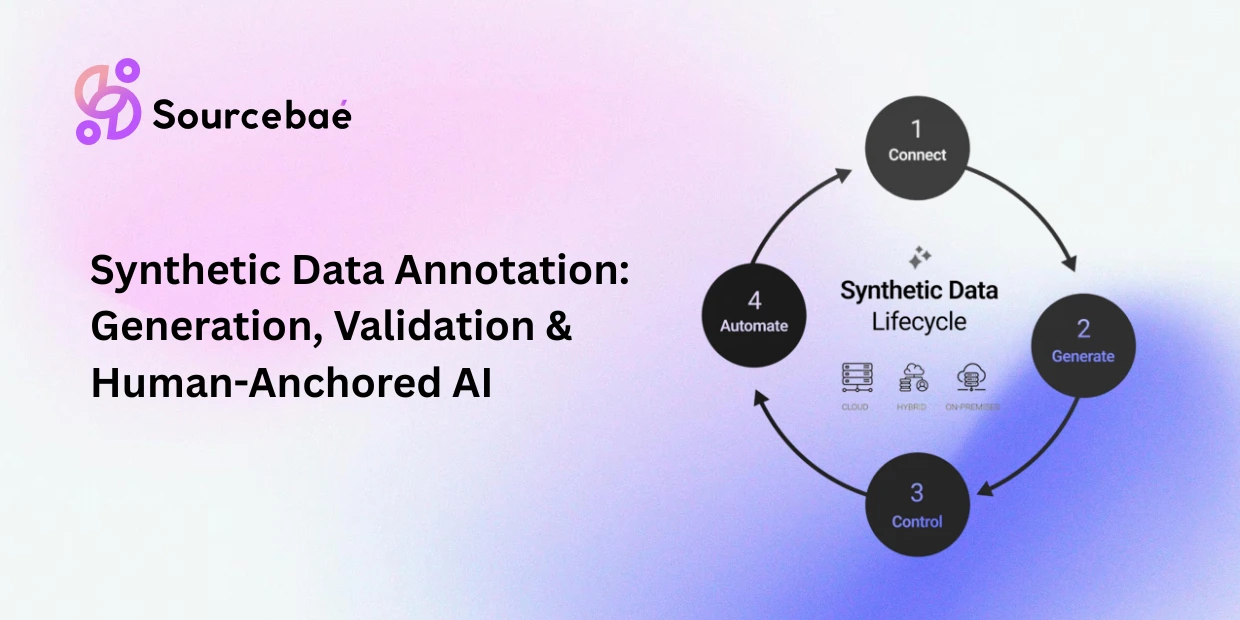

Synthetic data annotation is the process of generating artificial training examples and labeling them for AI model training. These examples include images, text, tabular records, sensor streams, or entire simulated environments. Labeling happens either automatically during generation or through human validation afterward. Unlike traditional annotation, humans don’t label already-collected real-world data. Instead, synthetic data for AI training inverts the pipeline. The data and its labels are produced together, often programmatically. This happens at a scale and speed that manual collection cannot match.
The trajectory of this approach is unmistakable. Gartner predicted that 60% of data used for AI would be synthetic by 2024 up from 1% in 2021. More recently, Gartner projected that synthetic structured data will grow at least three times as fast as real structured data through 2030. By that year, synthetic data will constitute more than 95% of data used for training AI models in images and video. In the 2026 Gartner Hype Cycle, synthetic data sits on the Slope of Enlightenment. It has moved past peak hype into practical, production-grade adoption. Organizations using synthetic data for edge case coverage report 30–50% reductions in real-world data collection costs.
But synthetic data is not a replacement for real-world data it is an amplifier. The most effective approach in 2026 is increasingly known as human-anchored synthetic data. It combines programmatically generated datasets with human-validated real-world annotations. These annotations ground the synthetic distribution in observable truth. This post explains how synthetic data generation works and how it gets annotated. It covers where its advantages and risks lie. It also shows how human-anchored validation prevents the failure modes that have undermined purely synthetic approaches.
What Is Synthetic Data?
Synthetic data is artificially generated information that mimics real-world data without being directly collected from real-world sources. It replicates statistical properties, structural patterns, or visual characteristics of actual data. It can take many forms. These include rendered images of objects in simulated environments and tabular records generated by statistical models trained on real schemas. It also covers text produced by language models following specific distributions. Entire simulated sensor streams from virtual worlds are another common form.
The key distinction from real data is that synthetic data is created, not observed. This creation process can follow three main approaches. Rule-based generation produces data according to predefined statistical distributions and constraints. Model-based generation uses generative AI models like GANs, diffusion models, or large language models to produce realistic examples. Simulation-based generation renders data from physics engines or virtual environments that model real-world processes.
Each approach produces data with different properties. Rule-based generation offers complete control over distributions but may lack realism. Model-based generation produces highly realistic individual examples but may encode biases from its training data. Simulation-based generation enables photorealistic rendering with perfect ground truth labels. However, it faces the “reality gap.” This refers to the visual and physical differences between simulation and the real world. These differences can degrade model performance when transferring from synthetic to real deployment. (For how simulation-to-real annotation addresses this gap in robotics, see our post on [annotation for autonomous agents — Post 22 via Pillar Page].)
How Synthetic Data Gets Annotated
One of the primary advantages of synthetic data is that annotation can happen automatically during generation a property that fundamentally changes the economics of the labeling pipeline.
Auto-labeling at generation time
When a simulated environment generates data, the simulator knows the ground truth by construction. The system automatically labels every pixel in a rendered image with its object identity, depth, surface normal, and material properties. Every synthetic tabular record carries its class label from the moment of generation. Each simulated sensor reading comes with the exact position, velocity, and identity of every object in the scene. This eliminates the manual annotation bottleneck entirely for the data that the simulator produces.
Synthetic data labeling for model-generated content
When data is produced by generative models (GANs, diffusion models, LLMs) rather than simulators, the labeling situation is different. The generative model produces realistic examples, but the labels must be assigned separately. This can happen through a classifier or heuristic rules applied during generation. For example, the generator can be conditioned on a specific class, using that condition as the label. Human review is another common approach. LLM-generated text can be prompted to produce examples of specific categories. However, the accuracy of those category labels depends on the prompt design and the model’s reliability.
The validation layer
Whether auto-labeled or heuristically labeled, synthetic annotations require validation. A simulator might perfectly label object boundaries, but the visual realism of the rendering might not match real-world conditions meaning the labels are correct for the simulated image but the simulated image itself is not representative of real data.
A generative model might produce text conditioned on a “positive sentiment” label, but the generated text might not actually express positive sentiment convincingly. This validation step checking whether synthetic examples and their labels are actually useful for training a model that will operate on real data is where human judgment remains essential.
Advantages of Synthetic Data Over Real-World Data
Synthetic data generation addresses several constraints that make real-world data collection and annotation expensive, slow, or impractical.
Scale without manual labor.
A synthetic pipeline can generate millions of labeled examples in hours. The same volume of real-world annotation might require months of human effort. For tasks where the model needs large training sets to generalize common in computer vision and NLP synthetic data provides volume that manual annotation cannot economically deliver.
Perfect edge case coverage
Real-world data collection is dominated by common scenarios. A camera at an intersection will capture thousands of normal traffic flows for every unusual event. Synthetic generation can deliberately over-sample rare scenarios: unusual weather conditions, uncommon object configurations, atypical human behaviors. This targeted generation fills the long tail of the distribution where models are most likely to fail and where real-world data is hardest to obtain. Gartner projects that synthetic data usage for filling edge scenarios will grow from approximately 5% today to over 90% by 2030.
Privacy by design
Synthetic data that is generated from statistical distributions rather than copied from individual records contains no personally identifiable information. This makes it a powerful tool for training models in privacy-sensitive domains healthcare, finance, telecommunications where real data is subject to HIPAA, GDPR, or other regulatory constraints. Gartner projects that by 2030, synthetic data will help organizations avoid 70% of privacy violation sanctions by reducing the need for personal data collection.
Cost efficiency
Organizations using synthetic data for edge case augmentation report 30–50% reductions in real-world data collection costs. The savings compound as datasets scale. Teams spend almost nothing to generate an additional synthetic example. In contrast, collecting and annotating an additional real-world example costs significantly more.
Controllable diversity
Synthetic generation allows precise control over data distribution characteristics: class balance, demographic representation, environmental conditions, and difficulty levels. If a model underperforms on a specific subgroup or scenario, synthetic generation can produce targeted training examples to address the gap without the collection bias inherent in real-world datasets.
Risks: Domain Gap, Distribution Shift, and Model Collapse
Synthetic data’s advantages come with well-documented risks that teams must actively manage.
The domain gap
Synthetic data, no matter how realistic, differs from real data in ways that can degrade model performance. Rendered images have different texture, lighting, and noise characteristics than photographs. Generated text follows slightly different distributional patterns than human-written text. Simulated sensor data lacks the calibration artifacts and environmental noise present in real sensor readings. Models trained exclusively on synthetic data often underperform on real-world benchmarks because they learn patterns specific to the synthetic distribution that do not generalize.
Distribution shift
If the synthetic generation process does not accurately model the real-world distribution, the model learns a distorted view of the world. A synthetic training set that over-represents certain scenarios and under-represents others will produce a model with corresponding blind spots. This risk is especially acute when the synthetic pipeline is designed based on assumptions about the real distribution rather than measured characteristics of it.
Model collapse from synthetic feedback loops.
When a generative model is trained on data that was itself generated by a similar model, performance can degrade over successive generations a phenomenon known as model collapse. Each generation of synthetic data loses some of the distributional richness of the original real data, and errors compound over iterations. This risk makes it essential to anchor synthetic data production in real-world ground truth rather than allowing synthetic pipelines to become self-referential.
Overconfidence in synthetic labels
Because synthetic labels are generated automatically, they can create a false sense of data quality. A simulator produces perfectly labeled data but the data itself may not be representative. Teams that treat synthetic labels with the same confidence as expert human annotations, without validating the synthetic-to-real transfer, are building on an unreliable foundation.
Human-Anchored Synthetic Data: The 2026 Validation Standard
Human-anchored synthetic data is the emerging best practice for combining synthetic scale with real-world reliability. The approach treats synthetic data as a scaling mechanism that amplifies human judgment rather than replacing it.
The principle
Every synthetic dataset must rely on a corpus of human-annotated real-world data a “golden corpus.” This corpus defines what correct labels look like and establishes the target data distribution. It also provides the benchmark that teams use to measure synthetic quality. Synthetic data extends the volume and diversity of this real anchor; it does not replace it.
The validation workflow
In a human-anchored pipeline, the process follows a specific sequence. First, collect and annotate a representative real-world dataset using human experts. This golden corpus defines the quality standard. Second, generate synthetic data using simulation, generative models, or rule-based methods, conditioning the generation on the patterns observed in the real corpus.
Third, validate synthetic examples against the golden corpus human reviewers examine a sample of synthetic examples, confirming that the generated data and its labels are consistent with the real-world standard. Fourth, train the model on the combined corpus (real plus validated synthetic), evaluating performance on held-out real data, not synthetic benchmarks. Fifth, monitor deployed model performance on real-world inputs and feed errors back into both the synthetic generation pipeline and the human annotation workflow.
Why humans remain essential
As one 2026 industry analysis framed it: “Synthetic data scales human judgment; it does not replace it. The most capable models will still rely on human data as their anchor. Humans define what ‘good’ looks like, set objectives, establish red lines, and manage trade-offs. The golden corpus is not a one-time artifact. It is a living dataset that grows as teams discover new edge cases. It evolves alongside the deployment domain. Its also expand as production monitoring reveals the model’s weaknesses. (For how human-in-the-loop validation connects to the broader HITL paradigm, see our post on [human-in-the-loop annotation Post 25].)
Privacy Benefits and Regulatory Alignment
One of the most compelling use cases for synthetic data is enabling AI development in privacy-regulated domains where real data access is restricted.
Healthcare
Medical imaging AI requires large annotated datasets of X-rays, CT scans, and pathology slides. Acquiring and de-identifying these datasets is expensive, slow, and subject to institutional review board approval and HIPAA compliance. Synthetic medical image generation producing realistic but non-patient-derived imaging data allows model development to proceed while patient data stays protected. The synthetic images still require validation by clinical experts to ensure they are medically realistic and appropriately labeled, but the privacy barrier to initial data access is eliminated. (For the specific requirements of medical annotation workflows, see our post on [medical imaging annotation Post 23].)
Financial services
Fraud detection, credit scoring, and transaction monitoring models need training data that includes rare fraud patterns. Generating synthetic transaction data that preserves the statistical relationships in real financial data while containing no actual customer records allows model development without customer data exposure.
Regulatory alignment
The EU AI Act’s data governance requirements for high-risk systems include obligations around data quality, representativeness, and bias testing. Synthetic data provides a controlled mechanism for meeting representativeness requirements if the real-world dataset under-represents a demographic group, synthetic examples can fill the gap without requiring additional collection of sensitive personal data. However, synthetic data used for compliance purposes must be transparently documented: regulators need to understand what proportion of training data is synthetic, how it was generated, and how it was validated.
Use Cases by Industry
Different industries have adopted synthetic data annotation at different maturity levels, with use case specifics that shape how the data is generated and validated.
Autonomous vehicles
The most mature synthetic data use case. Companies generate billions of simulated driving scenarios varying weather, lighting, pedestrian behavior, road conditions, and rare obstacle configurations with automatic ground truth labels from the simulation engine. Domain randomization varies visual parameters to reduce the sim-to-real gap. Real-world validation datasets from test fleets provide the human anchor. This approach is standard practice for autonomous vehicle companies in 2026.
Healthcare and life sciences
Synthetic medical image generation is used to augment rare pathology training sets, generate privacy-safe development data, and create balanced datasets for conditions that are uncommon in clinical populations. Human-anchored validation by pathologists and radiologists ensures clinical realism. Digital twin environments for agricultural and pharmaceutical applications extend synthesis to 3D structures.
Retail and e-commerce
Product image generation rendering products in varied backgrounds, lighting conditions, and orientations reduces the need for physical photography shoots. Synthetic customer interaction data (search queries, purchase patterns, reviews) supports recommendation model training without exposing real customer behavior.
Financial services
Synthetic transaction data supports fraud model training, stress testing, and regulatory scenario analysis. Tabular synthetic data generation preserves statistical relationships while eliminating personal data a critical advantage for cross-border compliance where data residency requirements prevent sharing real records across jurisdictions.
Manufacturing and inspection
Synthetic defect image generation creates training data for quality inspection models. Because real defects are rare (a well-run production line produces very few defective items), real-world defect datasets are small and expensive to collect. Synthetic generation can produce thousands of realistic defect variations from a small set of real examples, dramatically improving detection model performance.
Frequently Asked Questions
What is synthetic data annotation?
Synthetic data annotation is the process of generating artificial training examples and labeling them for AI model training, either automatically during generation (as in simulation) or through validation and review after generation.
How is synthetic data generated for AI training?
Three primary methods generate synthetic data. Simulation-based generation renders data from virtual environments with automatic ground truth. Model-based generation uses GANs, diffusion models, or LLMs to produce realistic examples. Rule-based generation creates data according to predefined statistical distributions and constraints.
What is human-anchored synthetic data?
Human-anchored synthetic data is a validation methodology where every synthetic dataset is grounded in a corpus of human-annotated real-world data that defines quality standards. Synthetic data extends the scale and diversity of this real anchor but does not replace it.
How does synthetic data compare to real training data?
Synthetic data offers superior scale, cost efficiency, privacy protection, and control over edge case coverage. Real data provides authenticity, distributional accuracy, and the ground truth that synthetic data must be validated against. The most effective approach combines both.
What are the risks of using synthetic data?
Key risks include the domain gap, which refers to differences between synthetic and real data. Distribution shift occurs when synthetic data does not accurately model reality. Model collapse degrades performance when models train on self-generated data. Teams also risk overconfidence in auto-generated labels, especially when they have not validated them against real-world ground truth.
How much training data will be synthetic by 2030?
Gartner projects that by 2030, synthetic data will constitute more than 95% of data used for training AI models in images and video. Synthetic structured data is projected to grow at least three times as fast as real structured data for AI model training through 2030.