
The Data Annotation Trends is defined by a single insight that the AI industry learned the hard way: model performance now depends less on architecture and more on data quality. The most advanced neural networks are only as reliable as the humans and the processes that produce their training data. High-profile failures in healthcare diagnostics and autonomous vehicle systems have been traced not to weak algorithms but to mislabeled training sets that failed to account for real-world complexity. Roughly 80% of machine learning effort is now spent on data preparation and labeling, not on model tuning.
The numbers reinforce the shift. The data annotation tools market reached $8.26 billion in 2026. It is projected to grow to $44.68 billion by 2035 at a 20.4% CAGR (Research Nester). Scale AI’s revenue climbed to approximately $870 million in 2024 and is tracking toward $2 billion. Meta invested ~$14.3 billion for a 49% stake in the company. The FDA authorized 295 new AI-enabled medical devices in 2025 alone each one built on annotated data. China’s government has unveiled a national plan to grow its data labeling sector by 20% annually through 2027. Data annotation trends 2026 are no longer niche industry news; they are front-page enterprise strategy.
This capstone post synthesizes the seven trends reshaping the data annotation industry drawing on the 29 posts in this series that have explored annotation methodologies, tools, and operations in depth and projects where the field is heading next.
Trend 1: Multimodal Annotation at Scale
The first and most visible trend is the shift from single-modality labeling to multimodal annotation. This approach captures relationships across data types simultaneously. Models in 2026 are increasingly multimodal. They integrate text, image, audio, and video in unified architectures like GPT-4o, Gemini, and open-source vision-language models. The training data must match.
This goes beyond annotating images in one tool and text in another. True multimodal annotation captures the relationships between modalities. It identifies which text describes which image region and which audio event corresponds to which video segment. It also maps which LiDAR points correspond to which camera pixels. These cross-modal correspondences are what multimodal models actually learn from. They do not come for free. They must be deliberately constructed through careful annotation.
The operational challenge is maintaining temporal and relational consistency across data types. In an autonomous cockpit, the system must synchronize a driver’s voice command with their eye movement and the external road environment. Each data stream carries its own temporal granularity. The annotation must capture not just what is happening in each stream. It must also record when each event occurs relative to events in the other streams.
Where the field is heading
Unified annotation environments that support simultaneous multi-pane display, cross-modal linking primitives, and shared ontology enforcement are becoming standard. Teams that still label each modality in isolation are producing training data that teaches models to process modalities independently rather than integrating them a fundamental misalignment with how multimodal architectures learn. (For the full multimodal annotation methodology, see our post on [multimodal annotation Post 19 via Pillar Page].)
Trend 2: Expert-Led, Not Crowd-Led Labeling
The annotation industry is splitting into two tiers: commodity labeling for basic tasks and specialized curation for high-stakes AI systems. Generalist crowdsourcing the dominant model of the early 2020s is being replaced by expert-led annotation for the projects that matter most.
The driver is straightforward. As AI systems enter healthcare, law, finance, autonomous vehicles, and other high-stakes domains, annotation demands domain expertise. A radiologist identifies subtle tissue variations. A financial compliance officer labels regulatory risk markers. A senior software engineer evaluates code quality for RLHF. These are not tasks that untrained generalists can handle without compromising the quality downstream models depend on.
Industry insiders describe the shift clearly. Companies need high-quality data labeling from domain experts like doctors, lawyers, or senior engineers to improve their models. The hard part is finding and recruiting those expert labelers. The cost implications are significant. Expert annotators command $50–$200 per hour versus single-digit rates for general crowd workers. But the return on investment is clear. A thousand expert-labeled examples can boost model performance more than a million noisy labels.
Where the field is heading
The annotation workforce of 2027 will be smaller but more skilled. Recruitment shifts from volume hiring to talent matching. Quality measurement shifts from simple accuracy checks to inter-annotator agreement, domain competency verification, and calibration protocols. The industry’s talent gap estimated at nearly 30 million workers globally is not a gap in bodies; it is a gap in qualified expertise. (For how expert requirements vary by domain, see our posts on [RLHF annotation Post 17] and [medical imaging annotation Post 23].)
Trend 3: LLM-as-Annotator Pipelines
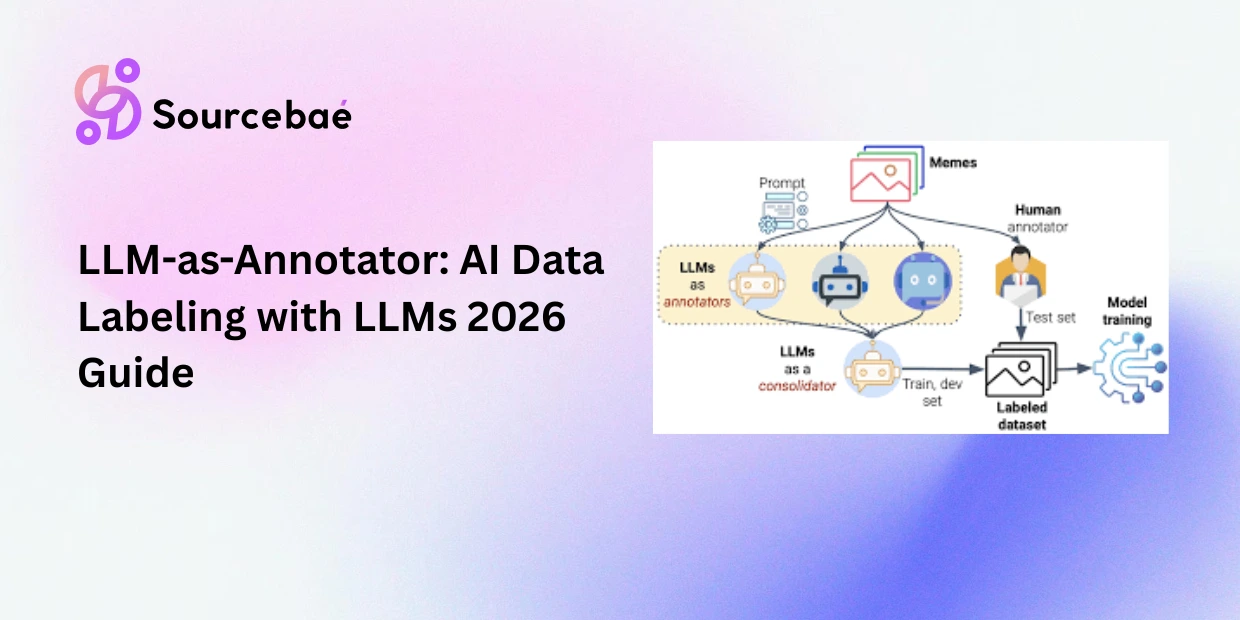
Large language models have become a standard component of production annotation pipelines. They don’t replace human annotators. Instead, they serve as a scalable first pass that humans refine. GPT-4 achieved 88.4% agreement with ground truth labels across multiple text classification benchmarks. It exceeded skilled crowd worker performance while costing roughly one-seventh as much. It also completed the work approximately twenty times faster.
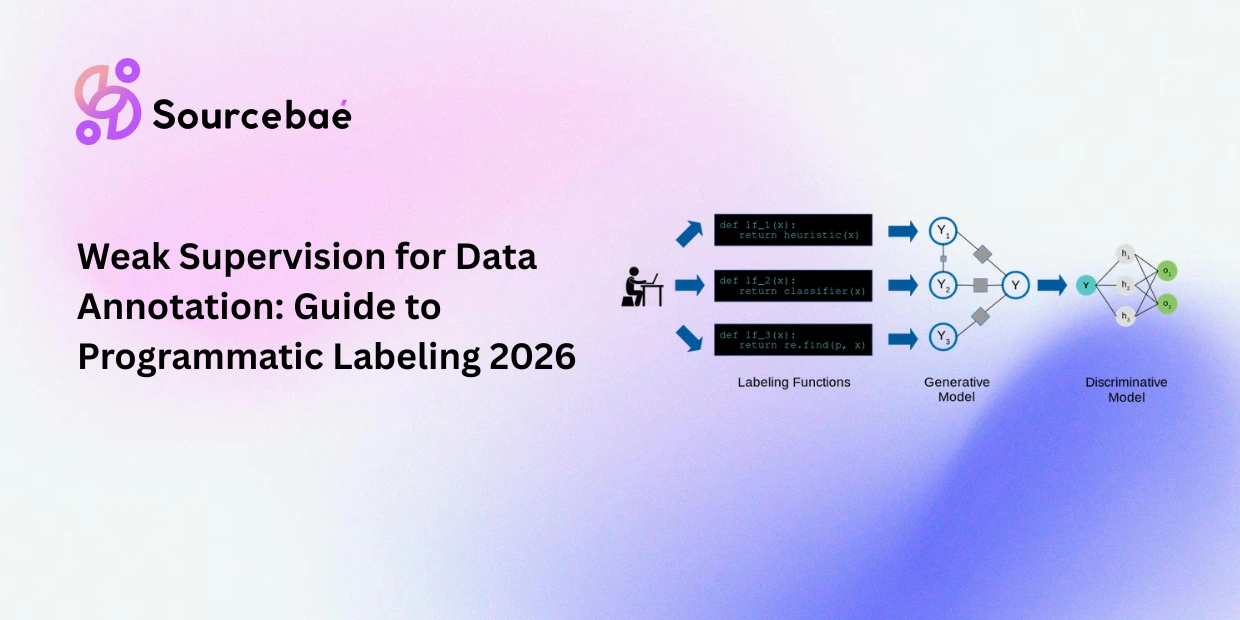
The operational model is a hybrid pipeline. The LLM generates initial labels for the full dataset. Confidence scoring identifies which labels are reliable and which need human review. Human annotators correct the uncertain subset. The corrected labels feed back into both the training set and the LLM’s prompt calibration. Teams that treat LLM outputs as one labeling function among many achieve the best results. These functions include heuristic rules, pretrained models, and knowledge base lookups within a unified label model.
The key limitation is well-documented. LLMs perform well on tasks with explicit textual evidence. They struggle with implicit reasoning, cultural nuance, subjective judgment, and domain-specific expertise. The ‘LLM labels everything’ approach works for straightforward text classification. It does not work for medical coding, legal analysis, or content moderation. In these domains, the correct label depends on context that the model lacks.
Where the field is heading
LLM annotation will become the default pre-labeling strategy for text-based tasks by 2027, with human review reserved for the long tail of ambiguous cases. Multi-prompt voting and self-consistency techniques will improve reliability. The distinction between “human-annotated” and “LLM-annotated” data will become a required disclosure in regulatory contexts. (See our post on [LLM-as-annotator Post 21].)
Trend 4: Continuous HITL Over Batch Labeling
The annotation paradigm is shifting from batch processing (annotate once, train once, deploy) to continuous human-in-the-loop (annotate, deploy, monitor, re-annotate, retrain, repeat). This shift reflects the reality that deployed models encounter distributional shifts, novel inputs, and emerging failure modes that static training sets cannot anticipate.
In the continuous model, deployed AI systems log their predictions with confidence scores. Low-confidence predictions and user-reported errors are flagged for human review. Human reviewers provide corrected labels that feed back into the training pipeline. The model is periodically retrained on the expanded dataset. Each cycle addresses the specific gaps the model is experiencing in production.
This is not a new concept active learning has existed for decades but the operational infrastructure to run it continuously at production scale is a 2026 achievement. Enterprise annotation platforms now support model-in-the-loop verification, uncertainty-driven routing, and continuous data integration as standard features. The result is a system that improves over time rather than degrading, and that adapts to changing real-world conditions rather than remaining static.
Where the field is heading
By 2028, batch annotation producing a fixed training set and never updating it will be considered a legacy practice for any production AI system. Annotation will be recognized as an ongoing operational function, not a project with a completion date. Annotation teams will be staffed and budgeted as continuous operations, not temporary project teams. (See our posts on [human-in-the-loop annotation Post 25] and [AI-assisted annotation Post 24].)
Trend 5: Regulatory-Driven Documentation
The EU AI Act, enforceable from August 2, 2026, has transformed annotation documentation from a quality best practice into a legal obligation. Article 10 explicitly names “annotation” and “labelling” as data-preparation operations subject to mandatory governance requirements. Arti. 14 requires human oversight. Article 50 mandates transparency. Non-compliance can result in fines of up to €15 million or 3% of global turnover.
For annotation teams, this means maintaining audit trails documenting every label creation, modification, and review; bias audits on annotated datasets with documented findings and corrective measures; data provenance records tracing every label to its source, annotator, method, and guideline version; and quality management systems meeting the conformity assessment requirements of Article 43.
The impact extends beyond Europe. The FDA’s January 2025 draft guidance introduced transparency and labeling requirements for AI-enabled devices. China’s national data labeling guidelines target standardization and growth through 2027. The NIST AI Risk Management Framework recommends human oversight for high-risk use cases. Annotation compliance is becoming a global requirement, not a regional one.
Where the field is heading.
By 2027, annotation without documented provenance will be considered unusable for any regulated AI application. Annotation platforms that do not support immutable audit logging, versioned guidelines, and bias documentation will lose enterprise market share. Compliance will become a competitive differentiator, not just a cost center. (See our post on [EU AI Act annotation compliance Post 28].)
Trend 6: Synthetic + Human-Anchored Data
Gartner projected that 60% of data used for AI would be synthetic by 2024, and that by 2030, synthetic data will constitute more than 95% of data used for training AI models in images and video. Organizations using synthetic data for edge case coverage report 30–50% reductions in real-world data collection costs. Synthetic data generation is no longer experimental it is a standard component of production data pipelines.
But the most important development in this space is the emergence of human-anchored synthetic data as the validation standard. The lesson of the last two years is that synthetic data scales human judgment; it does not replace it. Models trained exclusively on synthetic data suffer from domain gaps, distribution shift, and model collapse. The solution is anchoring every synthetic dataset in a golden corpus of human-annotated real-world data that defines what correct labels look like, establishes the target distribution, and provides the benchmark against which synthetic quality is measured.
In the human-anchored workflow, humans define the quality standard; synthetic generation extends the volume; human reviewers validate synthetic samples; and model evaluation happens on real-world held-out data, not synthetic benchmarks. This loop ensures that synthetic data amplifies human expertise without untethering from real-world ground truth.
Where the field is heading.
The distinction between “real” and “synthetic” training data will become less meaningful than the distinction between “human-validated” and “unvalidated” data. Regulatory frameworks will increasingly require disclosure of synthetic data proportions and validation methods. Human annotators’ role will shift from producing all labels to defining quality standards and validating generated labels. (See our post on [synthetic data and annotation Post 26].)
Trend 7: Annotation for Autonomous Physical AI
The seventh trend is the expansion of annotation beyond digital AI (text models, image classifiers, chatbots) into physical AI robots, autonomous vehicles, drones, surgical systems, and delivery agents that operate in the real world. IDC predicted breakthroughs in AI models, vision systems, and edge computing that would triple the number of achievable robotic application scenarios by 2026, with deployment expanding across manufacturing, logistics, healthcare, and services.
Annotation for physical AI is fundamentally different from annotation for digital AI. The feedback is evaluative (rewards) rather than instructive (correct labels). The data is temporal (action sequences) rather than static (individual examples). The environment is three-dimensional, and failure data is as valuable as success data. Reward shaping annotation, trajectory labeling, and environment annotation constitute an entirely distinct methodology that the annotation industry is still developing the infrastructure to support at scale.
The Robometer project (March 2026) released RBM-1M a reward-learning dataset with over one million robot trajectories signaling the scale at which robotics annotation is now operating. Simulation-to-real transfer annotation, using language-anchored labels and domain randomization, is reducing the reality gap that has historically limited sim-trained robot deployment. Continuous HITL feedback loops for deployed robotic fleets are creating annotation workflows that operate 24/7, not in project batches.
Where the field is heading.
By 2028, physical AI annotation will be the fastest-growing segment of the annotation market. Annotation teams will need spatial reasoning, temporal analysis, and reward function design capabilities that current text and image annotation workflows do not develop. The convergence of annotation and robotics operations will create a new specialization within the ML operations landscape. (See our post on [annotation for autonomous agents and robotics Post 22].)
What This Means for Your Team
These seven trends are not independent they reinforce each other. Multimodal annotation requires expert annotators who understand cross-modal relationships. LLM-as-annotator pipelines require continuous HITL validation. Regulatory compliance requires audit trails that document every stage of the annotation process, including synthetic data validation. Physical AI annotation requires all of the above, applied to fundamentally different data types.
The annotation teams that thrive in this environment will share several characteristics.
They treat annotation as infrastructure, not a project
Annotation is not something you do once before training; it is a continuous operational function that runs alongside model development and deployment. Budget, staff, and tooling should reflect this.
They invest in expertise over volume
The value of annotation in 2026 comes from precision, domain knowledge, and judgment not from labeling speed. A smaller team of calibrated experts producing high-quality labels will outperform a large team of generalists producing noisy ones.
They build for compliance from day one
Retrofitting documentation, audit trails, and bias audits after the data is produced is dramatically more expensive than building these into the workflow from the start. The EU AI Act makes this explicit, but the principle applies everywhere.
They close the feedback loop
Model performance, production errors, and deployment data flow back into the annotation pipeline. Guidelines evolve. Taxonomies update. The dataset improves with every cycle. The best training data is not the biggest it is the most responsive to the model’s actual needs.
Over the past 29 posts in this series, we have explored every major annotation methodology from image bounding boxes to RLHF preference ranking, from NLP entity tagging to robotic trajectory labeling, from manual annotation to LLM-generated labels, from single-modality projects to unified multimodal workflows. The thread connecting them all is the same: the quality of AI depends on the quality of the data humans produce to train it. That truth is not changing. What is changing rapidly is how we produce that data. The seven trends outlined here are the roadmap. (For the complete methodology reference, see our [Pillar Page the definitive guide to data annotation].)
Frequently Asked Questions
What is the future of data annotation?
The future of data annotation is defined by multimodal labeling at scale, expert-led annotation replacing crowd-led approaches, LLM-as-annotator hybrid pipelines, continuous HITL feedback loops, regulatory-driven documentation, human-anchored synthetic data, and the expansion into physical AI annotation.
What are the biggest data annotation trends in 2026?
The biggest trends are the shift from batch to continuous annotation, the rise of expert annotators over crowd workers, LLM pre-labeling with human validation, EU AI Act compliance requirements, synthetic data anchored in human-validated ground truth, and annotation infrastructure for autonomous robots and physical AI.
How large is the data annotation market?
The data annotation tools market reached $8.26 billion in 2026 and is projected to grow to $44.68 billion by 2035 at a 20.4% CAGR. The broader data collection and labeling services market was estimated at approximately $3.7 billion in 2024, with forecasts exceeding $17 billion by 2030.
Why does AI model performance depend on annotation quality?
A 2025 MIT study found that models trained on poorly annotated data experienced up to 40% degradation in accuracy. Even the most advanced architectures cannot overcome fundamental errors, biases, or inconsistencies in their training labels. Data quality is now the primary constraint on AI performance.
Will AI replace human annotators?
No. AI will handle an increasing share of routine labeling, but human judgment remains essential for edge cases, subjective tasks, domain expertise, regulatory compliance, and quality validation. The role shifts from producing all labels to defining quality standards, validating generated labels, and handling the cases that automation cannot.
What should annotation teams do to prepare for 2027?
Build continuous annotation pipelines rather than batch processes, invest in domain-expert annotators, implement compliance documentation from day one, adopt AI-assisted pre-labeling with human verification, and close the feedback loop between deployed model performance and annotation priorities.