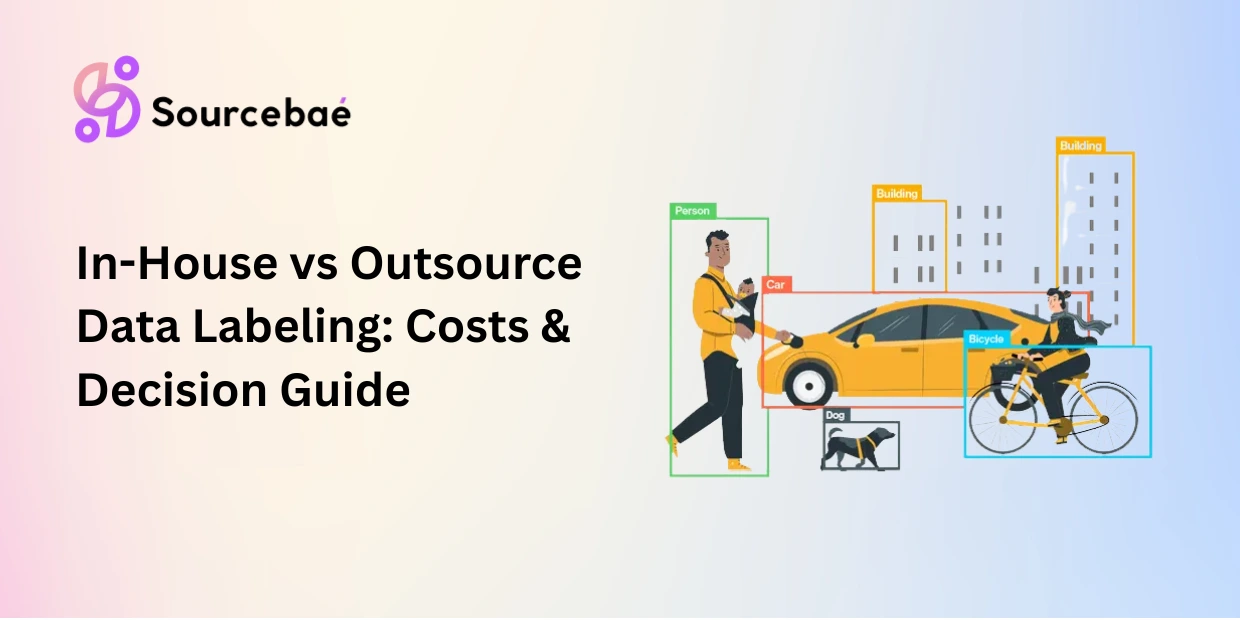

According to McKinsey, data preparation and annotation consume up to 80% of the time spent on AI projects. For teams moving beyond proof-of-concept, that reality forces a strategic question: should you build an internal annotation operation, outsource data annotation to a specialized provider, or combine both approaches? The in-house vs outsource data labeling decision isn’t just a cost calculation it shapes your team’s speed, data quality, domain expertise, and long-term ability to iterate on model performance.
Data annotation outsourcing is the practice of contracting a third-party vendor or managed service provider to label, tag, and enrich training data for machine learning models as an alternative to performing that work with an internal team.
The decision between in-house vs outsource data labeling is no longer a simple cost comparison. In 2026, the data annotation services market has matured into a multi-billion-dollar global industry with double-digit annual growth, and the “cheapest vendor wins” mindset is fading fast. CFOs and AI leaders now evaluate total cost of ownership factoring in quality, rework cycles, compliance overhead, and time-to-market rather than unit price alone. Meanwhile, companies that outsource annotation report cost savings averaging around 60% compared to building equivalent in-house capabilities, according to ROI CX Solutions.
This post provides a structured decision framework for choosing between in-house, outsourced, and hybrid annotation models. It includes real data annotation pricing benchmarks, a data annotation vendor selection checklist, and clear guidance on when each model fits best.
When In-House Data Annotation Services Make Sense
Building an internal annotation team gives you direct control over every aspect of the labeling process: guidelines, quality standards, annotator training, iteration speed, and data security. That control is worth the investment in specific circumstances.
Your data is highly sensitive or regulated. If your training data involves patient health records (HIPAA), financial transactions, classified information, or proprietary intellectual property, keeping annotation in-house eliminates the risk of exposing data to third parties. Internal data annotation services operate within your existing security perimeter without data transfer to outside vendors.
Your domain requires deep, proprietary expertise. When the annotation task depends on institutional knowledge understanding your specific product taxonomy, internal terminology, or custom classification schema external annotators face a steep learning curve. Medical AI companies often maintain in-house radiologists and pathologists because the expertise required cannot be transferred through written guidelines alone.
You need rapid iteration with your ML team. In-house annotators sit alongside data scientists and ML engineers. They can join standups, participate in error analysis sessions, and provide real-time feedback on guideline ambiguities. This tight feedback loop accelerates the data-centric iteration cycle described in our post on how annotation powers the ML pipeline.
Your annotation volume is stable and predictable. When you have a consistent, ongoing annotation workload not seasonal peaks or one-time projects the fixed cost of an internal team can be amortized effectively. The economics favor in-house when utilization stays high year-round.
Why Teams Outsource Data Annotation: Key Advantages
The decision to outsource data annotation shifts the workload and much of the operational burden to a partner who has already invested in the tooling, workforce, and quality processes required to label data at scale. Data annotation outsourcing has become a strategic choice for AI teams, not just a cost-cutting measure.
You need to scale rapidly. Outsourced providers can ramp from dozens to hundreds of annotators within days or weeks. Internal teams cannot match this elasticity without months of recruiting and onboarding. If your AI project’s data volume spikes a new product launch, a model expansion into new categories, a regulatory deadline outsourcing absorbs the surge without permanent headcount increases.
Your annotation needs are variable or project-based. When workload fluctuates high volume for three months, then minimal for six paying a fixed internal team during idle periods destroys ROI. When you outsource data annotation, you convert fixed costs into variable costs aligned to actual work volume.
You need specialized capabilities you do not have internally. Multilingual annotation across 20+ languages, LiDAR point cloud labeling for autonomous driving, or RLHF preference ranking for LLM alignment all require specialized skills and tools. The best data annotation companies already have these capabilities deployed and battle-tested across hundreds of client projects.
Your priority is speed to market. Outsourcing eliminates ramp-up time. Established data annotation services providers with trained workforces, pre-built tooling, and documented processes can begin annotating within days of contract signing. For AI teams racing to ship a model before competitors, this time advantage can be decisive.
Providers can also amortize tooling, workforce upskilling, and QA processes across multiple clients, which keeps their per-unit costs lower than what most enterprises can achieve internally a key reason data annotation outsourcing is growing at double-digit rates.
Understanding Data Annotation Cost: In-House vs. Outsourced
Data annotation cost is the single most common question AI teams ask when evaluating their labeling strategy. But comparing in-house and outsourced costs requires looking beyond the unit price to the full financial picture.
In-house cost structure
The total data annotation cost of an internal operation extends well beyond annotator salaries. Teams that budget only for headcount consistently underestimate the investment.
Direct costs include annotator compensation (ranging from $15–$25/hour for generalists in the U.S. to $40–$50+/hour for domain experts like radiologists or attorneys), annotation platform licensing (enterprise tools like Labelbox or Scale AI charge per-seat or per-annotation fees), and hardware and infrastructure for hosting data and running QA workflows.
Indirect costs are where budgets typically break. Recruiting and onboarding new annotators takes weeks. Training on domain-specific guidelines may take additional weeks before annotators reach full productivity. Annotator attrition a persistent challenge in repetitive labeling roles triggers repeated retraining cycles. Management overhead for quality review, task assignment, and performance tracking requires dedicated project management resources. And opportunity cost is real: every hour your data scientists spend managing annotators is an hour not spent on model development.
Data Annotation Pricing Models for Outsourced Work
When you outsource data annotation, providers typically offer three data annotation pricing structures.
Per-label pricing charges for each annotated item. This is the most transparent model and works best when annotation complexity is well defined.
- Simple text classification: $0.01–$0.05 per label
- Image bounding boxes: $0.05–$0.50 per annotation
- Polygon and segmentation annotation: $0.50–$2.00 per image
- Medical image segmentation or 3D point cloud labeling: $1–$5+ per item
Hourly rate pricing is common for complex or exploratory annotation, where per-item costs are hard to estimate. Rates range from $8–$15/hour for general annotation to $25–$50/hour for specialized domains requiring subject-matter expertise.
Project-based fixed pricing bundles a defined scope into a single fee. This works well for discrete projects with clear requirements but demands accurate scope definition upfront to avoid costly change orders.
Hidden costs to budget for
Regardless of which model you choose, factor in these additional expenses: quality issues requiring revision cycles (add 10–15% to your base estimate), communication overhead from time zone differences and guideline clarification (budget 10–20% additional project management effort), and potential vendor lock-in if proprietary tools or formats are used. The true data annotation cost is the base price plus these operational realities.
In-House vs Outsource Data Labeling: The Hybrid Model
The in-house vs outsource data labeling debate increasingly resolves to a third option: hybrid. In 2026, the most effective annotation operations are neither purely in-house nor fully outsourced they combine the strengths of both.
The hybrid model works like this: a small, skilled internal team owns the annotation strategy designing taxonomies, writing guidelines, handling edge cases, performing quality audits, and managing the vendor relationship. The external partner provides the scaled workforce that executes volume annotation under the guidelines and quality SLAs the internal team defines.
This structure captures the best of both worlds. Internal experts maintain control over quality, domain knowledge, and strategic direction. External partners provide elasticity, speed, and access to specialized capabilities without permanent headcount commitments. The internal team focuses on the highest-leverage activities (guideline design, error analysis, model evaluation), while routine labeling is handled by a partner at lower data annotation cost than maintaining an equivalent in-house workforce.
Enterprise AI teams at major technology companies, healthcare organizations, and autonomous vehicle developers have converged on this hybrid approach because it balances control, cost, quality, and scalability more effectively than either extreme alone. When evaluating in-house vs outsource data labeling for your own team, the hybrid model is the right default for most production AI operations in 2026.
Data Annotation Vendor Selection: How to Evaluate the Best Data Annotation Companies
If outsourcing is part of your strategy, data annotation vendor selection determines whether it succeeds or fails. The lowest bid consistently produces the most expensive outcomes because low-quality annotations require rework, delay model development, and degrade production performance.
Here is a structured evaluation framework for comparing the best data annotation companies and choosing the right partner.
1. Domain experience and relevance.
Has the vendor annotated data in your industry? Medical imaging, autonomous driving, legal NLP, and e-commerce product tagging each have domain-specific requirements. The best data annotation companies bring proven experience in your vertical, not just generic labeling capability. Request case studies and references from comparable projects.
2. Quality assurance methodology.
What metrics does the vendor use? Industry leaders in 2026 use Inter-Annotator Agreement (Cohen’s Kappa or Fleiss’ Kappa), IoU for spatial annotations, and regular gold-standard benchmarking. Ask for their quality dashboards, not just their promises. Rigorous QA separates top-tier data annotation services from commodity labeling shops.
3. Workforce composition and training.
Does the vendor use generalist crowdsourced workers or trained, managed annotators? For specialized domains, does the vendor recruit subject-matter experts? How does the vendor onboard annotators to your specific guidelines? The best data annotation companies invest in annotator training, certification, and ongoing performance monitoring.
4. Data security and compliance posture.
What certifications does the vendor hold SOC 2, ISO 27001, HIPAA, GDPR? How is data transferred, stored, and accessed? For regulated industries, security posture is non-negotiable. Proper data annotation vendor selection always includes a security audit.
5. Scalability and ramp-up speed.
How quickly can the vendor scale from pilot to production volume? What is their maximum sustained throughput? Can they handle volume spikes without quality degradation? Elastic scaling is a core differentiator when you outsource data annotation for production AI.
6. Data annotation pricing transparency.
Does the vendor offer clear, predictable data annotation pricing whether per-label, hourly, or project-based? Are there hidden fees for revisions, project management, or data storage? Transparent pricing is a signal of operational maturity.
7. Tooling and integration.
Does the vendor’s annotation platform support your data formats, annotation types, and export requirements? Can it integrate with your MLOps pipeline via API? Does it support AI-assisted pre-labeling to reduce data annotation cost per item?
8. Partnership orientation.
In 2026, the strongest annotation relationships are strategic partnerships, not transactional vendor contracts. Enterprises are building long-term relationships where vendors serve as extensions of internal AI teams, with shared accountability for model performance outcomes. Look for data annotation services providers willing to co-design guidelines, participate in regular quality reviews, and adapt as your models evolve.
Always run a paid pilot before committing.
A pilot of 500–1,000 annotated items, evaluated against your quality benchmarks, reveals more about a vendor’s real capabilities than any sales presentation. Budget for the pilot as due diligence, not as a cost to minimize.
The Decision Framework: Quick Reference
Use this framework to determine which model fits your situation.
Choose in-house when your data is highly sensitive and cannot leave your security perimeter, your domain requires proprietary expertise that external annotators cannot learn from guidelines alone, your annotation volume is stable and predictable, and your ML team needs the fastest possible iteration loop between annotation and model training.
Choose to outsource data annotation when you need to scale annotation volume rapidly, your workload is variable or project-based, you need specialized capabilities (multilingual, LiDAR, RLHF) that you do not have internally, speed to market is your top priority, and you want to focus your internal data scientists on model development rather than data labeling operations.
Select the hybrid model when you need strategic control over quality and guidelines but also need elastic scale for volume labeling, you are building a long-term AI capability that requires both internal expertise and external throughput, you work in a regulated industry where some data must stay internal but bulk annotation can be externalized, or you want to minimize data annotation cost while maximizing quality and speed.
For most production AI teams in 2026, the hybrid model is the right starting point. Begin with a small internal team focused on guideline design and quality ownership, run a vendor pilot, and scale the external partnership as your volume and confidence grow.
Frequently Asked Questions
How much does data annotation outsourcing cost?
Data annotation pricing varies by data type, complexity, and required expertise. Simple text classification ranges from $0.01–$0.05 per label. Image bounding boxes cost $0.05–$0.50 per annotation. Complex work like medical image segmentation or 3D point cloud labeling costs $1–$5+ per item. Hourly rates for general annotation range from $8–$15/hour, while specialized domain experts command $25–$50/hour. The total data annotation cost also includes project management overhead (10–20%) and potential revision cycles (10–15%).
What are the best data annotation companies in 2026?
The best data annotation companies are evaluated by domain expertise, quality methodology, workforce composition, security posture, and pricing transparency not by brand recognition alone. Leading enterprise-grade data annotation services providers include Scale AI (market leader, ~$2B projected 2026 revenue, strong government and enterprise contracts), Labelbox (MLOps-focused, strong automation and model evaluation), Encord (multimodal and healthcare specialist, recently raised $60M Series C), Appen (25+ years, 1M+ contributors, 235+ languages), and V7 Labs (strong medical imaging and AI agent workflows). Evaluate each against your specific domain, data type, and quality requirements rather than selecting on reputation alone.
Should I outsource data annotation or build in-house?
The in-house vs outsource data labeling decision depends on four factors: data sensitivity, domain expertise requirements, volume predictability, and iteration speed needs. In-house works best for sensitive data, proprietary domains, and stable workloads. Outsourcing wins on scalability, speed to market, variable workloads, and access to specialized skills. Most production AI teams in 2026 adopt a hybrid model: a small internal team owns strategy and quality, while an external partner handles volume labeling.
What criteria should I use for data annotation vendor selection?
Effective data annotation vendor selection evaluates eight factors: domain experience in your industry, quality assurance methodology (ask for IAA metrics and QA dashboards), workforce composition (managed experts vs. crowdsourced generalists), data security certifications (SOC 2, ISO 27001, HIPAA, GDPR), scalability and ramp-up speed, data annotation pricing transparency, tooling and MLOps integration, and partnership orientation. Always run a paid pilot of 500–1,000 items before committing to a production contract.
Can I outsource data annotation for sensitive data?
Yes, with the right safeguards. Many enterprise data annotation services providers hold SOC 2 Type II, ISO 27001, HIPAA, and GDPR certifications. Options include on-premise annotation (vendor’s annotators work within your infrastructure), secure cloud environments with encryption and access controls, and data anonymization pipelines that strip personally identifiable information before labeling. Evaluate the vendor’s security posture as rigorously as you would evaluate any data processor.
How long does it take to onboard an annotation vendor?
For straightforward projects with clear guidelines, established data annotation services providers can begin annotating within one to two weeks of contract signing. Complex projects requiring custom guideline development, domain-expert recruitment, and calibration rounds typically take three to six weeks before reaching production-quality throughput. Running a paid pilot during this period helps calibrate data annotation pricing expectations and refine guidelines before you fully outsource data annotation at scale.