
Text annotation is the process of adding structured labels entity tags, sentiment scores, intent classes, relational links, and grammatical markers to raw language data so that natural language processing models can learn to understand, classify, and generate human language. It is the largest single segment of the annotation tools market, accounting for approximately 34% of global market share according to Fortune Business Insights.
Every NLP application you use daily from chatbots and search engines to fraud detection systems and clinical documentation tools depends on text annotation for NLP to function. Roughly 80% of all enterprise data is unstructured text: emails, support tickets, social media posts, legal documents, medical records, and product reviews. Without annotation, that data is invisible to machine learning algorithms.
NLP data annotation spans a wide range of techniques, each designed to teach models a different dimension of language understanding. NER annotation teaches models to identify people, places, and organizations. Sentiment annotation teaches them to detect emotion. Intent classification annotation teaches them to understand what a user wants. Relation extraction annotation maps how entities connect to each other.
This guide covers every major text annotation method used in production NLP today. Each technique is structured as a standalone mini-guide: a clear definition, a worked example, common pitfalls, and the downstream tasks it powers. Whether you are building chatbots, fine-tuning LLMs, or training document processing models, text labeling for machine learning starts here.
Named Entity Recognition Annotation: Identifying Who, What, Where, and When
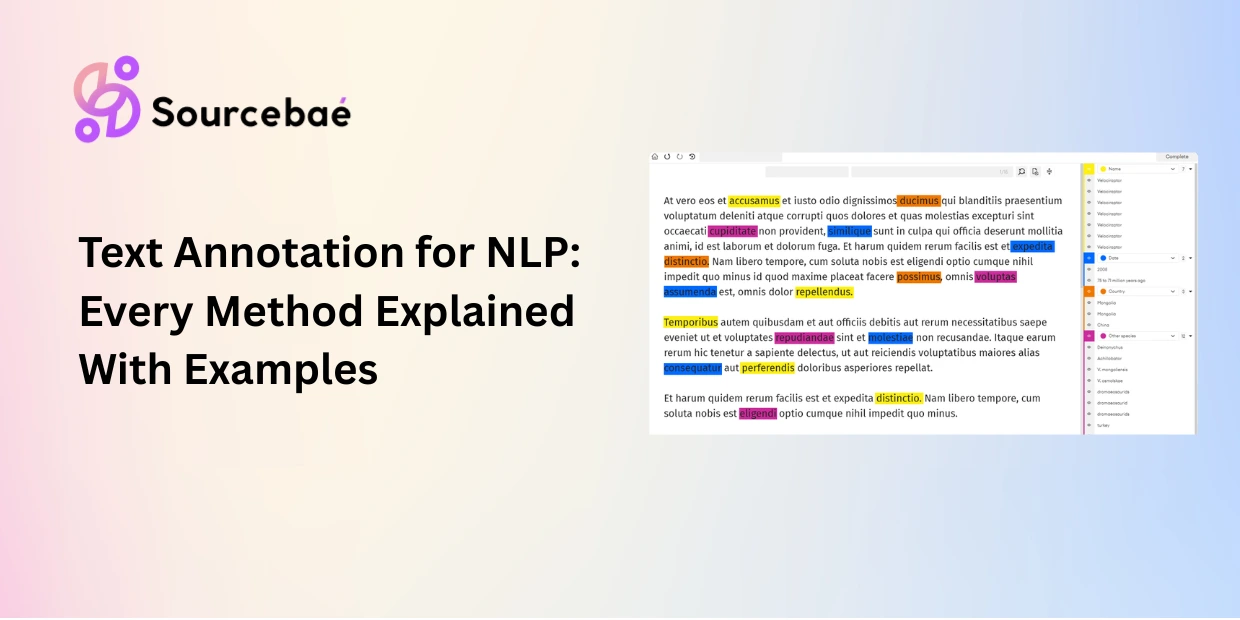
Named entity recognition annotation (commonly called NER annotation) is the process of identifying and classifying specific entities within text people, organizations, locations, dates, monetary values, products, and other proper nouns by tagging each entity with its semantic category.
NER annotation is foundational. Nearly every downstream NLP task information retrieval, question answering, knowledge graph construction, document summarization depends on the model’s ability to first identify the entities involved. Get NER wrong, and every subsequent layer of understanding degrades.
Worked example
Consider the sentence: “In March 2026, Anthropic released Claude Opus 4.6 from its San Francisco headquarters.”
A properly executed NER annotation labels this as:
- “March 2026” → DATE
- “Anthropic” → ORGANIZATION
- “Claude Opus 4.6” → PRODUCT
- “San Francisco” → LOCATION
Each entity is marked with its start and end character positions and assigned a class from a predefined taxonomy. The output is typically stored as JSON spans or inline markup.
Common pitfalls
Ambiguous entities are the single biggest challenge in named entity recognition annotation. “Apple” could be a company or a fruit. “Jordan” could be a person, a country, or a brand. Annotation guidelines must include disambiguation rules and contextual examples for every ambiguous entity class.
Nested entities create complexity. In “New York University,” is “New York” a location inside the organization, or is the entire phrase one entity? Your schema must define how to handle nesting and annotators must be trained on it explicitly.
Domain-specific entities are frequently missed by generalist annotators. Medical text contains drug names, dosage patterns, and anatomical terms that require specialized knowledge. Legal text includes jurisdiction-specific terminology. Financial text uses ticker symbols, fund names, and regulatory references. For high-stakes NER annotation, domain experts significantly outperform generalists.
Sentiment Annotation: Teaching Models to Detect Emotion and Opinion
Sentiment annotation is the process of labeling text with its emotional polarity positive, negative, or neutral so that NLP models can learn to assess how an author feels about a subject. It is the backbone of brand monitoring, customer feedback analysis, product review systems, and social media listening platforms.
Worked example
Consider three product reviews:
- “This laptop is incredibly fast and the battery lasts all day.” → Positive
- “Terrible customer service. Waited three weeks for a response.” → Negative
- “The package arrived on Tuesday.” → Neutral
At a basic level, sentiment annotation assigns one label per text unit. More advanced schemas use multi-class scales (1–5 stars), aspect-based sentiment (positive about battery, negative about screen), or emotion categories (joy, anger, frustration, surprise).
Common pitfalls
Sarcasm and irony defeat most sentiment annotation models. “Oh great, another software update that breaks everything” reads as positive to a surface-level classifier but is clearly negative. Research from the SarcasmBench study found that even GPT-4 underperforms fine-tuned smaller models on sarcasm detection. Guidelines must include explicit sarcasm examples and escalation rules.
Annotator subjectivity is highest in sentiment annotation compared to any other NLP task. What one annotator labels “neutral,” another may call “slightly negative.” Target a minimum Cohen’s Kappa of 0.8 or higher. Use at least three annotators per item and resolve disagreements through majority voting or expert adjudication.
Domain-specific sentiment shifts catch teams off guard. In financial text, “the stock dropped 15%” is negative in a consumer context but may be neutral (merely factual) in a research analyst’s report. In medical text, “the tumor shrank by 40%” is positive but only if you know the clinical context. Domain-adapted annotation guidelines are essential.
Intent Classification Annotation: Understanding What Users Want
Intent classification annotation labels user input by its underlying purpose the action or goal the user is trying to accomplish. It is the core annotation layer for chatbots, virtual assistants, voice interfaces, and any system that must interpret user requests and route them to the appropriate response.
Worked example
For a travel booking chatbot, user utterances might be annotated as:
- “Book me a flight from London to Tokyo next Friday” → BOOK_FLIGHT
- “What’s the cheapest hotel near the Eiffel Tower?” → SEARCH_HOTEL
- “Cancel my reservation for order #4892” → CANCEL_BOOKING
- “What’s your refund policy?” → FAQ_REFUND
Each utterance receives a single intent label from a predefined taxonomy. Alongside intent, annotators often perform slot annotation marking the key information the system needs to fulfill the intent (departure city, destination, date, order number).
Common pitfalls
Overlapping intents are the most common problem in intent classification annotation. “I want to change my flight to a cheaper option” could be classified as MODIFY_BOOKING, SEARCH_FLIGHT, or PRICE_INQUIRY depending on your taxonomy. Clear, mutually exclusive intent definitions with boundary examples are critical.
Multi-intent utterances create complexity. “Book me a hotel and find me a restaurant nearby” contains two intents in one message. Your annotation schema must define whether to assign the primary intent, split into multiple labels, or use a multi-label classification approach.
Insufficient training diversity leads to brittle intent classifiers. If all “cancel booking” training examples use the word “cancel,” the model fails on “I don’t want this reservation anymore.” Annotated datasets need linguistic diversity multiple phrasings for every intent to build robust classifiers.
Relation Extraction Annotation: Mapping How Entities Connect
Relation extraction annotation labels the semantic relationships between entities within text. After NER identifies the entities, relation extraction annotation defines how those entities are connected transforming flat entity lists into structured knowledge graphs that models can reason over.
Worked example
In the sentence: “Satya Nadella is the CEO of Microsoft, which is headquartered in Redmond.”
Relation extraction annotation would produce:
- Satya Nadella CEO_OF → Microsoft
- Microsoft HEADQUARTERED_IN → Redmond
Each relation consists of a subject entity, a predicate (relationship type), and an object entity forming a structured triple the model can store and query.
Common pitfalls
Implicit relations are easy for humans to infer but difficult to annotate consistently. In “She graduated from MIT and now leads the research team at Google,” the relation WORKS_AT(She, Google) is implied but not explicitly stated. Guidelines must define whether annotators label only explicit relations or also infer implicit ones.
Distant relations spanning multiple sentences or paragraphs challenge annotators. “The company was founded in 2015. Three years later, it reached $1 billion in revenue.” The FOUNDED_IN(company, 2015) relation is straightforward, but linking “it” back to “the company” across sentences requires coreference resolution as a prerequisite step.
Relation taxonomy design directly impacts model utility. Too few relation types produce overly generic knowledge graphs. Too many create annotation ambiguity and inconsistency. Most production schemas use 10–30 relation types, refined through iterative pilot rounds.
Coreference Resolution Annotation: Linking Mentions to Entities
Coreference resolution annotation identifies when different words or phrases in a text refer to the same real-world entity. In the sentences “Anthropic launched a new model. The company said it outperforms competitors,” coreference annotation links “The company” and “it” back to “Anthropic” and “a new model” respectively.
This annotation type is essential for document summarization, question answering, and dialogue systems where the model must track entities across multiple sentences or turns. Without coreference resolution, a model treating “The company” as an unknown entity loses critical context.
Common pitfalls
Ambiguous pronouns are the core challenge. In “Alice told Bob she would handle the report,” does “she” refer to Alice or someone else? Annotation guidelines must establish resolution rules based on syntactic proximity, semantic plausibility, and domain conventions.
Text Categorization: Organizing Documents at Scale
Text categorization (also called document classification) assigns topic or category labels to entire documents, paragraphs, or passages. Unlike entity-level or token-level annotation, text categorization operates on the document level sorting content into predefined classes.
Common applications include spam detection (spam vs. not spam), support ticket routing (billing, technical, account access), news categorization (politics, sports, technology, entertainment), and content moderation (policy-compliant vs. violation). Text categorization is often the simplest form of text annotation and serves as the starting point for many NLP data annotation projects because it requires less expertise than entity-level methods and scales efficiently with crowdsourced workforces.
Common pitfalls
Multi-label ambiguity arises when documents belong to multiple categories simultaneously. A news article about a tech CEO’s political donation touches both “technology” and “politics.” Your schema must define whether to assign one primary label, allow multiple labels, or use hierarchical categories.
Part-of-Speech Tagging: Grammatical Foundations for Language Models
Part-of-speech (POS) tagging assigns a grammatical role noun, verb, adjective, adverb, preposition to every word in a sentence. It is the most granular form of text annotation, operating at the individual token level.
POS tagging supports syntactic parsing, dependency tree construction, and grammatical error detection. While modern transformer-based models have reduced direct reliance on POS tags for many tasks, POS annotation remains essential for linguistic research, rule-based NLP systems, and language-learning applications.
Worked example
“The quick brown fox jumped over the lazy dog.”
- The (DET) → quick (ADJ) → brown (ADJ) → fox (NOUN) → jumped (VERB) → over (ADP) → the (DET) → lazy (ADJ) → dog (NOUN)
Standard tagsets like the Penn Treebank (36 tags) or Universal Dependencies (17 tags) provide consistent frameworks for POS annotation across languages.
Text Annotation for Large Language Models: RLHF, SFT, and Preference Data
The rise of large language models has created an entirely new category of NLP data annotation: labeling data specifically for LLM training, fine-tuning, and alignment. This represents the fastest-growing segment of text annotation in 2026.
Supervised fine-tuning (SFT) data consists of high-quality instruction-response pairs that teach a pre-trained model to follow user prompts. Annotators write or curate examples of ideal model responses across diverse tasks answering questions, writing code, summarizing documents, translating languages. The quality of SFT annotation directly determines the model’s instruction-following capabilities.
RLHF preference annotation involves presenting annotators with multiple model-generated responses to the same prompt and asking them to rank the outputs from best to worst. These preference rankings train a reward model that aligns the LLM with human values, safety standards, and quality expectations. The annotators performing RLHF work are typically domain experts PhDs, software engineers, professional writers because the task requires nuanced judgment about response quality, factual accuracy, and safety.
Red-teaming and safety annotation identifies harmful, biased, or factually incorrect model outputs. Annotators probe the model with adversarial prompts and label the resulting outputs by harm category toxicity, bias, hallucination, privacy violation, or instruction non-compliance.
Text annotation for LLMs demands a fundamentally different approach than traditional NLP data annotation. Instead of labeling raw text with categories, annotators evaluate and rank AI-generated text judging quality, safety, and helpfulness rather than applying predefined tags. This shift has elevated the expertise requirements and compensation for annotators, with STEM-domain projects now paying $40+ per hour for specialists with advanced degrees.
→ Deep dive: [RLHF Annotation: How Human Feedback Trains and Aligns Large Language Models]
Choosing the Right Text Annotation Method
Selecting the correct text annotation for NLP method depends on what your model needs to learn. Here is a practical decision guide.
Choose NER annotation when your model must identify and extract specific entities names, dates, locations, products, monetary values from unstructured text. NER annotation is the starting point for information extraction, knowledge graph construction, and document understanding.
Choose sentiment annotation when your model must assess emotional tone positive, negative, neutral in customer reviews, social media, support tickets, or survey responses. Use aspect-based sentiment annotation when you need to know sentiment toward specific features rather than overall polarity.
Choose intent classification annotation when your model must understand user purpose booking a flight, asking a question, requesting a refund. Intent classification annotation is essential for any conversational AI, chatbot, or voice interface.
Select relation extraction annotation when your model must understand how entities are connected who works where, what product belongs to which company, which drug treats which condition. Relation extraction annotation transforms entity lists into structured knowledge.
Select text categorization when your model must sort documents into predefined classes spam filtering, support ticket routing, content moderation, or topic classification. This is the simplest text labeling for machine learning task and the best starting point for teams new to NLP annotation.
Choose POS tagging when your model requires grammatical understanding at the token level for linguistic research, grammar checking, or syntactic parsing.
Combine methods when your application requires multi-layer understanding. A customer service AI might need NER annotation (to extract account numbers and product names), sentiment annotation (to detect frustration), and intent classification annotation (to route the request) all applied to the same text. Multi-layer NLP data annotation produces the richest training signals but requires careful guideline coordination across annotation layers.
Frequently Asked Questions
What is text annotation for NLP?
Text annotation for NLP is the process of adding structured labels to raw language data tagging entities, marking sentiment, classifying intent, mapping relationships, and assigning grammatical roles so that natural language processing models can learn to understand, classify, and generate human language. It accounts for roughly 34% of the global annotation tools market, making it the largest single annotation category.
What is NER annotation and why does it matter?
NER annotation (named entity recognition annotation) identifies and classifies named entities in text people, organizations, locations, dates, products, and monetary values. It matters because NER is foundational to nearly every downstream NLP task: information retrieval, question answering, knowledge graph construction, and document summarization all depend on the model’s ability to first identify who, what, where, and when. High-quality named entity recognition annotation requires clear disambiguation rules for ambiguous entities and domain-specific training for specialized vocabularies.
How does sentiment annotation work?
Sentiment annotation labels text with its emotional polarity positive, negative, or neutral. Basic schemas assign one label per text unit. Advanced schemas use multi-class scales (1–5), aspect-based sentiment (positive about battery, negative about screen), or granular emotion categories (joy, anger, frustration). The biggest challenges in sentiment annotation are sarcasm detection, annotator subjectivity, and domain-specific sentiment shifts. Best practice: use at least three annotators per item and target Cohen’s Kappa above 0.8.
What is intent classification annotation used for?
Intent classification annotation labels user input by its underlying purpose the action or goal the user wants to accomplish. It is the core annotation layer for chatbots, virtual assistants, and voice interfaces. For example, in a travel chatbot, “Book me a flight to Tokyo” would be labeled BOOK_FLIGHT. Intent classification annotation often pairs with slot annotation, which marks the specific information the system needs (destination, date, passenger count) to fulfill the intent.
What is relation extraction annotation?
Relation extraction annotation labels the semantic relationships between entities in text who works where, what company owns which product, which drug treats which disease. It transforms flat entity lists into structured triples (subject → predicate → object) that models can store in knowledge graphs and reason over. Relation extraction annotation is essential for biomedical research, legal AI, financial intelligence, and enterprise search systems.
How is text labeling for machine learning different for LLMs?
Traditional text labeling for machine learning involves categorizing raw text with predefined tags (entities, sentiment, intent). LLM annotation is fundamentally different: instead of labeling raw text, annotators evaluate and rank AI-generated responses by quality, accuracy, safety, and helpfulness. This includes supervised fine-tuning data curation, RLHF preference ranking, and red-teaming. LLM text annotation demands higher expertise (often domain specialists with advanced degrees) and commands significantly higher compensation ($40+/hour for STEM domains).
What tools are best for NLP data annotation?
Leading platforms for NLP data annotation in 2026 include Label Studio (open-source, most flexible, 50+ templates), Labelbox (enterprise-grade with LLM evaluation features), Prodigy (best for active learning with solo engineers), LightTag (optimized for team collaboration), and SuperAnnotate (AI-assisted workflows). For large-scale projects, managed services from Appen, Surge AI, or Scale AI provide trained annotator workforces with built-in quality control. Choose tools based on annotation type, team size, LLM integration needs, and whether you need managed annotators or a self-service platform.